
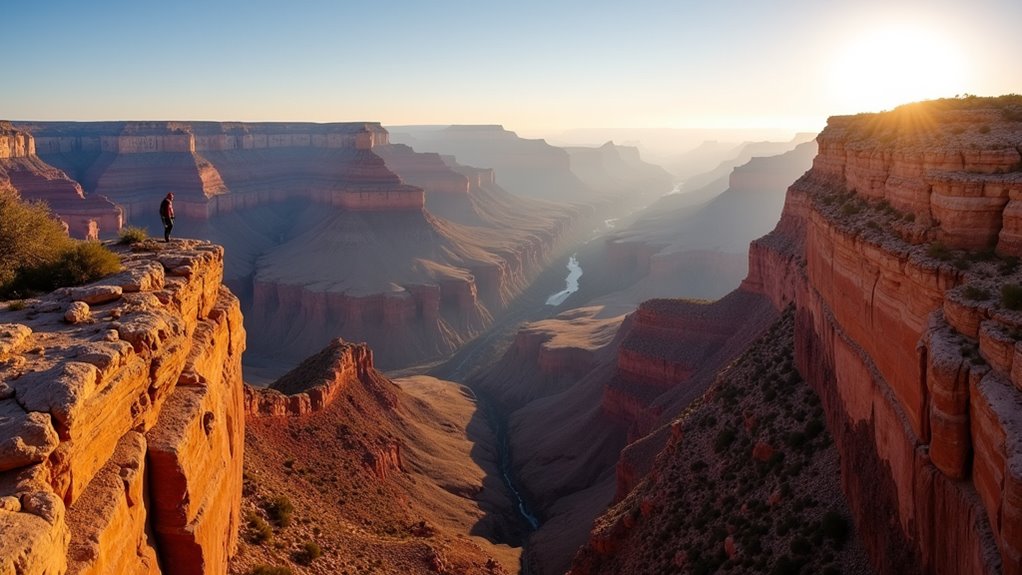
Start your Grand Canyon adventure at Mather Point for sweeping views, then walk sections of the 13-mile Rim Trail to access multiple viewpoints. Experience the Trail of Time’s geology exhibits and take the shuttle to Hermit’s Rest. Hike down Bright Angel Trail to the 1.5 Mile Resthouse, catch a ranger program, and plan for sunrise at Mather Point or sunset at Hopi Point. Explore historic Grand Canyon Village buildings and try the South Kaibab Trail for panoramic vistas—these essential experiences will transform your first visit into an unforgettable journey.
- Start at Mather Point for Your First Canyon Glimpse
- Walk the Rim Trail to Get Your Bearings
- Experience the Trail of Time’s Geology Lesson
- Take the Red Route Shuttle to Hermits Rest
- Hike Down the Bright Angel Trail to the 1.5 Mile Resthouse
- Visit Yavapai Geology Museum for the Big Picture
- Drive Desert View Drive and Climb the Watchtower
- Catch a Ranger Program to Learn the Stories
- Plan Your Sunrise or Sunset Viewing Strategy
- Take a Short Hike Down the South Kaibab Trail
- Explore Grand Canyon Village’s Historic Buildings
- The Sum Up
Start at Mather Point for Your First Canyon Glimpse
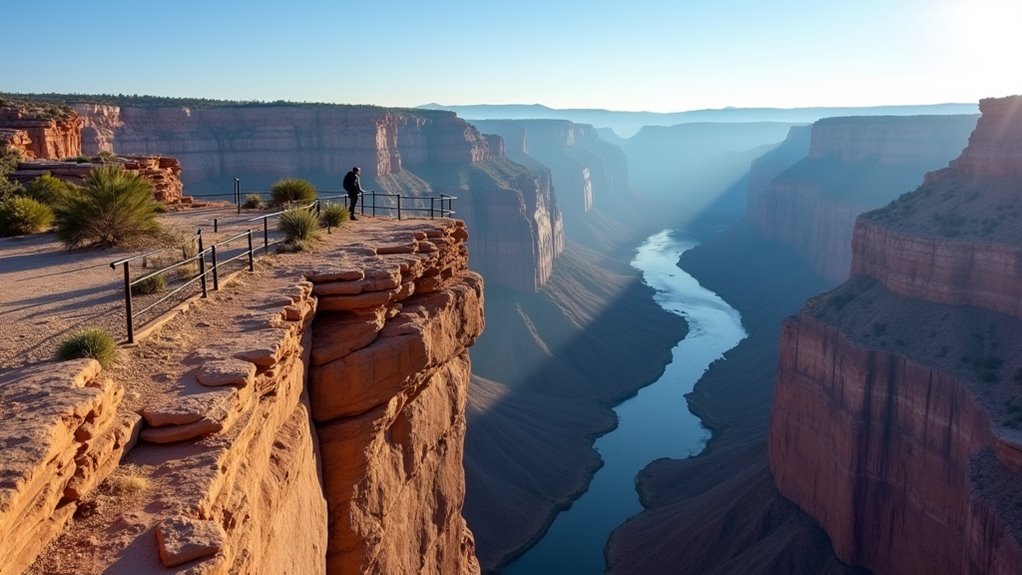
When you’re standing at the edge of one of the world’s most famous natural wonders for the first time, Mather Point delivers that jaw-dropping moment without breaking your budget or requiring a strenuous hike.
Located next to the Visitor Center, it’s the perfect starting point for first-timers. You’ll get sweeping 180-degree views stretching 30+ miles east and 60+ miles west, with the Colorado River 4,500 feet below.
Park at the Visitor Center lots and take the short paved walk to the rim – it’s wheelchair accessible too. Interpretive panels help you identify major rock formations like Vishnu Schist. The viewpoint was named after Stephen Tyng Mather, the first director of the National Park Service who helped establish Grand Canyon as a protected park.
For the best experience, arrive early before sunrise or sunset crowds gather. The Orange Route shuttle connects you to other South Rim attractions afterward.
Walk the Rim Trail to Get Your Bearings
After soaking in those first stunning views from Mather Point, you’ll want to explore more of the canyon’s edge without committing to a challenging hike.
The Rim Trail delivers exactly that – 13 miles of mostly paved, relatively flat walking along the canyon rim with only 200 feet of elevation change.
You don’t need to tackle the entire trail. Use the shuttle system’s fourteen stops to customize your walk length, with segments ranging from 0.3 to 1.8 miles between stops.
The western section toward Hermit’s Rest offers multiple bailout points if you get tired. The trail is mostly downhill from east to west, making it easier if you start from the South Kaibab Trailhead area.
This trail’s perfect for getting oriented – you’ll map out major viewpoints and landmarks while adjusting to the 6,820-foot elevation before attempting steeper canyon descents.
Experience the Trail of Time’s Geology Lesson
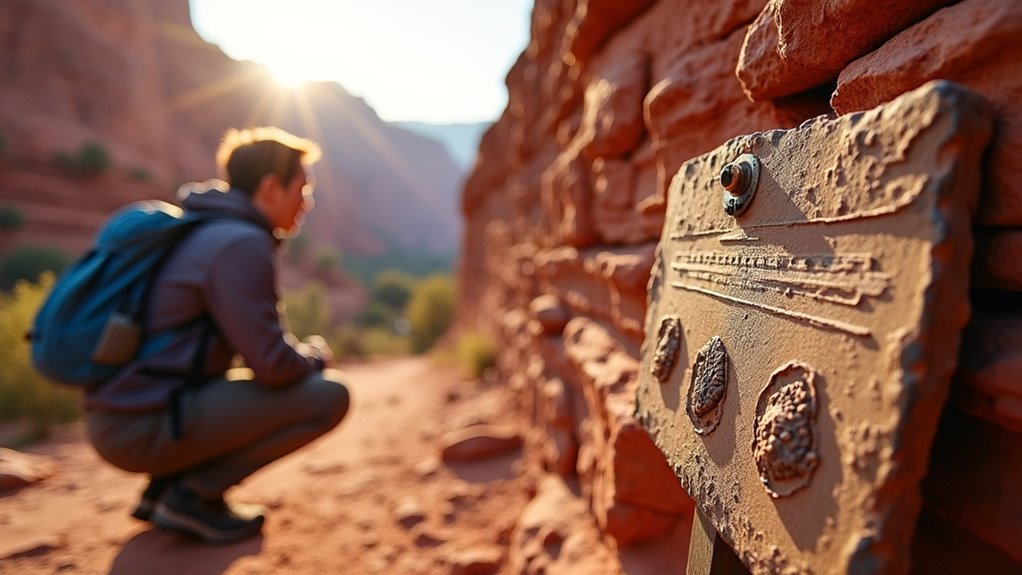
While you’re walking the Rim Trail, don’t miss the Trail of Time – a brilliant 2.8-mile geology exhibit that turns your casual stroll into a journey through Earth’s entire 4.56-billion-year history. Each step you take represents one million years, making this free educational experience incredibly immersive.
You’ll find bronze markers every meter and over 60 rock specimens positioned at their actual “birthdays” based on scientific dating. The trail connects what you’re seeing across the canyon to specific time periods – those dark rocks at the bottom are nearly 2 billion years old!
Viewing tubes help you spot different rock layers while interpretive panels explain how ancient seas, deserts, and mountains shaped this landscape. The exhibit showcases fascinating fossil assemblages in formations like the Redwall Limestone, where you can learn about ancient crinoids, bryozoa colonies, and other marine life from 340 million years ago. It’s wheelchair-accessible and transforms sightseeing into understanding.
Take the Red Route Shuttle to Hermits Rest
Since private vehicles can’t access Hermit Road from March through November, you’ll need to hop on the free Red Route shuttle to reach some of the Grand Canyon’s most spectacular western viewpoints.
The shuttle covers seven miles between Grand Canyon Village and Hermits Rest, stopping at nine scenic overlooks including The Abyss and Powell Point.
Catch the shuttle at the Village Transfer Station starting at 8:00 am. Outbound buses hit all stops, while return buses only stop at four locations.
The complete round trip takes 80 minutes without getting off.
Pro tip: During busy seasons, you might wait for multiple buses. Consider walking the Rim Trail one direction and taking the shuttle back.
Don’t miss that last bus—it’s an eight-mile walk back to the village! The last bus runs one hour after sunset, so arrive at least 30 minutes after sunset to catch your ride back.
Hike Down the Bright Angel Trail to the 1.5 Mile Resthouse
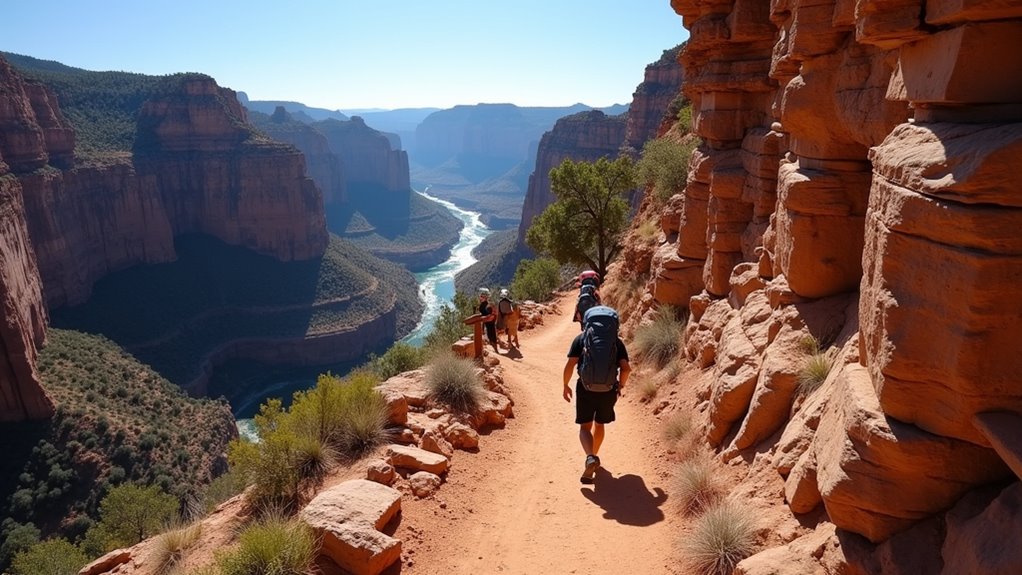
Ready to get below the rim? The Bright Angel Trail offers the perfect introduction to canyon hiking. This 3-mile round trip to the 1.5 Mile Resthouse gives you stunning canyon views without the commitment of an all-day trek.
Start early to beat crowds and heat – canyon temperatures run 20-30°F hotter than the rim. The well-maintained trail switchbacks down through two rock tunnels before reaching the historic stone resthouse, built by the Civilian Conservation Corps in the 1930s.
Remember: going down is easy, but you’ll climb 1,100 feet back up at 7,000-foot elevation. Bring plenty of water, wear sturdy shoes, and don’t underestimate the return hike. In winter conditions, consider bringing traction devices like YakTrax as the trail can become icy with limited sun exposure for melting.
The resthouse has seasonal water and restrooms, making it an ideal turnaround point for first-timers.
Visit Yavapai Geology Museum for the Big Picture
After you’ve experienced the canyon from below, head to Yavapai Geology Museum to understand what you just hiked through. Located at Yavapai Point along the Village Loop Road, this free museum transforms your canyon experience from sightseeing to genuine understanding.
The museum’s panoramic windows offer one of the best vantage points for studying Grand Canyon geology, with labels identifying specific rock formations across the canyon. Inside, you’ll find wall panels, rock samples, and a sculpted relief map that explains how this massive canyon formed over millions of years.
The museum’s open daily from 8 am–6 pm and connects to the nearby Trail of Time interpretive walk. It’s recommended to verify hours before visiting, as special days or holidays may have different opening times. You can drive there, take the free Kaibab Rim shuttle, or walk the paved Rim Trail from Mather Point.
Drive Desert View Drive and Climb the Watchtower
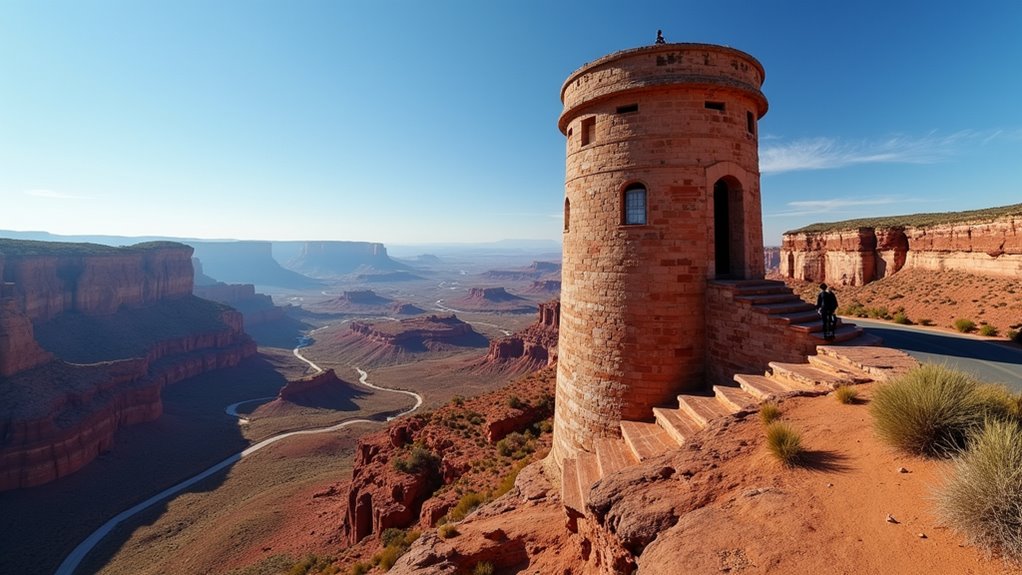
When you’re ready to explore beyond the village area, Desert View Drive offers the Grand Canyon’s most scenic road trip. This 25-mile route connects multiple overlooks along the South Rim, culminating at the historic Desert View Watchtower.
Budget 2-3 hours for the drive with stops at key viewpoints like Grandview Point and Lipan Point, where you’ll catch stunning Colorado River views.
The road’s eastern end features Mary Colter’s 1932 stone watchtower—the highest constructed vantage point on the South Rim.
Climb the 70-foot tower’s interior stairways for 360-degree panoramic views (free admission, open 9 a.m.–4 p.m.). Inside, you’ll discover interior murals and interpretive displays that showcase Native American history and cultural heritage.
You’ll drive your own vehicle since shuttles don’t operate here, and parking’s available at each overlook.
It’s an ideal half-day adventure from the village.
Catch a Ranger Program to Learn the Stories
Beyond scenic drives and viewpoints, you’ll gain a deeper appreciation for the Grand Canyon through free ranger-led programs that bring the landscape’s hidden stories to life. These 20-30 minute talks and guided walks cover geology, wildlife, Native American cultures, and park history at South Rim Village, Desert View, and other locations.
You’ll discover how rock layers formed over millions of years, learn about mountain lions and birds of prey, and explore Indigenous histories. Programs operate year-round at South Rim Village, with seasonal offerings elsewhere. Most are first-come, first-served with no reservations needed.
Check the official NPS online calendar for current schedules and meeting locations. Popular winter programs include topics like rattlesnake species and condor conservation efforts. If you’re traveling with kids, grab Junior Ranger activity booklets at visitor centers for an engaging educational experience that earns them an official badge.
Plan Your Sunrise or Sunset Viewing Strategy
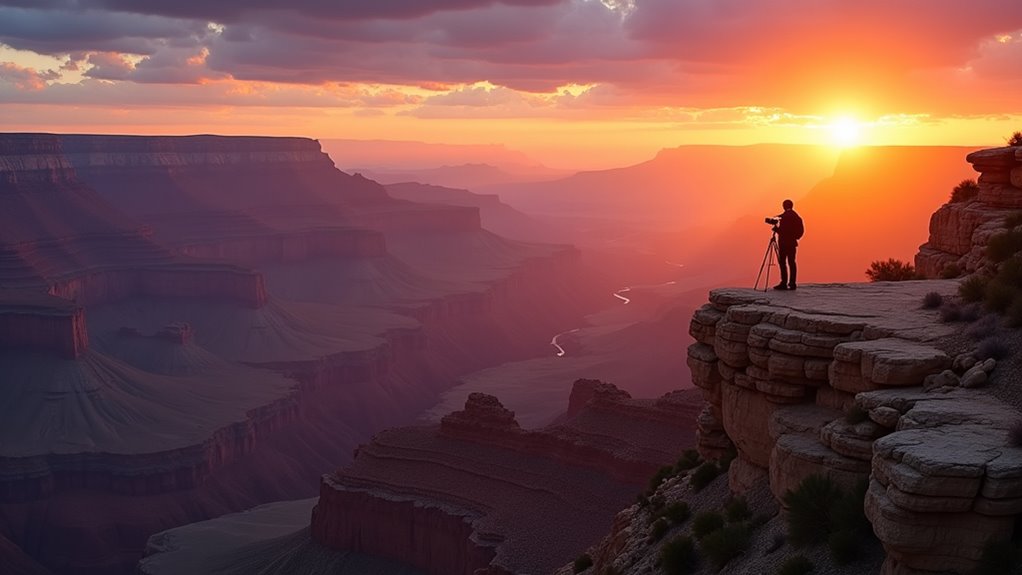
While ranger programs teach you about the canyon’s formation, nothing matches the transformative experience of watching sunrise or sunset paint the rock layers in shifting bands of gold, orange, and deep red.
For your first visit, stick with South Rim viewpoints like Mather Point for sunrise (easy 5-minute walk from the Visitor Center) or Hopi Point for sunset (accessible via free shuttle).
Visit during shoulder seasons (April-May or September-October) for the best balance of moderate temperatures, lighter crowds, and clear atmospheric conditions.
Arrive 30-60 minutes early to secure your spot and watch the color show develop. If you want a more secluded experience, consider walking southeast along the Rim Trail from Mather Point to find a quiet, private spot on the rocks.
Check daily sunrise/sunset times through park services, bring layers for temperature changes, and pack a headlamp since you’ll be walking back in darkness.
Take a Short Hike Down the South Kaibab Trail
After soaking in those rim views, you’ll want to experience the canyon from below — and the South Kaibab Trail offers the perfect introduction to hiking into this geological wonder. This well-maintained trail delivers constant panoramic views as it follows an exposed ridgeline.
Since you can’t drive to the trailhead, catch the free shuttle bus to Yaki Point Road.
For your first descent, stick to Ooh-Aah Point (1.8 miles roundtrip) or Cedar Ridge (3 miles roundtrip) — both offer spectacular payoffs without overdoing it.
Pack plenty of water since there’s none available on-trail.
Remember: going down’s easy, but climbing back up takes twice as long. The trail’s steep switchbacks and mule steps make for a challenging but rewarding introduction to Grand Canyon hiking. Avoid hiking during peak summer when high temperatures and minimal shade create dangerous conditions.
Explore Grand Canyon Village’s Historic Buildings
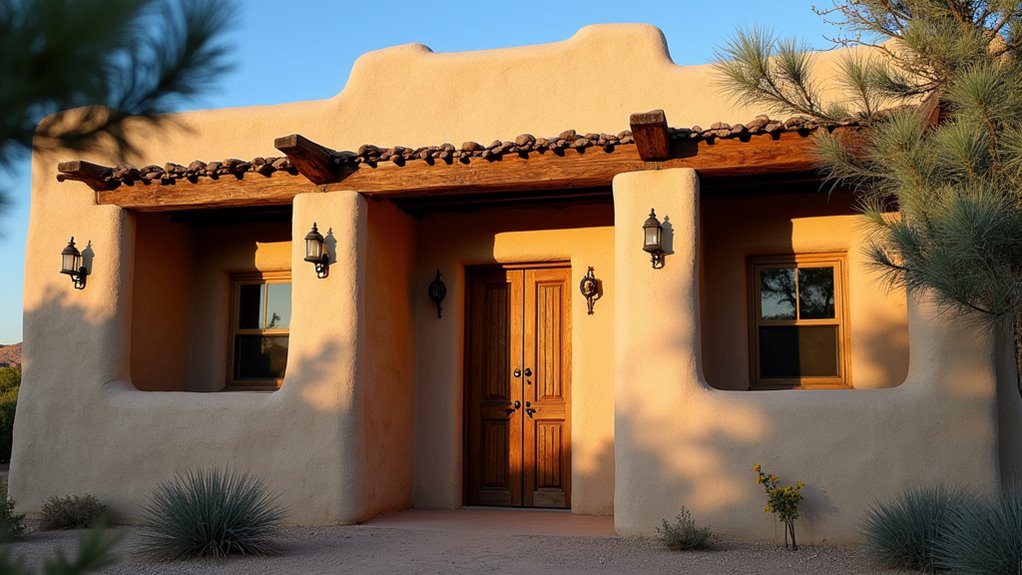
Once you’ve worked up an appetite from hiking, head to Grand Canyon Village to explore the largest collection of early National Park Service architecture in the country. This National Historic Landmark district showcases buildings from the early 1900s built by the Santa Fe Railway and Fred Harvey Company.
Start at the rustic El Tovar Hotel, designed by Charles Whittlesey in 1905 as the “most luxurious hotel west of the Mississippi.” Browse Native American arts at Hopi House, architect Mary Colter’s 1905 pueblo-style building.
Visit the historic train depot from 1901, one of America’s oldest surviving wooden stations.
Don’t miss Colter’s other masterpieces: Lookout Studio and Hermit’s Rest, both blending seamlessly into the canyon rim. These National Historic Landmarks offer incredible views without admission fees. Stop by Bright Angel Lodge to visit the Fred Harvey Museum and learn about the hospitality pioneer who helped shape American travel in the West.
The Sum Up
You’ve got the essentials covered for an unforgettable first visit. Don’t try cramming everything into one day – you’ll burn out and miss the magic. Pick three or four activities that excite you most, wear comfortable shoes, and bring plenty of water. The Canyon isn’t going anywhere, so take your time soaking it in. Most importantly, don’t forget your camera and prepare to have your mind completely blown by nature’s masterpiece.