
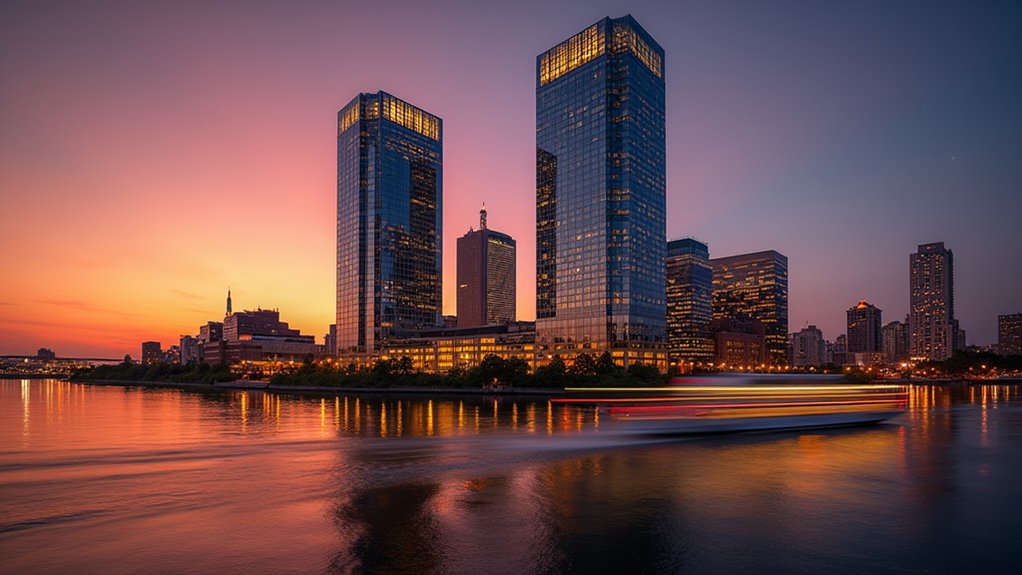
You’ll find Detroit packed with affordable attractions, from the stunning 5.5-mile RiverWalk offering skyline views to the thought-provoking Heidelberg Project‘s colorful outdoor art installation. Don’t miss the Guardian Building’s Art Deco splendor, Diego Rivera’s powerful murals at the Detroit Institute of Arts, and the historic Ford Piquette Avenue Plant where the Model T was born. You can easily walk between downtown’s three major sports venues, explore Underground Railroad sites, or venture to Dearborn’s expansive Greenfield Village for hands-on history experiences that’ll enrich your Motor City adventure.
- Stroll the Detroit International RiverWalk for Skyline Views and Border Town Atmosphere
- Marvel at the Guardian Building’s Art Deco Splendor and Colorful Tilework
- Explore Diego Rivera’s “Detroit Industry” Murals at the Detroit Institute of Arts
- Step Into Motown History at Hitsville U.S.A
- Experience the Heidelberg Project’s Thought-Provoking Outdoor Art Installation
- Tour the Restored Michigan Central Station and Ford’s Innovation Campus
- Catch a Game at Downtown’s Walkable Sports District
- Discover Early Auto History at the Ford Piquette Avenue Plant
- Follow Underground Railroad Sites From Second Baptist Church to the Riverfront Memorial
- Venture to Dearborn for The Henry Ford’s 80-Acre Greenfield Village
- The Sum Up
Stroll the Detroit International RiverWalk for Skyline Views and Border Town Atmosphere
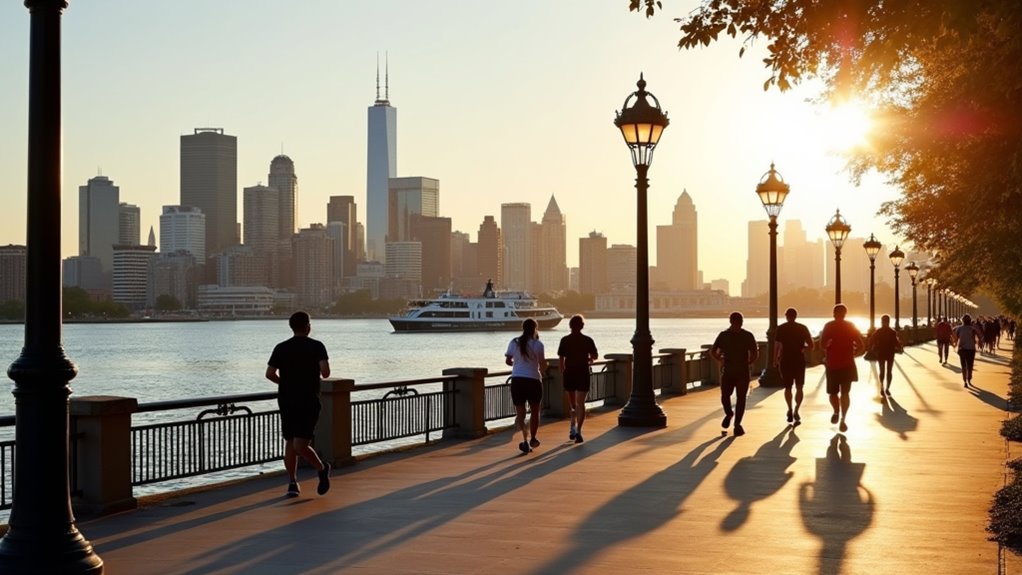
One of Detroit’s most impressive free attractions stretches 5.5 miles along the Detroit River, offering you unparalleled skyline views and a unique international atmosphere you won’t find anywhere else in the Midwest.
You’ll walk along a 62-foot-wide promenade with dedicated lanes for pedestrians and cyclists, taking in panoramic views of Detroit’s downtown skyscrapers and Windsor, Ontario directly across the water.
The Detroit International RiverWalk connects key spots like Rivard Plaza with its carousel and bike rentals, William G. Milliken State Park‘s marina facilities, and Ralph C. Wilson Jr. Centennial Park’s 22 acres of green space. Children can cool off in the interactive splash parks while adults relax nearby.
You’ll experience a true border-town vibe with multilingual visitors, public art celebrating binational heritage, and dual-skyline views that create an unforgettable international city-pair atmosphere.
Marvel at the Guardian Building’s Art Deco Splendor and Colorful Tilework
Rising 496 feet above downtown Detroit’s Financial District, the Guardian Building stands as one of the world’s most striking Art Deco skyscrapers. You can explore its cathedral-like interior absolutely free. Step inside to witness architect Wirt C. Rowland’s 1929 masterpiece, nicknamed the “Cathedral of Finance” for its soaring nave-like design.
You’ll be amazed by the intricate Guastavino tile vaulting and brilliantly colored tilework created by Detroit’s Pewabic Pottery. The main banking hall showcases a stunning patterned ceiling in vivid greens, golds, and earth tones, blending Native American and Aztec influences with Art Deco geometry.
Don’t miss the Monel metal screens, stained glass windows, and Ezra Winter’s glass mosaics celebrating Michigan’s industrial heritage. The exterior features distinctive custom-made orange-red brick that creates a unique glow, making the building one of the most visible landmarks on Detroit’s skyline. Located at 500 Griswold Street, it’s easily accessible during business hours.
Explore Diego Rivera’s “Detroit Industry” Murals at the Detroit Institute of Arts
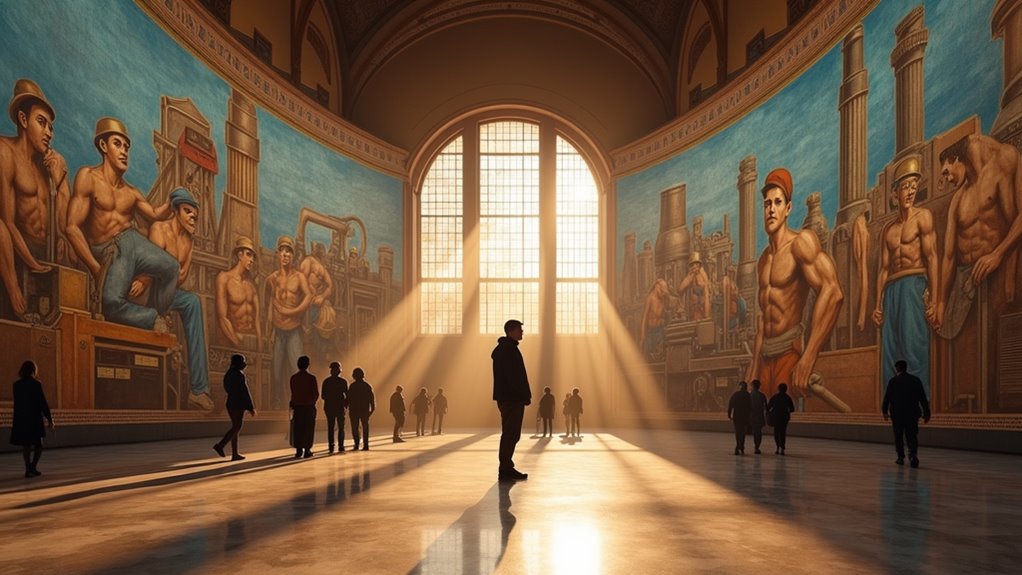
From Detroit’s architectural masterpieces, you’ll want to head to the Detroit Institute of Arts to witness one of America’s most powerful artistic achievements: Diego Rivera’s “Detroit Industry” murals. These 27 fresco panels, painted between 1932-1933, cover all four walls of Rivera Court in an immersive chapel-like environment.
Rivera spent months researching Detroit’s factories, especially Ford’s River Rouge plant, creating thousands of preparatory drawings before executing these monumental works.
The murals showcase Detroit’s manufacturing prowess through stunning imagery of automotive assembly lines, chemical plants, and workers from all backgrounds. Rivera’s technique—true buon fresco on wet plaster—creates permanent, vibrant colors that seem to pulse with industrial energy.
You’ll discover fascinating dualities throughout: technology versus nature, creation versus destruction, human bodies merged with powerful machinery in this Depression-era masterpiece. The creation process was documented by Ford’s Moving Picture Department, capturing Rivera and his assistants as they brought these monumental frescoes to life.
Step Into Motown History at Hitsville U.S.A
Just two miles from downtown Detroit sits the modest house that changed American music forever: Hitsville U.S.A. at 2648 West Grand Boulevard. This unassuming building served as Berry Gordy’s headquarters, home, and hit-making factory from 1959 to 1972, operating nearly 22 hours daily during Motown’s golden age.
Today’s Motown Museum preserves Studio A where The Supremes, Temptations, and Stevie Wonder recorded their biggest hits. You’ll walk through Gordy’s restored apartment and see original costumes, photographs, and memorabilia. The centerpiece of Studio A is an 1877 Steinway grand piano that was played by legendary artists and the Funk Brothers.
The museum connects three houses that once housed Motown’s empire, including the Jobete Publishing building.
Tours reveal how Gordy adapted Detroit’s assembly-line principles to music production, creating a self-contained ecosystem for developing superstars. It’s Detroit’s most popular tourist attraction for good reason.
Experience the Heidelberg Project’s Thought-Provoking Outdoor Art Installation
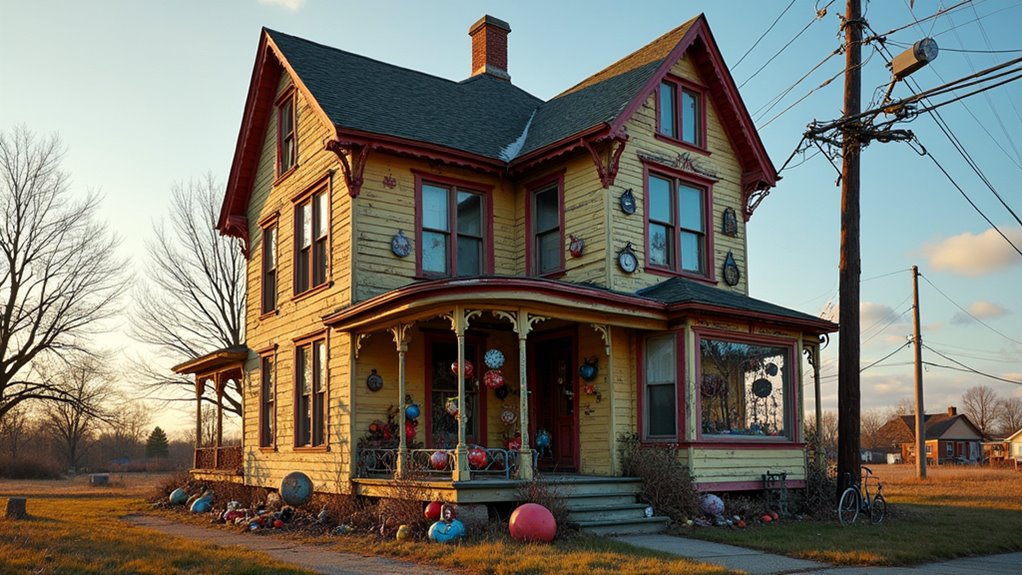
Thirty-seven years ago, Detroit artist Tyree Guyton transformed a blighted neighborhood block into one of the world’s most provocative outdoor art installations.
You’ll walk through an evolving streetscape where abandoned houses become canvases covered in bright polka dots, and vacant lots overflow with repurposed clocks, toys, and furniture.
The Heidelberg Project spans multiple blocks in the McDougall-Hunt neighborhood, creating an immersive experience that confronts urban decay while celebrating community resilience.
Visit the iconic Number House for photos and browse the small gift shop.
Since installations constantly change, each visit offers something new.
The project attracts 275,000 annual visitors and operates as Detroit’s third most popular cultural destination. Despite facing demolition orders from city officials in 1991 and 1999, the installation has persevered and expanded.
You’ll witness how art can spark dialogue about poverty and renewal while exploring this free, thought-provoking landmark.
Tour the Restored Michigan Central Station and Ford’s Innovation Campus
Where else can you witness one of America’s most ambitious historic preservation projects while exploring cutting-edge mobility technology? Michigan Central Station, Detroit’s stunning Beaux-Arts landmark, reopened in 2022 after Ford’s $740 million restoration transformed the abandoned depot into a world-class innovation campus.
You’ll marvel at the 54-foot-high Guastavino tile ceiling with 29,000 original tiles and explore 23,000 square feet of restored marble flooring. The building showcases incredible craftsmanship – workers replaced 8 million bricks and installed 300 miles of electrical wiring during the massive renovation.
Take guided tours through the Grand Hall, arcade, and exhibitions detailing the station’s history. While Ford’s offices aren’t publicly accessible, you can appreciate this remarkable comeback story that symbolizes Detroit’s own renaissance from decay to innovation. The surrounding area features roads with embedded electromagnetic coils that wirelessly charge electric vehicles as they drive, demonstrating the future of transportation technology.
Catch a Game at Downtown’s Walkable Sports District
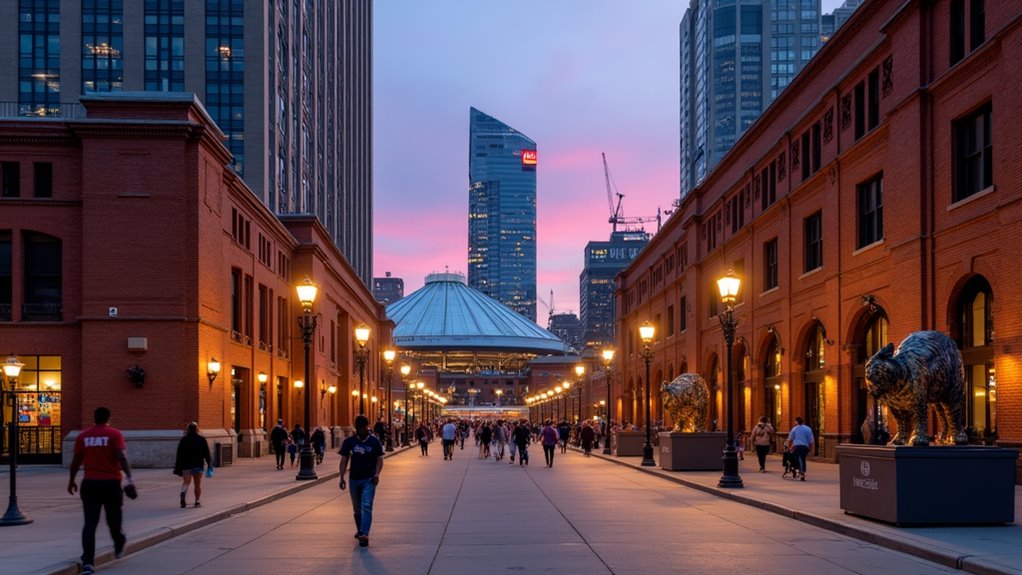
Few cities offer the convenience of catching four major professional sports teams within a compact, walkable downtown district. Detroit’s District Detroit spans 50 blocks, letting you walk between Comerica Park (Tigers), Ford Field (Lions), and Little Caesars Arena (Red Wings and Pistons) without needing a car.
You’ll find plenty of budget-friendly parking in structured decks, plus affordable eats and drinks at nearby bars along Woodward Avenue. Use the ParkDetroit app to pay for parking via mobile and avoid getting tickets while you’re enjoying the games.
The baseball season runs spring through fall at Comerica Park’s open-air ballpark, while Ford Field hosts indoor NFL action. Little Caesars Arena keeps things lively year-round with hockey and basketball games.
Between games, explore the connected entertainment options, restaurants, and downtown attractions like Campus Martius—all within walking distance of the stadiums.
Discover Early Auto History at the Ford Piquette Avenue Plant
Step into automotive history at the Ford Piquette Avenue Plant, where Henry Ford’s team designed and built the first Model T in 1908. This restored brick factory showcases over 65 rare automobiles, including early Ford models and period artifacts that tell Detroit’s automotive story.
You’ll explore the three-story building where Ford produced his first 12,000-14,000 Model Ts and experimented with assembly-line techniques that revolutionized manufacturing. The factory’s innovative design included an advanced fire-suppression system with firewalls, fire doors, and a rooftop water tank holding 25,000 gallons.
The plant became the first auto facility to assemble more than 100 cars daily, making Ford America’s largest automaker by the mid-1920s.
Located in Detroit’s Milwaukee Junction, this National Historic Landmark offers an authentic glimpse into early automotive innovation. The museum’s affordable admission makes it perfect for history buffs and families wanting to understand how Detroit earned its Motor City reputation.
Follow Underground Railroad Sites From Second Baptist Church to the Riverfront Memorial
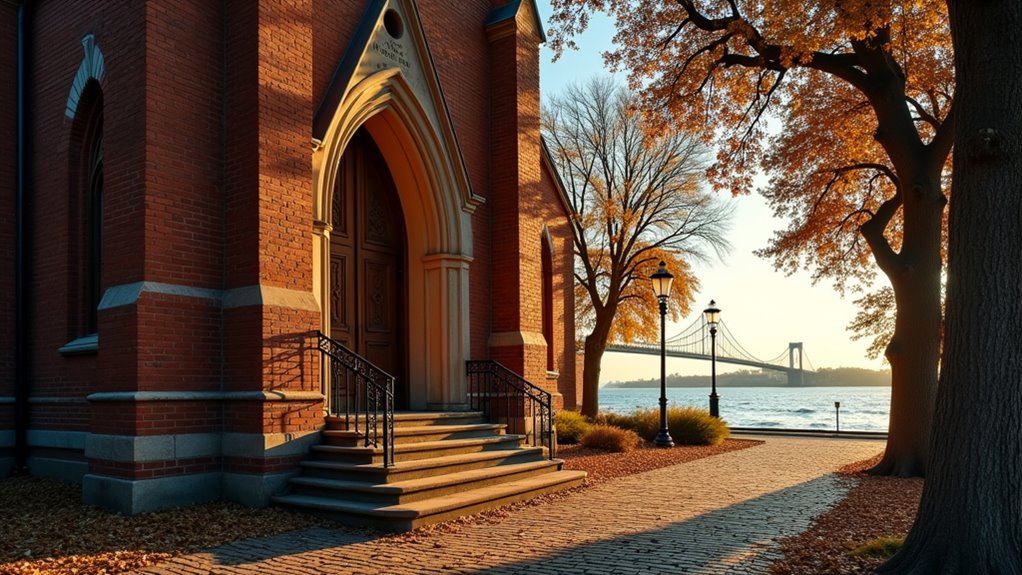
Detroit’s role as the final American stop on the Underground Railroad comes alive when you trace the historic path from Second Baptist Church to the riverfront memorials. Start at Second Baptist Church on Monroe Street in Greektown, where guided tours reveal basement rooms that sheltered 4,000-5,000 freedom seekers between 1836-1865.
The church hosted Frederick Douglass, John Brown, and Sojourner Truth during pivotal abolitionist meetings.
Walk the short 0.3-mile route from the church toward the Detroit River, following the same path thousands took seeking freedom.
At the riverfront, you’ll find memorials depicting families preparing to cross into Canada. These monuments point directly toward Windsor, emphasizing how tantalizingly close freedom was—just one to three miles across the water. The church was established by 13 former slaves who broke away from First Baptist Church due to discrimination they faced there.
Venture to Dearborn for The Henry Ford’s 80-Acre Greenfield Village
Just 10 miles from downtown Detroit, you’ll discover one of America’s most impressive outdoor history museums at The Henry Ford’s 80-acre Greenfield Village in Dearborn. You’ll explore 300 years of American innovation through over 80 authentic historic structures, including Thomas Edison’s reconstructed Menlo Park laboratory and the Wright Brothers’ original home and cycle shop.
Plan for a full day since you’ll want at least three hours to cover the seven districts. You can ride authentic Model T cars, take steam train rides around the village, and watch craftsmen demonstrate traditional trades like glassblowing and pottery. The village features the only working 19th-century roundhouse where you can explore early railroad technology that was crucial to American industrial growth.
The working farms showcase historic agricultural methods with ripening crops and livestock. Remember that rides cost extra beyond general admission, so consider combination packages for better value.
The Sum Up
You’ll find Detroit offers incredible experiences without breaking the bank. Most attractions like the RiverWalk and Heidelberg Project are free, while museums offer affordable admission. Don’t miss the Guardian Building’s stunning lobby—it’s completely free to explore. Pack comfortable walking shoes since downtown’s compact and walkable. Whether you’re into history, art, or sports, Detroit’s got something that’ll surprise you. The city’s renaissance is real, and you’ll feel it everywhere you go.