
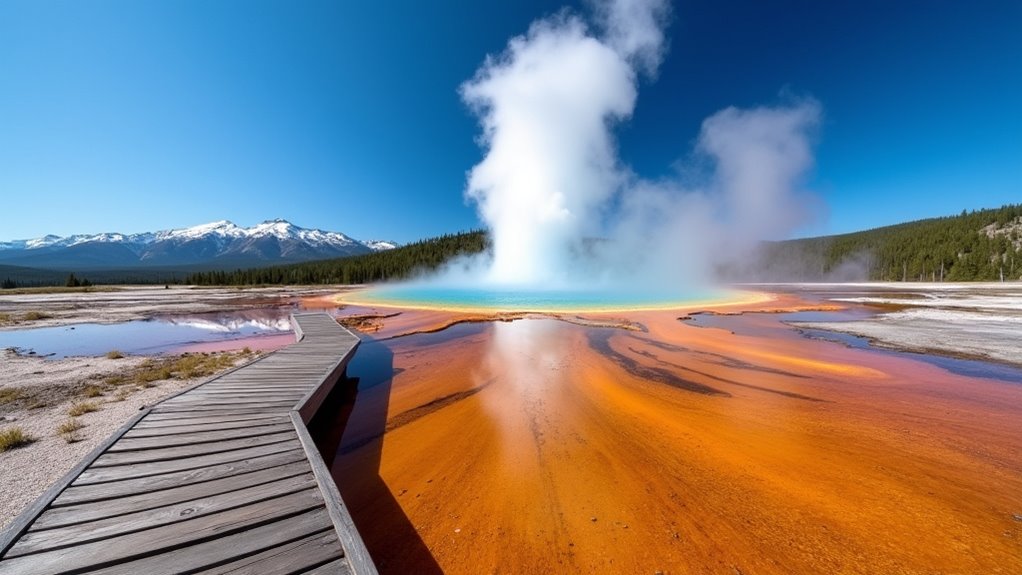
You’ll want to catch Old Faithful’s eruptions (posted intervals help you plan), stand at Artist Point before 8 a.m. for that iconic canyon shot, and arrive in Lamar Valley pre-dawn when wolves are most active. Don’t miss Grand Prismatic‘s vibrant colors from both the boardwalk and the Fairy Falls overlook, plus explore West Thumb’s lakeside geysers and Mammoth’s terraced springs. Time your Hayden Valley visit for dawn or dusk to spot massive bison herds and grizzlies—we’ll show you exactly how to maximize each experience.
- Watch Old Faithful Erupt and Explore the Upper Geyser Basin
- Marvel at Grand Prismatic Spring From Ground Level and Above
- Stand at Artist Point for the Classic Canyon View
- Rise Early for Wildlife Watching in Lamar Valley
- Walk the Mammoth Hot Springs Terraces
- Hike to Morning Glory Pool via the Upper Geyser Basin Boardwalk
- Drive the Grand Loop Road for Scenic Overlooks
- Spot Bison and Bears in Hayden Valley
- Explore West Thumb Geyser Basin Along Yellowstone Lake
- Take the Fairy Falls Trail to Grand Prismatic Overlook
- Visit the Historic Fort Yellowstone District
- The Sum Up
Watch Old Faithful Erupt and Explore the Upper Geyser Basin
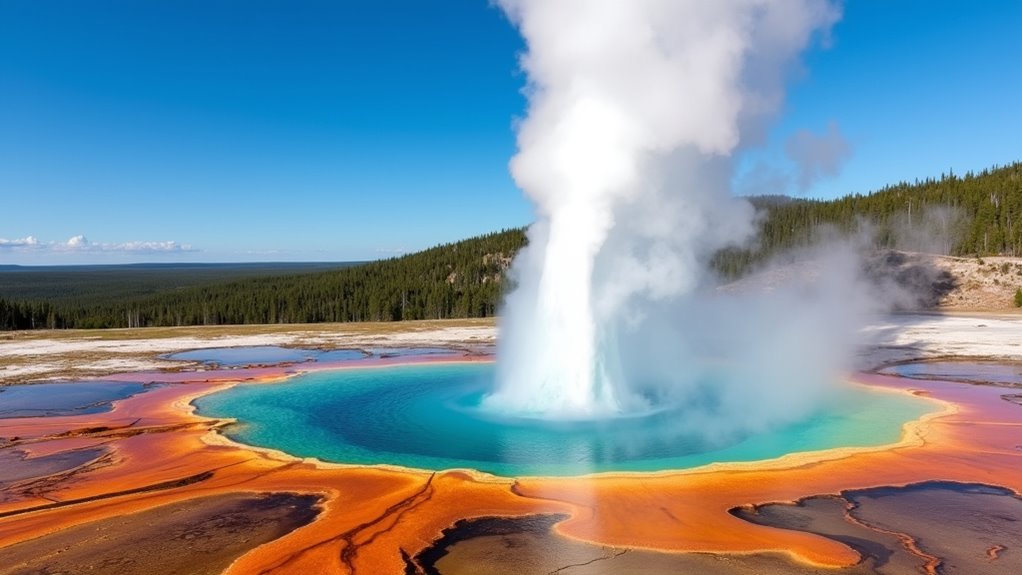
Although Old Faithful isn’t the tallest or most frequent geyser in Yellowstone, it’s earned its reputation as the park’s most reliable performer—erupting roughly 20 times daily with 90% accuracy in predictions.
You’ll find eruption forecasts posted throughout visitor center buildings, with intervals typically ranging 60-110 minutes between shows.
The viewing area offers excellent bench seating and boardwalk access around the oval platform, giving you clear sightlines from multiple angles.
While you’re waiting, explore the Upper Geyser Basin’s extensive boardwalk network to see Castle, Grand, and Beehive Geysers—this area contains the world’s highest concentration of active geysers. Each eruption shoots water 130-140 feet into the air and lasts between 1.5 to 5 minutes.
Stay on designated paths; the ground’s deceptively thin over scalding water systems.
Early morning visits typically offer smaller crowds and better visibility.
Marvel at Grand Prismatic Spring From Ground Level and Above
When you’re ready to witness Yellowstone’s most photogenic thermal feature, Grand Prismatic Spring delivers a kaleidoscope of colors that’ll leave you scrambling for your camera. This 370-foot-wide behemoth is America’s largest hot spring, with vivid rings of yellow, orange, and red created by heat-loving bacteria surrounding the deep blue center.
You’ll want to experience it from two perspectives. The Midway Geyser Basin boardwalk brings you close to the colorful runoff channels and bacterial mats, though steam often obscures the view.
For the iconic aerial-like shot, hike 0.5 miles on Fairy Falls Trail to the official overlook—it reveals the spring’s complete circular rainbow. The spring sits at an impressive 7,270 feet elevation, adding to the dramatic mountain landscape surrounding this natural wonder.
Visit early morning or late afternoon to avoid crowds and parking nightmares. Stay on boardwalks; the penalties for wandering off are steep.
Stand at Artist Point for the Classic Canyon View
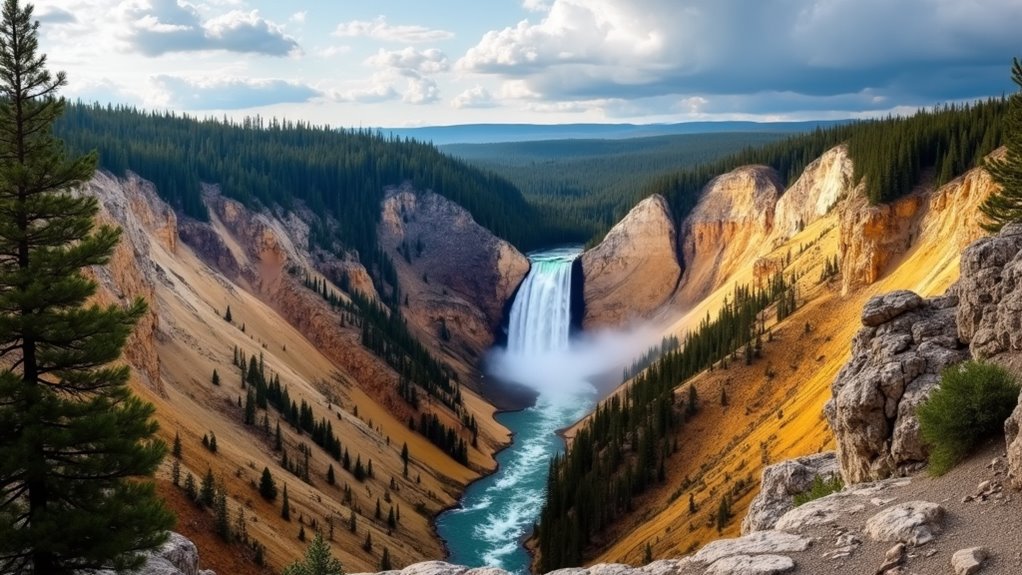
For the quintessential Yellowstone postcard shot, Artist Point delivers exactly what you’d expect—a spectacular frontal view of the 308-foot Lower Falls thundering into the multicolored Grand Canyon of the Yellowstone.
The canyon’s vivid yellow, red, and orange walls stretch 1,200 feet deep, carved through volcanic rhyolite over millennia.
You’ll find Artist Point at the end of South Rim Drive, requiring just a 0.1-mile paved walk from the small parking lot.
Arrive before 8 a.m. or after 5 p.m. to avoid crushing crowds and parking struggles.
September through October offers the best experience—fewer people, crisp air, and golden light that enhances the canyon’s already dramatic colors. Watch for rainbows emerging from the waterfall’s mist during mid-morning hours, adding an extra layer of magic to your photographs.
The multitiered observation platform provides various angles for photography.
Rise Early for Wildlife Watching in Lamar Valley
While Artist Point showcases Yellowstone’s geological drama, the park’s wildlife spectacle unfolds 30 miles northeast in Lamar Valley—America’s Serengeti. You’ll want to arrive before sunrise to catch peak animal activity from pre-dawn through 11 a.m. Pack binoculars, warm layers, and hot coffee—dawn temperatures often hover near freezing even in summer.
Watch for wolf packs, grizzly bears, massive bison herds, and soaring raptors across the valley’s open meadows. Stop where other spotters with scopes have gathered; they’ve likely found something worth seeing. Stay put rather than constantly driving—patience pays off here.
Keep 25 yards from most wildlife and 100 yards from bears and wolves. Drive slowly around bison, and park only in designated pullouts. Fall visitors can witness the dramatic elk rut as these massive animals compete for mates across the valley.
Walk the Mammoth Hot Springs Terraces
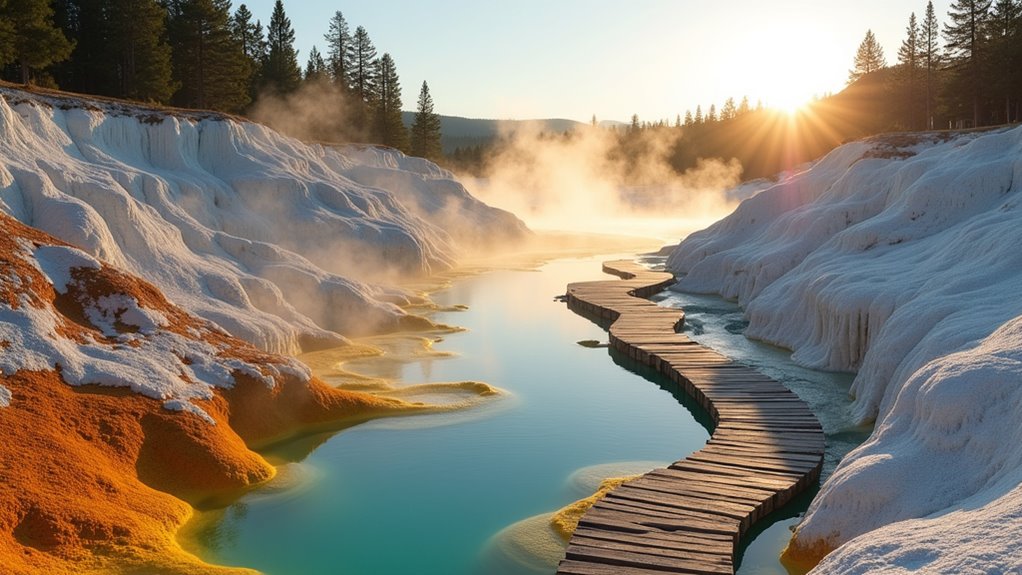
After witnessing Lamar Valley’s wildlife drama, head south to Mammoth Hot Springs where you’ll discover something equally remarkable—massive travertine terraces that reshape themselves daily.
These calcium carbonate formations grow from hot water dissolving underground limestone, creating one of Earth’s largest carbonate-depositing spring systems.
Start at the Lower Terraces near the main parking area, then drive the 1.5-mile Upper Terrace Drive for elevated views.
Stick to designated boardwalks—the fragile surfaces can’t handle foot traffic.
Don’t miss Minerva Terrace’s intricate rimstone pools and Orange Spring Mound’s vivid bacterial colors. The springs receive over two tons of calcium carbonate daily from limestone formations along underground fault lines, making this one of the most active travertine-building sites on the planet.
The terraces change constantly as springs shift locations, so what you see today might look completely different next year.
That’s what makes this geological wonder so mesmerizing.
Hike to Morning Glory Pool via the Upper Geyser Basin Boardwalk
Once you’ve marveled at Mammoth’s ever-changing terraces, make your way to Old Faithful for what’s arguably Yellowstone’s most rewarding easy hike. The 3.5-5 mile round-trip trek to Morning Glory Pool combines flat boardwalks with incredible thermal features.
Start at Old Faithful’s visitor center, then cross the Firehole River toward Geyser Hill. You’ll pass Beehive Geyser, Heart Spring, and dozens of colorful pools before reaching Grotto and Riverside Geysers.
The finale—Morning Glory Pool—showcases brilliant blue-green waters ringed by orange microbial mats. This vibrant hot spring requires special caution against throwing objects, which can damage its delicate ecosystem.
Budget 2-3 hours for the journey, including geyser-watching stops. Stay strictly on boardwalks; the thin crust conceals near-boiling water below.
For bonus views, tackle the steep Observation Point side trail overlooking Old Faithful.
Drive the Grand Loop Road for Scenic Overlooks
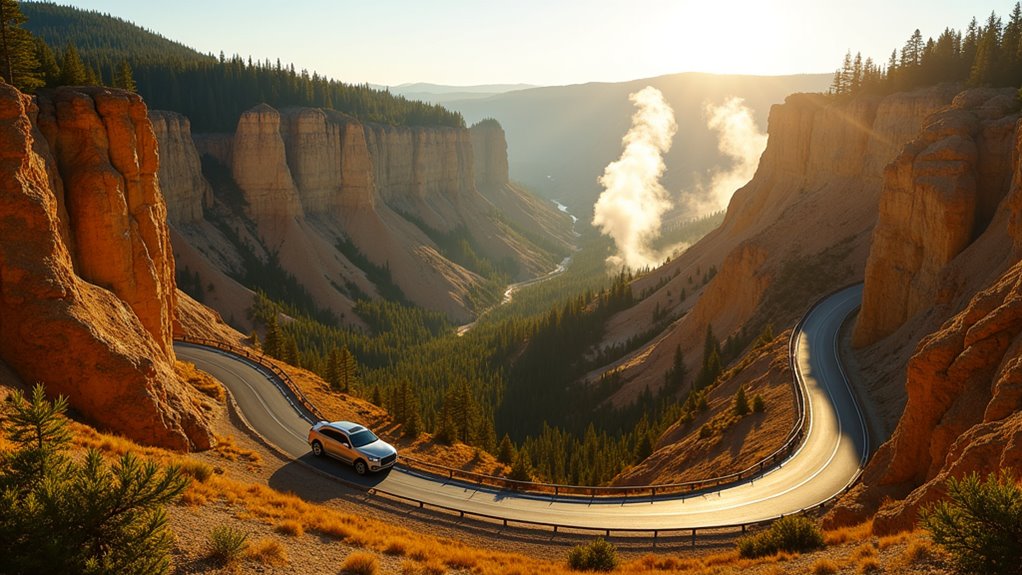
The 142-mile Grand Loop Road serves as Yellowstone’s ultimate scenic highway, connecting every major attraction in a figure-eight route that’ll take you from steaming geysers to thundering waterfalls. You’ll hit all five park entrances while linking Mammoth Hot Springs, Canyon, Lake, Old Faithful, and Norris areas.
Don’t miss the Upper Loop’s Dunraven Pass—at 8,859 feet, it’s your highest viewpoint with sweeping Hayden Valley vistas. Tower Fall‘s 132-foot drop and Calcite Springs overlook are quick roadside stops worth making.
On the Lower Loop, Craig Pass crosses the Continental Divide at 8,391 feet, where unique Isa Lake drains to both oceans.
Plan 1-2 days for the complete loop with stops. Artist Point offers the park’s most iconic waterfall photography, while wildlife and construction frequently slow traffic—embrace the delays as viewing opportunities. The fully paved road accommodates cars, RVs, and motorcycles with two-way traffic flowing in either direction.
Spot Bison and Bears in Hayden Valley
Wildlife enthusiasts won’t find a better spot than Hayden Valley to witness Yellowstone’s most iconic animals in their natural habitat. This broad glacial valley hosts massive bison herds that can reach nearly 1,000 individuals during peak seasons. Plus, it’s one of Yellowstone’s premier grizzly bear viewing locations.
Time your visit for spring or fall when bear activity peaks, and arrive at dawn or dusk for the best wildlife encounters. Multiple roadside pullouts let you safely scan the meadows with binoculars—you’ll often spot wolves, elk, and coyotes too. The valley is situated just north of the Lake area and Mud Volcano thermal area, making it easy to combine with other Yellowstone attractions.
Remember the safety rules: stay 25 yards from bison and 100 yards from bears. Bison are extremely dangerous when provoked, especially during rutting season, so respect these distances religiously.
Explore West Thumb Geyser Basin Along Yellowstone Lake
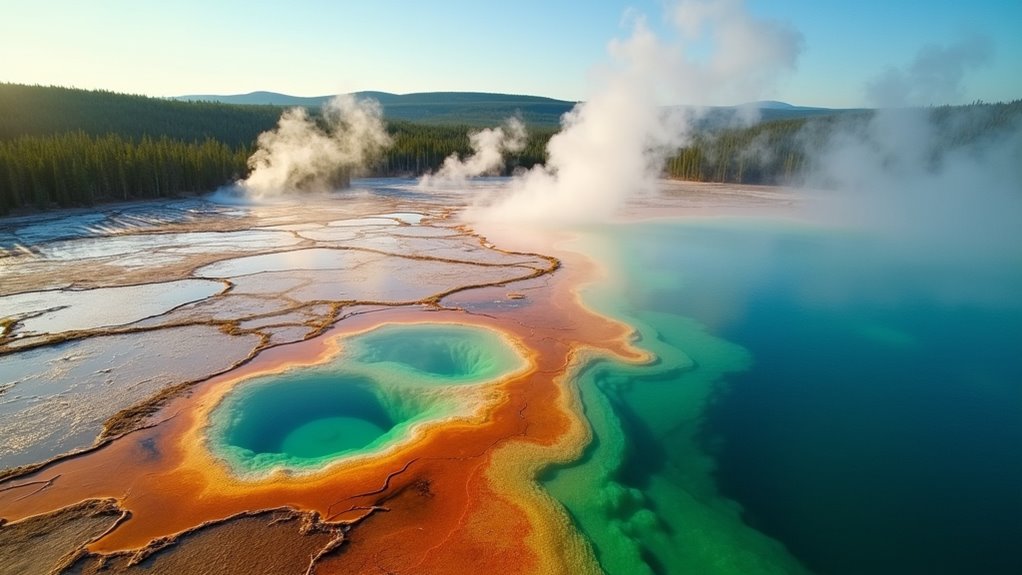
After watching bison graze across Hayden Valley’s expanses, you’ll discover an entirely different side of Yellowstone’s geothermal wonders at West Thumb Geyser Basin. This compact lakeside basin packs incredible diversity into an easy 0.6-mile boardwalk loop that takes just 30-60 minutes.
You’ll walk directly along Yellowstone Lake’s shoreline, passing the famous Fishing Cone where early visitors once cooked their catch in bubbling geyser water.
Don’t miss Black Pool’s stunning colors or the bubbling West Thumb Paint Pots. Watch for Occasional Geyser’s 3-12 foot eruptions every 20-40 minutes.
The real magic happens underwater—look for mysterious slick spots on the lake surface marking submerged hot springs. This unique bay was created by a volcanic explosion approximately 150,000 years ago, forming the collapsed caldera that now holds these remarkable thermal features.
In winter, these thermal features create dramatic melt holes through the ice.
Take the Fairy Falls Trail to Grand Prismatic Overlook
Beyond the lakeside thermal features, you’ll want to experience Grand Prismatic Spring from above to truly appreciate America’s largest hot spring. The Fairy Falls Trail offers this perfect aerial perspective through a short 0.5-mile hike to the overlook platform.
You’ll see the spring’s complete sunburst shape and vivid rainbow bands—blues, greens, yellows, and oranges—that aren’t visible from the basin boardwalk below. The trail starts near Midway Geyser Basin, following a flat, wide dirt path that’s bike-friendly initially.
Skip early morning visits when steam obscures the colors. Instead, arrive mid to late afternoon for clearer views.
Parking’s limited and fills quickly during summer, so start early or visit later in the day for better spots. The trail remains accessible from late May through early November, with peak hiking conditions in August and September.
Visit the Historic Fort Yellowstone District
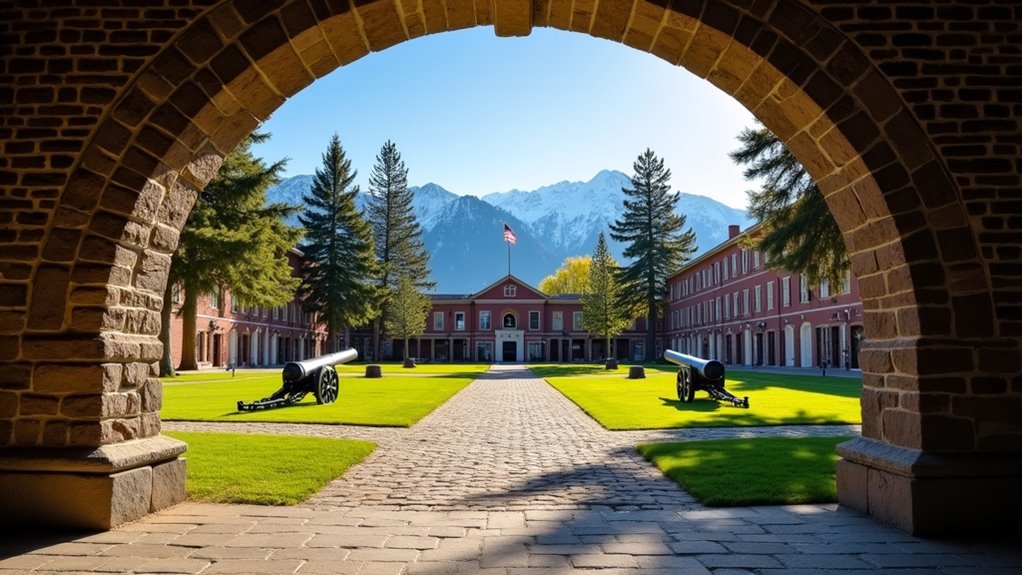
While most visitors rush past Mammoth Hot Springs toward the geysers, you’ll discover one of Yellowstone’s most overlooked treasures in the Historic Fort Yellowstone District. This National Historic Landmark tells the fascinating story of the U.S. Army’s 32-year stewardship of America’s first national park from 1886 to 1918.
Start at the Horace Albright Visitor Center, housed in the original bachelor officers’ quarters, where you’ll find exhibits detailing the fort’s military history.
Walk Officers’ Row to see the impressive stone double quarters where cavalry officers once lived. Don’t miss the three-story cavalry barracks, now park headquarters, and the charming fort chapel at the district’s southern end.
The parade ground offers perfect photo opportunities of this authentic western army post that protected Yellowstone’s natural wonders. A detailed 1905 map compiled by Lieutenant A. R. Jones, the Post Engineer Officer from the 3rd Cavalry, documented the fort’s comprehensive infrastructure including the hotels, roads, and water systems that served this remote military outpost.
The Sum Up
You’ve got enough adventure here to fill multiple trips, so don’t stress about seeing everything in one visit. Pack layers—Yellowstone’s weather changes fast. Download the park app for real-time geyser predictions and road conditions. Start early to beat crowds at popular spots like Grand Prismatic and Old Faithful. Most importantly, stay flexible with your itinerary. Wildlife sightings and thermal features don’t follow schedules, and those spontaneous moments often become your best memories.