

At Bolivia’s Salar de Uyuni, you’ll witness the world’s largest mirror during rainy season (December-March), capture mind-bending perspective photos on endless white horizons, and hike Incahuasi Island among 500-year-old giant cacti. Explore the haunting Train Cemetery‘s abandoned locomotives, visit Colchani’s salt-mining operations, and experience geothermal geysers at Sol de Mañana. Sleep in unique salt hotels perfect for stargazing, climb Thunupa Volcano for panoramic overlooks, and discover surreal rock formations in the Siloli Desert for truly otherworldly adventures.
- Experience the Mirror Effect During Rainy Season (December to April)
- Capture Perspective Photos on the Endless White Horizon
- Hike Incahuasi Island for Panoramic Views and Giant Cacti
- Explore the Train Cemetery Outside Uyuni Town
- Visit Colchani Salt-Mining Village and Natural Brine Springs
- Chase Flamingos at Colorful High-Altitude Lagoons
- Witness Geysers and Soak in Hot Springs at Sol De Mañana
- Sleep in a Salt Hotel and Stargaze Under Dark Skies
- Climb Thunupa Volcano for Salt Flat Overlooks
- Discover Surreal Rock Formations in the Siloli Desert
- The Sum Up
Experience the Mirror Effect During Rainy Season (December to April)
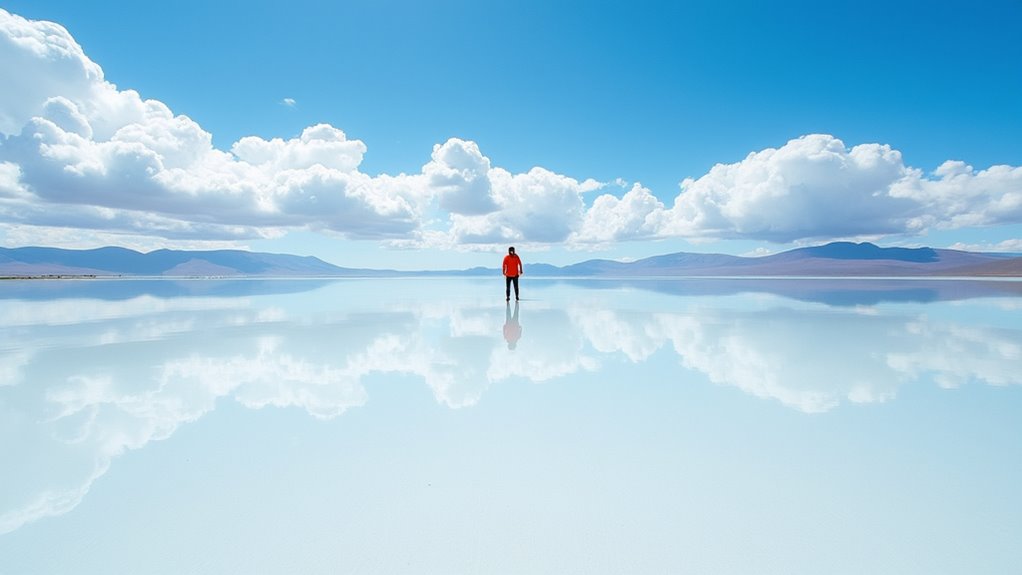
When the rainy season transforms Bolivia’s Salar de Uyuni into the world’s largest mirror, you’ll witness one of nature’s most spectacular optical phenomena. From mid-December to mid-March, rainwater creates a thin surface layer across the 10,000+ km² salt crust, producing perfect reflections of sky, clouds, and distant mountains.
January and February offer your best chances for extensive mirroring.
You’ll find the smoothest reflections at sunrise when calm winds minimize ripples, while sunset delivers dramatic pink and orange hues duplicated across the flooded surface. The water depth of only few centimeters actually enhances the mirror effect, creating impossibly clear reflections. At night, star-filled skies reflect beneath you, effectively doubling the visible cosmos.
However, expect accessibility trade-offs—heavy flooding may prevent visits to Incahuasi Island, and tour routes often change for safety reasons.
Capture Perspective Photos on the Endless White Horizon
During the dry season, Salar de Uyuni’s endless white salt crust becomes your ultimate canvas for mind-bending perspective photography. Position your camera very low to the ground, often lying down, to align subjects on a single visual plane. Keep the horizon mid-frame or lower so foreground props and distant subjects share an uninterrupted line.
Use small apertures for maximum depth of field, keeping both toy dinosaurs and distant friends sharp. Pack lightweight props like Pringles cans, bottles, and frying pans for classic “crushing” or “eating” illusions. Shoot with the sun behind you to avoid harsh backlighting on the brilliant salt surface.
Watch for long shadows that reveal true distances and break your carefully crafted trick. Move close to foreground props without cropping them for the strongest effect. Avoid using your camera’s zoom function, as it can blur distant subjects and ruin the perspective illusion you’re working to create.
Hike Incahuasi Island for Panoramic Views and Giant Cacti
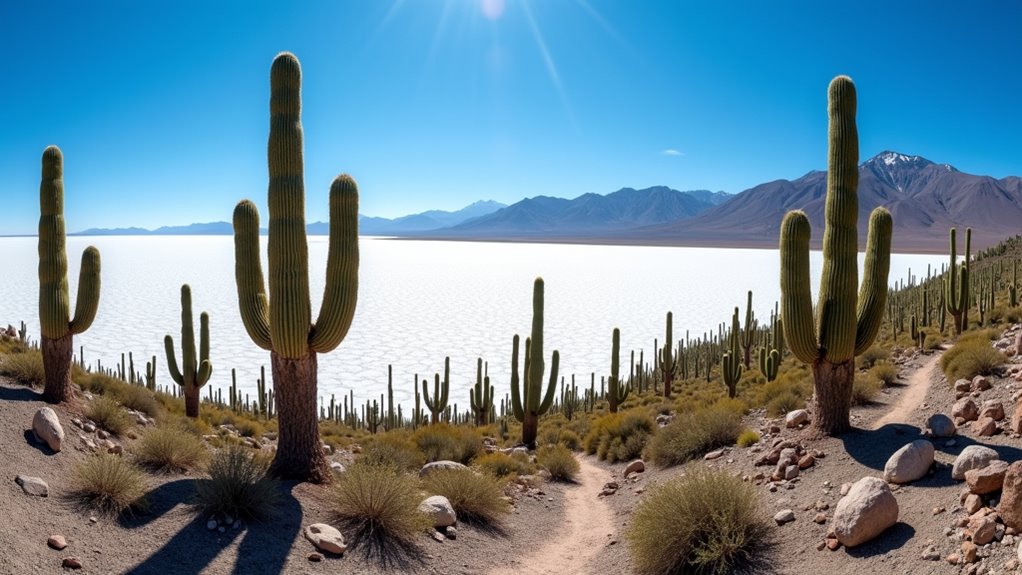
Beyond capturing creative shots on the salt’s surface, you’ll want to gain elevation for sweeping panoramic views of this otherworldly landscape. Incahuasi Island, an ancient volcanic summit rising from Salar de Uyuni’s center, offers the perfect vantage point at 11,995 feet elevation.
The marked loop trail takes just 20 minutes to reach the summit, though the high altitude makes this easy-to-moderate hike more challenging than expected. You’ll climb through slopes covered with giant Trichocereus pasacana cacti—some reaching 39 feet tall and over 500 years old, growing merely one centimeter annually.
From the top, you’ll enjoy 360-degree views across the geometric salt polygons stretching endlessly toward distant volcanic peaks. The island’s name means “house of the Inca” in Quechua, reflecting its historical significance as a traveler’s refuge. Explorers may also discover archaeological remains scattered across the island, evidence of ancient civilizations that once used this elevated sanctuary.
Explore the Train Cemetery Outside Uyuni Town
Just three kilometers from Uyuni town, you’ll discover one of Bolivia’s most haunting industrial relics—a sprawling graveyard of over 100 abandoned locomotives and rail cars scattered across the high-altitude desert.
These British-imported steam engines date from the early 20th century, when Uyuni served as Bolivia’s vital railway hub transporting silver, tin, and salt to Pacific ports. After Bolivia lost its coastline in the War of the Pacific and mining declined post-1940s, these trains were simply abandoned to the elements.
You can freely climb inside the rusted carriages and explore their hollowed interiors. The salt-laden winds from the nearby Salar accelerate corrosion, creating dramatic photo opportunities against the stark Altiplano landscape. Some visitors have added graffiti decorations to the trains, transforming them into outdoor art displays. Most Salar tours include this cemetery as an atmospheric opening stop.
Visit Colchani Salt-Mining Village and Natural Brine Springs
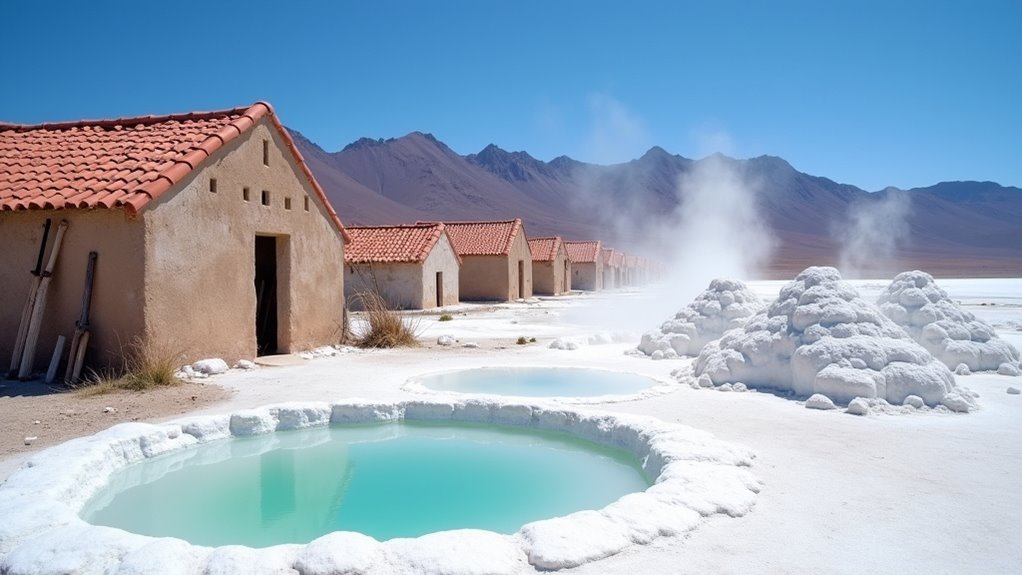
While most visitors focus solely on the salt flats themselves, the working village of Colchani offers an authentic glimpse into the centuries-old traditions that sustain local Aymara communities. You’ll witness the complete salt-harvesting process, from hand-hacked surface blocks to grinding and bagging in family-run workshops.
The village’s small free museum and salt sculptures provide cultural context, while roadside stalls sell locally-crafted salt figurines and cardón cactus-wood products. The village operates the Juanito Salt Processing Plant, which demonstrates the industrial side of salt production alongside traditional methods.
Colchani serves as your gateway to the salt flats, offering essential facilities before entering the vast expanse. You’ll observe miners working under intense high-altitude sun, extracting salt from the 10-billion-tonne reserve using simple tools.
The cooperative structure guarantees decent wages for workers, maintaining economic traditions that’ve sustained these communities for generations.
Chase Flamingos at Colorful High-Altitude Lagoons
When you venture south from Uyuni’s salt flats into Eduardo Avaroa Andean Fauna National Reserve, you’ll discover a chain of spectacular high-altitude lagoons that host three flamingo species amid some of Earth’s most extreme landscapes.
Laguna Colorada stands out with its blood-red waters at 3,653 meters elevation, where local folklore attributes the crimson hue to “blood of the gods.” You’ll encounter Chilean, Andean, and rare James’s flamingos feeding on mineral-rich algae in these shallow saline waters. These resilient birds have developed tough leg skin that allows them to withstand the harsh, salty conditions of these extreme environments.
The lagoons display intense colors—red, turquoise, green, milky white—created by sediments and microorganisms. Visit during late afternoon for enhanced color intensity and dramatic flamingo silhouettes.
November through April brings the largest flocks during breeding season, coinciding with Salar de Uyuni’s mirror conditions.
Witness Geysers and Soak in Hot Springs at Sol De Mañana
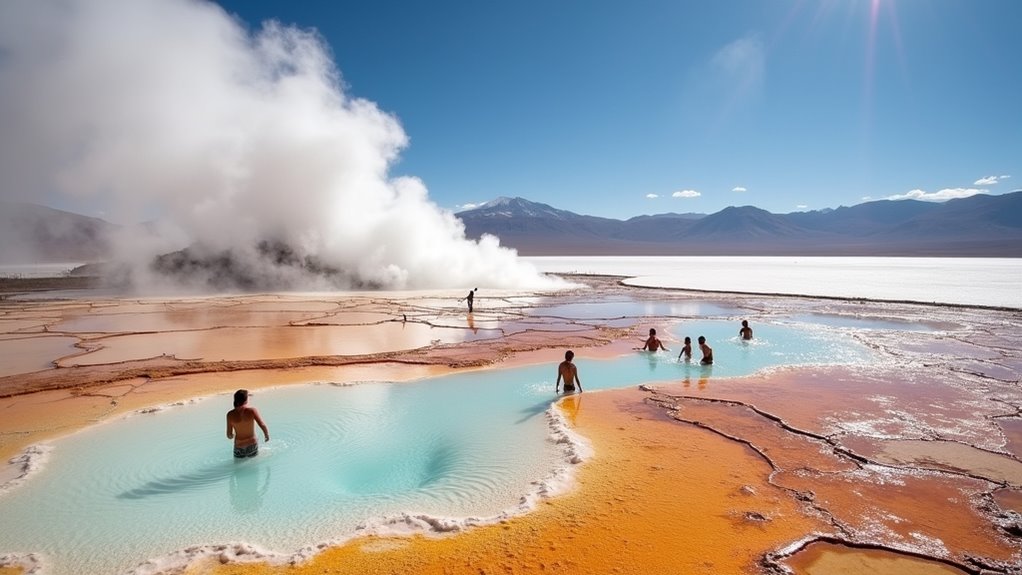
At nearly 5,000 meters above sea level, Sol de Mañana presents one of the world’s highest active geothermal fields, where dramatic steam columns and boiling mud pots create an otherworldly landscape across 10 square kilometers of the Eduardo Avaroa National Reserve.
You’ll witness fumaroles shooting steam 10-50 meters skyward while sulfurous gases paint the volcanic soil in vivid yellows and reds. The name “Morning Sun” reflects ideal viewing conditions at dawn, when freezing air temperatures intensify steam visibility against the clear Andean sky.
After exploring the geysers, you can soak in nearby Chalviri’s natural hot springs, where 30°C mineral-rich waters provide welcome relief from the harsh altitude. Bolivia is investigating this site’s potential as a source of renewable energy due to its significant geothermal activity.
The stark temperature contrast between boiling vents and frigid mountain air creates an unforgettable high-desert experience.
Sleep in a Salt Hotel and Stargaze Under Dark Skies
After experiencing the raw geothermal power of Sol de Mañana, you’ll find extraordinary accommodation awaits on the salt flats themselves, where hotels constructed entirely from salt blocks offer an architectural marvel unlike anywhere else on Earth. These igloo-style dome structures feature salt decorations, private bathrooms, and panoramic desert views.
Hotel Palacio de Sal, the world’s original salt hotel, sits 25km outside Uyuni offering rates from $180-$280 nightly. Luna Salada provides luxury alternatives with spa facilities. The on-site restaurant offers spectacular views of sunsets that paint the sky in blue, purple, and pink tie-dye colors behind the horizon.
At 3,658 meters elevation, you’ll experience unparalleled stargazing conditions—the thin atmosphere, remote location, and minimal light pollution create perfect dark skies for viewing the Milky Way and southern constellations through your salt-walled room’s windows.
Climb Thunupa Volcano for Salt Flat Overlooks
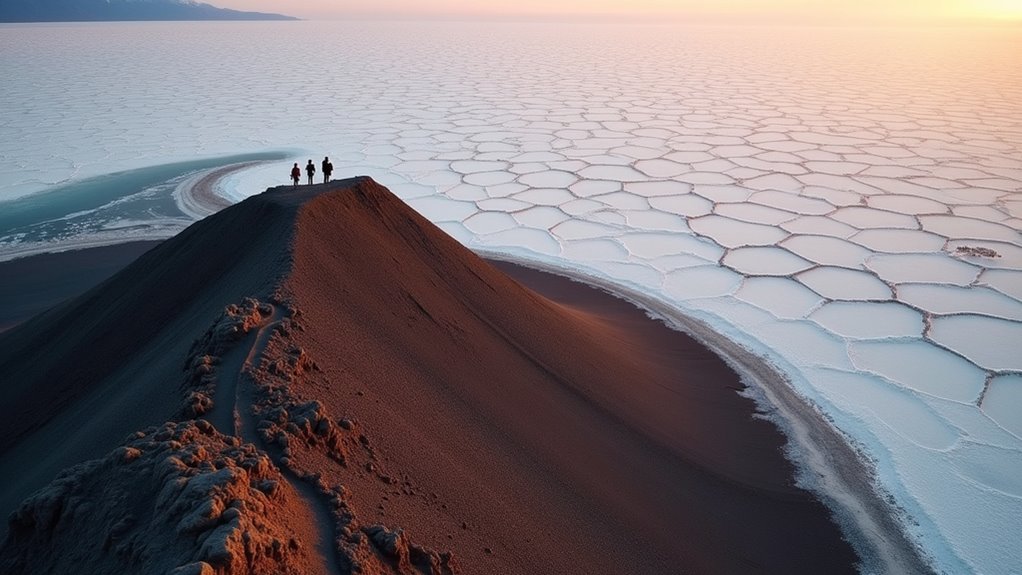
Rising 5,321 meters above sea level, the dormant stratovolcano Thunupa commands the northern edge of Salar de Uyuni and offers the most spectacular elevated views of Bolivia’s iconic salt flats.
You’ll climb to a viewpoint at 4,700 meters—a moderate 3-4 hour hike that doesn’t require technical skills but demands good physical condition due to altitude.
The trail leads from a village with a modest salt hotel, passing through eroded volcanic terrain.
Halfway up, you’ll discover a cave containing ancient mummies, adding cultural significance to your ascent.
From the viewpoint, you’ll witness the entire salt flat stretching endlessly toward the horizon, with polygonal patterns and mirror-like reflections visible during rainy season. The volcano rises about 1.8 km above the surrounding salar, creating this dramatic perspective over one of the world’s largest salt deposits.
Proper acclimatization is essential before attempting this rewarding climb.
Discover Surreal Rock Formations in the Siloli Desert
Beyond the endless white expanse of the salt flats, you’ll encounter one of Earth’s most otherworldly landscapes in the Siloli Desert—a windswept plateau at 4,500 meters where millions of years of erosion have carved volcanic rock into gravity-defying sculptures.
The star attraction is Árbol de Piedra (“Stone Tree”), a 5-meter-tall formation protected as a natural monument within Eduardo Avaroa Reserve. Wind carrying sand and salt has undercut its quartz-rich base while preserving the iron-rich cap, creating its distinctive top-heavy silhouette. Climbing is prohibited to preserve the fragile structure’s integrity for future generations.
You’ll discover mushroom-shaped rocks, towering pillars, and animal-like formations scattered across this Martian-like terrain. The contrast between dark ignimbrite sculptures and bare desert floor creates exceptional photography opportunities, making Siloli an essential stop on multi-day Uyuni tours.
The Sum Up
You’ll find Bolivia’s Uyuni Salt Flats offer experiences you can’t replicate anywhere else on Earth. Whether you’re chasing the perfect mirror reflection or capturing surreal perspective shots, each activity connects you to this otherworldly landscape’s raw power. The local Quechua and Aymara communities have called this region home for centuries, and their salt-harvesting traditions remain unchanged. Pack layers for extreme temperature swings, bring extra camera batteries, and you’ll create memories lasting a lifetime.