
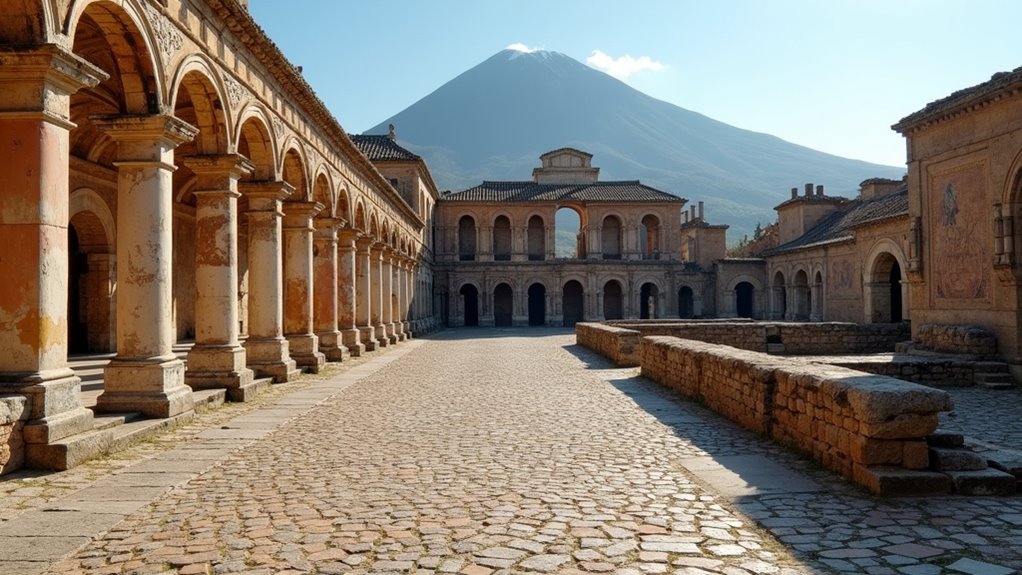
You’ll find yourself standing at the gates of history when you visit Pompeii, but knowing where to start can feel overwhelming. The ancient city sprawls before you with countless ruins, each telling its own story of that fateful day in 79 AD. Rather than wandering aimlessly through the archaeological maze, you need a strategic approach to make the most of your time here. These ten essential stops will transform your visit from confusing to unforgettable.
- Explore the Forum – Pompeii’s Ancient Heart
- Walk Through the House of the Faun and Its Million-Tile Mosaic
- Experience the Amphitheater in the Early Morning Quiet
- Discover the Villa of the Mysteries’ Stunning Frescoes
- Relax at the Stabian Baths Like a Roman
- Pay Your Respects at the Garden of the Fugitives
- Visit the Lupanar for a Glimpse of Ancient Daily Life
- Catch a Performance Vibe at Teatro Grande
- Worship at the Temple of Apollo
- Stroll Through Praedia of Giulia Felice’s Gardens
- The Sum Up
Explore the Forum – Pompeii’s Ancient Heart
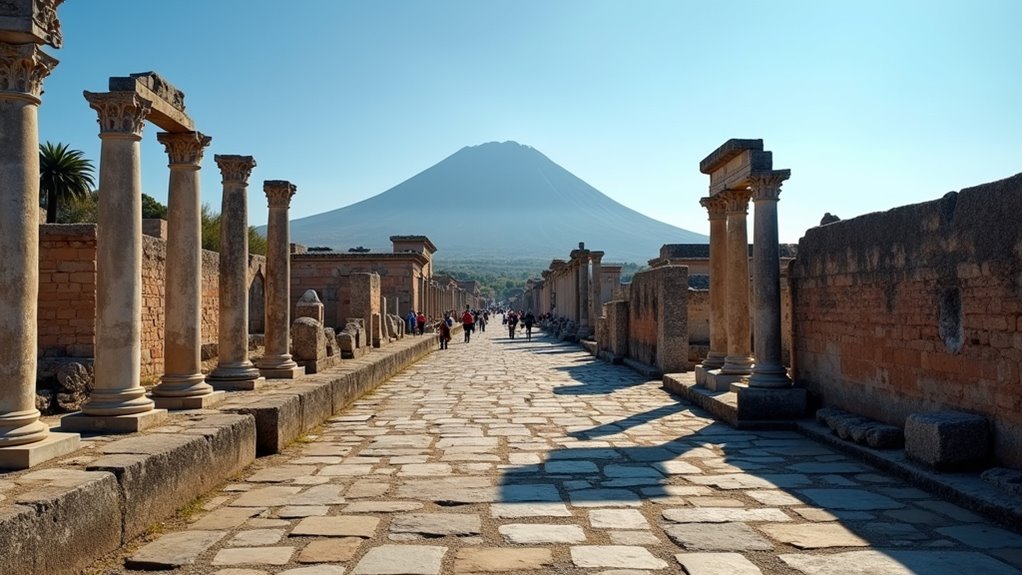
When you step into Pompeii’s Forum, you’re entering what was once the beating heart of this ancient Roman city. This rectangular space served as the center for business, politics, and social life. You’ll notice how the layout creates a dramatic view toward Mount Vesuvius, with the Temple of Jupiter dominating the northern end.
Walk along the porticoes that frame the Forum—these covered walkways once bustled with citizens conducting daily affairs.
Don’t miss the massive Basilica in the southwestern corner, where legal proceedings took place, and the Edifice of Eumachia on the eastern side, which housed important civic functions. As you explore, you’ll see that the forum was originally paved with simple clay before being upgraded to travertine slabs in the Imperial era.
The shops lining the eastern edge show how commerce integrated seamlessly with public life in ancient Pompeii.
Walk Through the House of the Faun and Its Million-Tile Mosaic
After exploring Pompeii’s public spaces, you’ll want to see how the city’s wealthy elite lived by visiting the House of the Faun, one of the most spectacular private residences ever uncovered. This massive 3,000-square-meter mansion showcases incredible Hellenistic architecture with two peristyles, dual atria, and dozens of rooms including bedrooms, dining areas, and even a private bathing complex.
The crown jewel is the Alexander Mosaic—originally crafted from over one million tiny tiles depicting Alexander the Great battling King Darius of Persia. While the original resides in Naples’ Archaeological Museum, you’ll see an excellent replica in its original location.
Don’t miss the Latin “HAVE” greeting mosaic at the entrance and the beautiful Nile-themed floor decorations throughout this aristocratic masterpiece. At the heart of the atrium, you’ll encounter the graceful bronze dancing satyr that gives the house its name, positioned near the impluvium and fountain.
Experience the Amphitheater in the Early Morning Quiet
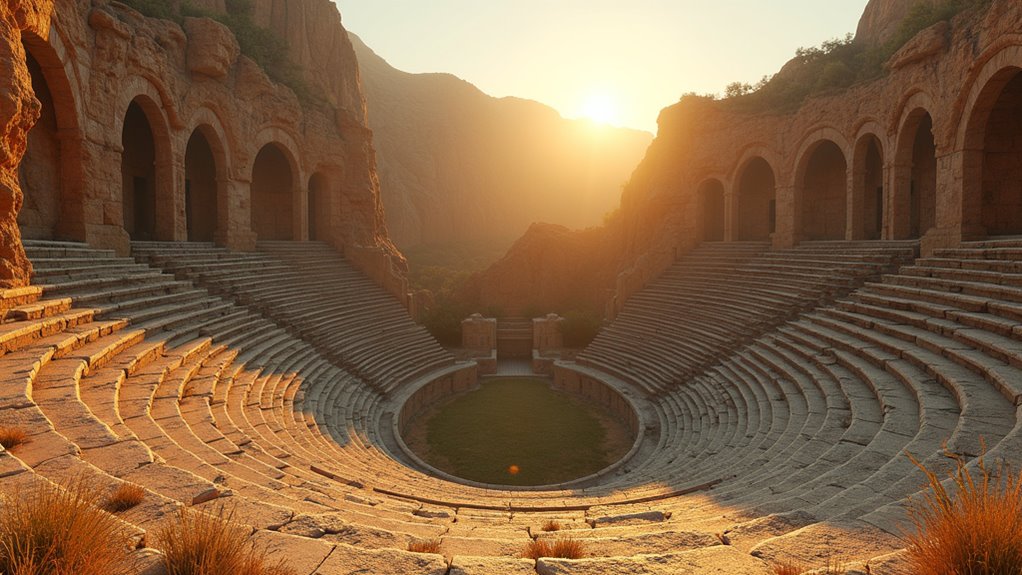
While most visitors arrive mid-morning when tour groups fill the space with chatter, you’ll discover the amphitheater’s true grandeur by visiting at dawn when silence amplifies every architectural detail.
Built between 80-70 BCE, this oldest surviving Roman amphitheater becomes your private arena in early morning light. You’ll appreciate the sophisticated crowd-control design as you walk through empty vomitoria and staircases that once efficiently moved 20,000 spectators.
The quiet reveals intricate brick buttresses and colorful balustrade panels depicting gladiatorial fights. Without distractions, you can absorb the arena’s scale where gladiators once fought and the AD 59 riot erupted between Pompeii and Nuceria fans.
The peaceful atmosphere lets you connect emotionally with this cornerstone of Roman entertainment culture. The structure’s remarkable preservation stems from being buried under volcanic ash during Mount Vesuvius’s 79 CE eruption, protecting it from centuries of weathering and human interference.
Discover the Villa of the Mysteries’ Stunning Frescoes
Though the Villa of the Mysteries sits on Pompeii’s outskirts, you’ll find yourself face-to-face with the ancient world’s most enthralling frescoes in this remarkably preserved 1st-century BCE estate.
Step into the triclinium where life-sized figures painted in vivid reds and purples depict mysterious Dionysian initiation rites. You’ll witness scenes showing a young woman’s ritual preparation for marriage, complete with maenads, satyrs, and symbolic elements tied to spiritual transformation.
The buon fresco technique created artwork that’s literally part of the walls, surviving nearly 2,000 years since Vesuvius’s eruption. Beyond the famous painted chamber, explore the villa’s winepress area that reveals how wealthy Romans combined luxury with agricultural production.
These Second Style paintings offer rare insight into secretive mystery cults that Romans practiced. Don’t rush—take time to absorb the dramatic poses and complex symbolism that make this villa Pompeii’s most enigmatic treasure.
Relax at the Stabian Baths Like a Roman
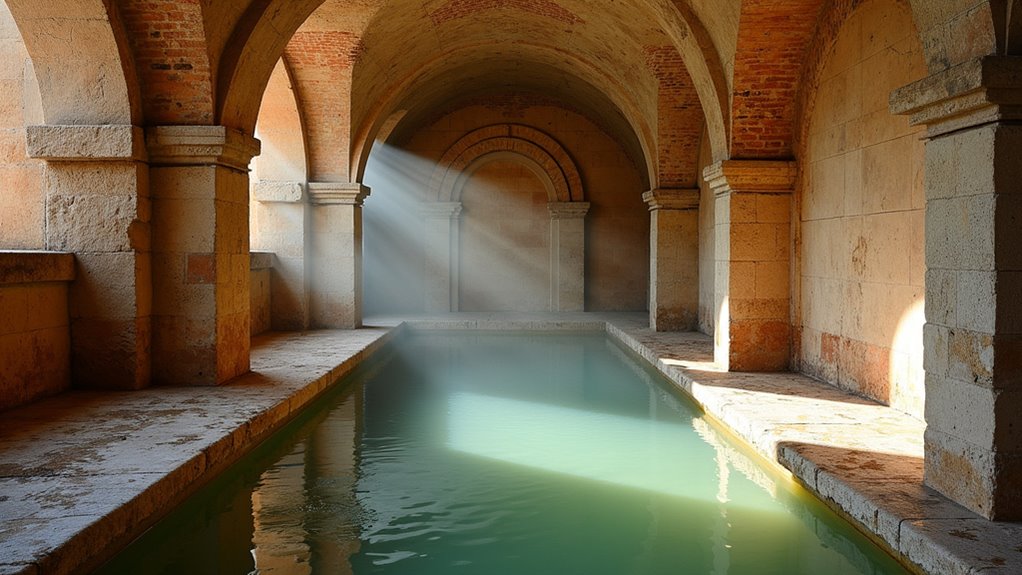
Since ancient Romans viewed bathing as essential to daily life, you’ll discover authentic Roman culture at the Stabian Baths, Pompeii’s oldest and largest public bath complex dating to 125 BC.
You’ll walk through the same sequence Romans followed: start in the apodyterium (changing room), then progress through the frigidarium (cold bath), tepidarium (warm bath), and caldarium (hot bath). The innovative hypocaust heating system still visible beneath floors warmed these thermal rooms.
Men accessed the large palaestra with its swimming pool and garden, while women used smaller, separate facilities. The complex also featured a rare nine-lane bowling alley with stone balls that provided additional entertainment for visitors.
You’ll notice erotic frescoes reflecting Pompeian attitudes toward sexuality. Don’t miss the recently excavated round saunas—exclusive male privileges that reveal Roman social dynamics.
This complete bathing experience shows how Romans combined hygiene, socializing, and relaxation.
Pay Your Respects at the Garden of the Fugitives
When you enter the Garden of the Fugitives in southeastern Pompeii, you’ll encounter one of archaeology’s most haunting discoveries—thirteen plaster casts of victims who died fleeing the 79 AD eruption. These casts, created by filling voids left by decomposed bodies with liquid plaster, preserve their final moments in heartbreaking detail.
You’ll find this moving memorial near Porta Nocera gate, about fifteen minutes from the main entrance. The victims perished on the eruption’s second day, caught by deadly pyroclastic flows while escaping through what was once a vineyard. Their grouped arrangement suggests families trying to flee together. The site was carefully restored in 2011, with the casts positioned on a thin layer of ash to better preserve and display these poignant remains.
Visit early morning for quiet reflection at this less crowded site. The garden offers profound insight into Pompeii’s human tragedy, making it both educational and deeply emotional.
Visit the Lupanar for a Glimpse of Ancient Daily Life
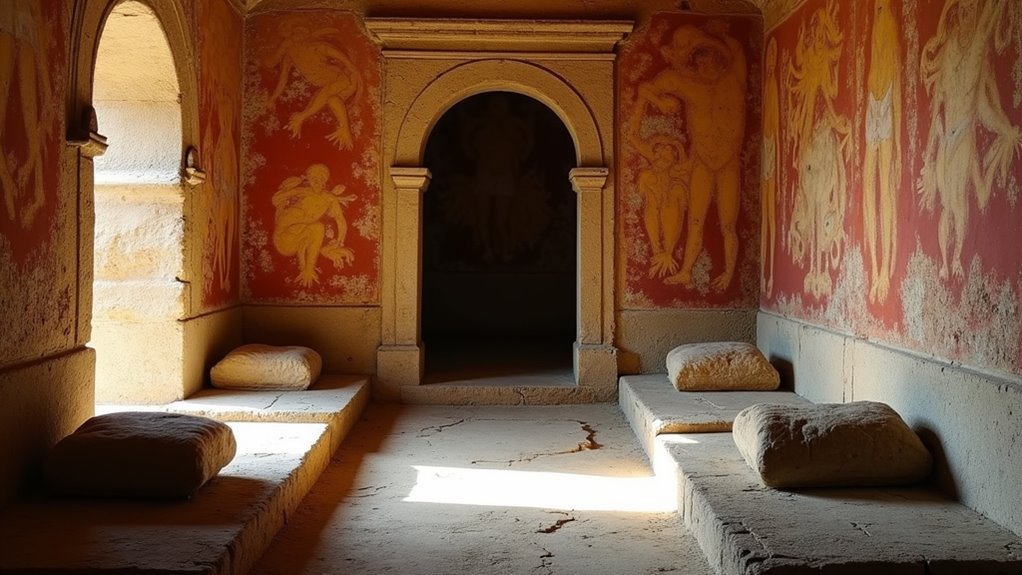
While exploring Pompeii’s preserved streets, you’ll discover the Lupanar—one of antiquity’s most revealing glimpses into Roman daily life. Located near the town center for easy access, this two-story brothel housed approximately 10 stone beds where prostitutes served clients from all social classes.
You’ll see explicit frescoes depicting sexual acts that functioned as service menus, alongside 120 pieces of graffiti showing client reviews, prostitute names like Victoria and Felicula, and pricing details. Services cost 2-16 asses, reflecting structured economic integration.
The preserved beds, artwork, and personal inscriptions offer unfiltered insight into Roman attitudes toward sexuality and commerce. This site demonstrates how prostitution operated as a regulated, taxed industry within Pompeii’s urban economy before Vesuvius froze this intimate slice of ancient life. The brothel was managed by a leno who purchased slaves primarily from Eastern regions to work as prostitutes.
Catch a Performance Vibe at Teatro Grande
As you approach Teatro Grande, you’ll immediately sense the grandeur that once captivated 5,000 Roman spectators in this 2nd-century BCE masterpiece. Built into a natural hillside following Greek tradition, this stone theatre showcases remarkable engineering and social hierarchy.
You’ll notice three distinct seating zones—the elite decurions sat closest in the ima cavea, while representatives of corporations occupied the middle section, and regular citizens filled the upper tier.
Look for the stone rings embedded in the upper walls that once supported protective canopies shielding audiences from sun.
The impressive two-story stage backdrop, rebuilt after the 62 CE earthquake, features columns and decorated niches that housed statues. The theatre’s circular orchestra, measuring over 20 meters in diameter, served as the central performance space where actors and musicians brought Roman entertainment to life.
Don’t miss the Bacchus bust at the entrance—he was the theatre’s divine protector.
Worship at the Temple of Apollo
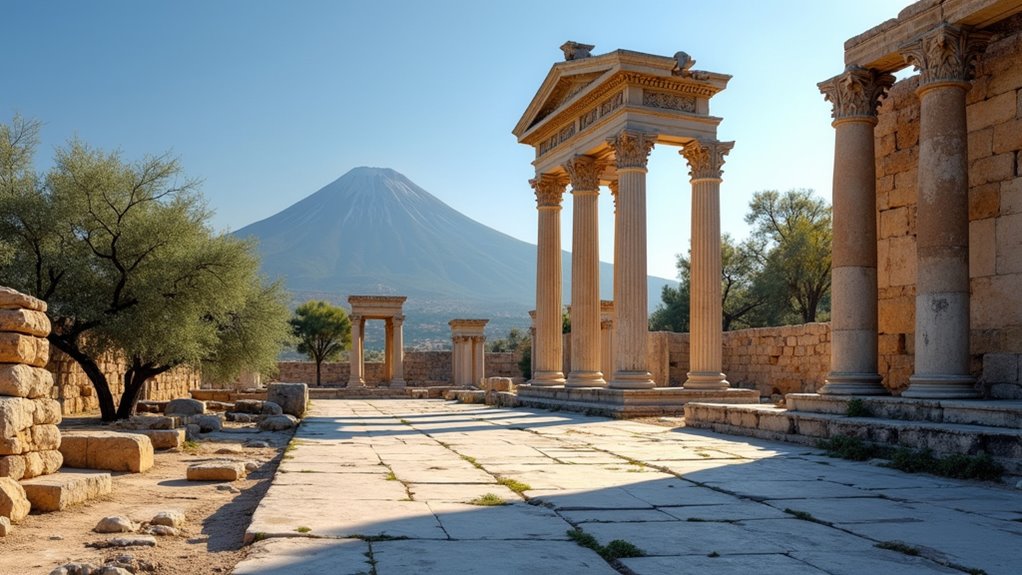
Step into Pompeii’s most sacred space at the Temple of Apollo, where over eight centuries of devotion shaped this extraordinary sanctuary. You’ll discover Pompeii’s principal religious building, originally dating to the 8th-7th century BCE and magnificently reconstructed by Romans around 120 BCE.
As you climb the 14 steps to the elevated platform, you’re following the path of ancient worshippers who came to honor Apollo, god of prophecy and healing.
Inside the cella, you’ll find the symbolic “navel of the world” stone, connecting this temple to Delphi’s famous oracle. The 48 surrounding Ionic columns create an impressive peristyle that blends Greek and Roman architectural styles. The temple’s Corinthian hexastyle design demonstrates the sophisticated architectural evolution that occurred during the Samnite period.
Don’t miss the altar’s Latin inscription and the spots where Apollo and Diana’s statues once stood.
Stroll Through Praedia of Giulia Felice’s Gardens
After exploring Pompeii’s sacred spaces, you’ll find a different kind of wonder at the Praedia of Julia Felix—one of the ancient city’s most impressive private estates that showcases how entrepreneurial Romans lived and thrived.
This massive property occupies nearly an entire city block, where wealthy Julia Felix cleverly converted her home into rental apartments, shops, and public baths after the devastating 62 AD earthquake.
You’ll be struck by the expansive ornamental garden that covers two-thirds of the estate. Walk among the remnants of fruit trees, marble columns, and frescoed dining areas where Romans once relaxed. Look for the ornamental water canal with bridges that creates a tranquil, oasis-like environment throughout the property.
Don’t miss the sophisticated bath complex with its frigidarium, tepidarium, and calidarium—these luxury facilities were reserved for “respectable” citizens and demonstrate the owner’s savvy business acumen.
The Sum Up
You’ve just scratched the surface of what Pompeii offers. Don’t rush through these sites—take time to absorb the incredible preservation and imagine daily life frozen in time. Wear comfortable shoes since you’ll walk on ancient stone streets, and bring water for the journey. Consider hiring a guide to reveal stories you’d miss on your own. Pompeii isn’t just ruins—it’s a window into human civilization that’ll stay with you long after you leave.