
You’ll experience Bolivia’s extremes by witnessing Salar de Uyuni’s mirror effects during rainy season, riding La Paz’s cable cars at 13,000 feet, and biking the infamous Death Road‘s 3,500-meter descent. Don’t miss flamingo watching at Laguna Colorada’s red waters, climbing 20,000-foot Huayna Potosí, or spotting jaguars in Madidi National Park. Take boats across Lake Titicaca to sacred Isla del Sol and soak in Polques hot springs under star-filled skies. These insider details will transform your Bolivian adventure.
- Marvel at Salar De Uyuni’s Mirror Effect and Salt Patterns
- Ride La Paz’s Cable Cars Above the Clouds
- Bike Down the World’s Most Dangerous Road
- Take a Boat to Isla Del Sol on Lake Titicaca
- Climb Huayna Potosí for Your First 20,000-Foot Peak
- Explore Sucre’s Colonial Streets and Rooftop Views
- Tour the Silver Mines of Potosí
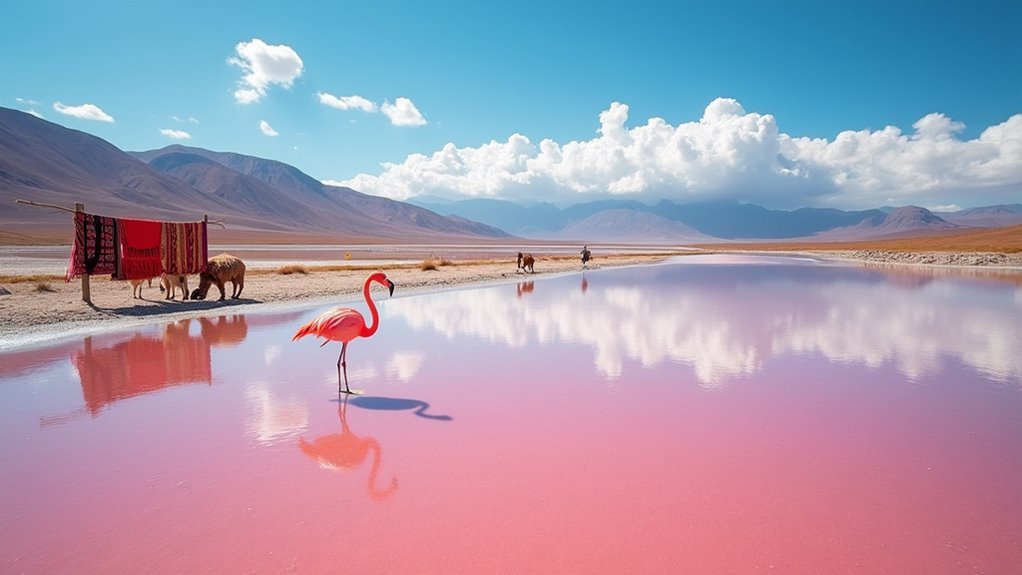
- Spot Flamingos at Laguna Colorada’s Red Waters
- Search for Jaguars in Madidi National Park
- Soak in Natural Hot Springs Under Andean Stars
- The Sum Up
Marvel at Salar De Uyuni’s Mirror Effect and Salt Patterns
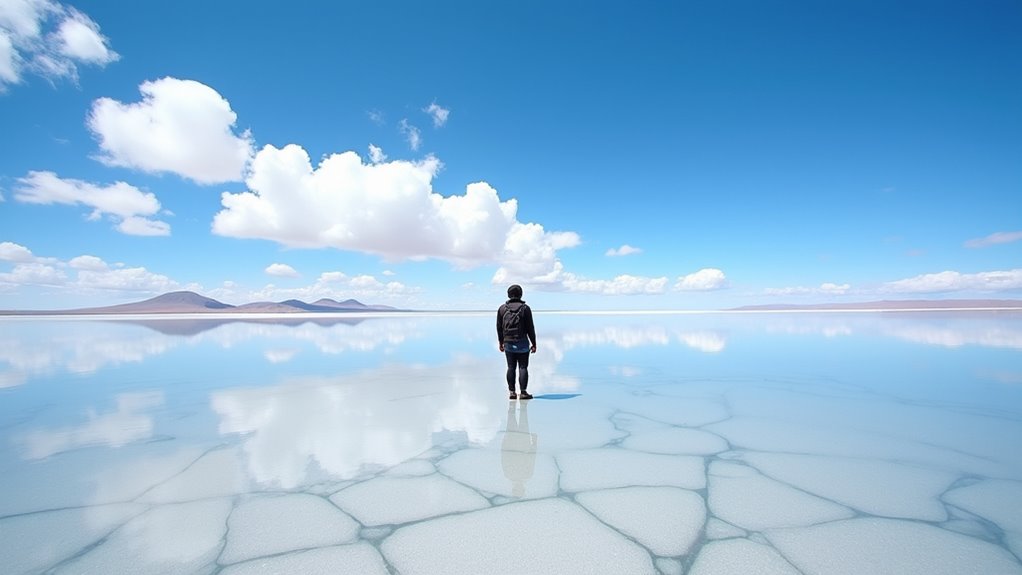
Bolivia’s Salar de Uyuni transforms into the world’s largest natural mirror when thin water layers form across its 10,582 km² surface after rainfall. You’ll witness the most spectacular mirror effects during the rainy season from December to April, when calm, shallow water creates perfect reflections of sky, clouds, and stars.
The salt flat’s extreme flatness—varying only about one meter across the entire surface—produces optical illusions where horizons blur and you’ll feel surrounded by sky. The intense reflections can cause disorientation for visitors, making it challenging to distinguish between earth and sky.
During dry season (May-November), you’ll discover striking hexagonal salt polygons formed by evaporation and crystallization. These geometric patterns create an otherworldly landscape with raised ridges marking polygon boundaries.
Time your visit strategically: wet season for expansive mirrors, dry season for defined salt patterns.
Ride La Paz’s Cable Cars Above the Clouds
Since La Paz sits in a dramatic bowl-shaped valley with neighborhoods cascading up canyon walls, you’ll experience the world’s highest urban cable car system as both practical transport and breathtaking sightseeing platform. Operating at 13,000 feet above sea level, Mi Teleférico cuts travel time from La Paz to El Alto from one hour to just 10-17 minutes.
Start with the classic Red Line connecting the historic center to El Alto, then hop onto Yellow Line for ridge viewpoints and Green Line through southern valleys. The system runs on electricity and solar power, making it an environmentally friendly way to traverse the city.
At only 3 BOB per ride (half-price for students and seniors), you’ll afford multi-line circuits across 10+ lines spanning the metropolitan area. Cabins depart every 12 seconds with panoramic windows perfect for photographing Illimani mountain and Andean peaks rising above the urban sprawl.
Bike Down the World’s Most Dangerous Road
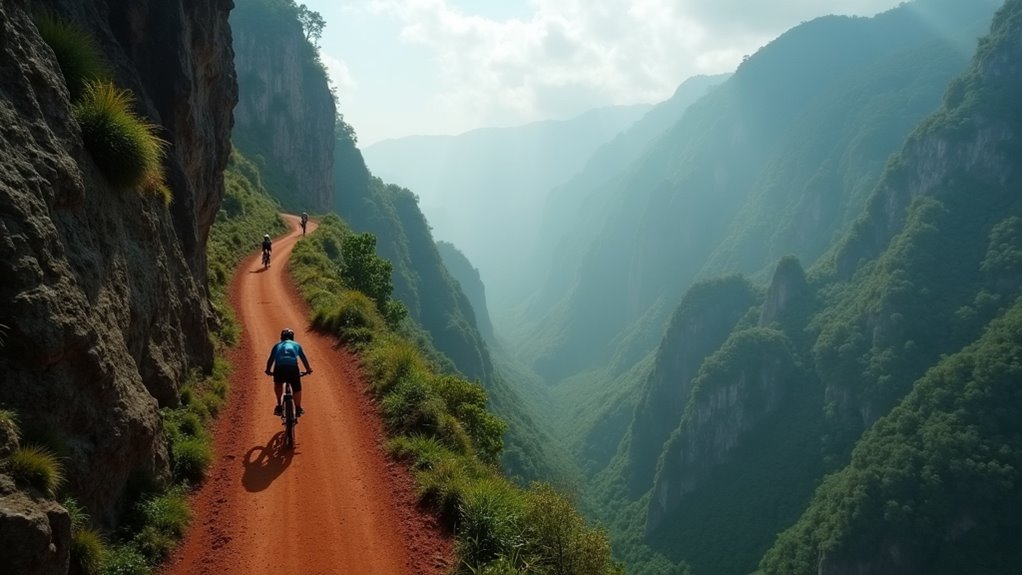
While most travelers admire Bolivia’s mountains from cable cars, adrenaline seekers plunge down North Yungas Road—infamously dubbed “Death Road”—on mountain bikes for one of the world’s most extreme cycling adventures.
You’ll descend 3,500 meters over 60+ kilometers from La Cumbre’s windswept tundra at 4,700 meters to Coroico’s humid jungle at 1,200 meters. The single-lane track features sheer 1,000-meter drops with virtually no guardrails—once claiming 200-300 lives annually before a new highway diverted vehicle traffic. This treacherous route was originally built in the 1930s by Paraguayan prisoners during the Chaco War.
Book a full-day tour from La Paz that includes quality bikes, protective gear, and support vehicles. Expect loose gravel, crossing waterfalls, sudden weather shifts, and left-hand traffic rules.
Despite improved safety protocols, eighteen cyclists have died since 1998—this isn’t for nervous riders.
Take a Boat to Isla Del Sol on Lake Titicaca
From Copacabana’s lakeside docks, you’ll board weathered wooden boats or modern catamarans for the 90-minute journey across Lake Titicaca’s sapphire waters to Isla del Sol—the sacred birthplace of Inca civilization and the sun god Inti.
At 12,507 feet elevation, pack warm layers and sunscreen for rapidly changing conditions.
Most tours focus on the southern Yumani sector, where you’ll climb ancient Inca staircases to Pilkokaina Temple and drink from the three-watered Fountain of Eternal Youth.
Standard departures leave Copacabana at 12:30 and 2:00 PM, returning mid-afternoon.
Half-day tours run four hours total, while full-day options from La Paz include bus transfers and lunch. For a more personalized experience, private tour options are available with exclusive access and English-speaking guides.
Book multi-day stays to catch sunrise over the Andes and explore the restricted northern archaeological sites.
Climb Huayna Potosí for Your First 20,000-Foot Peak
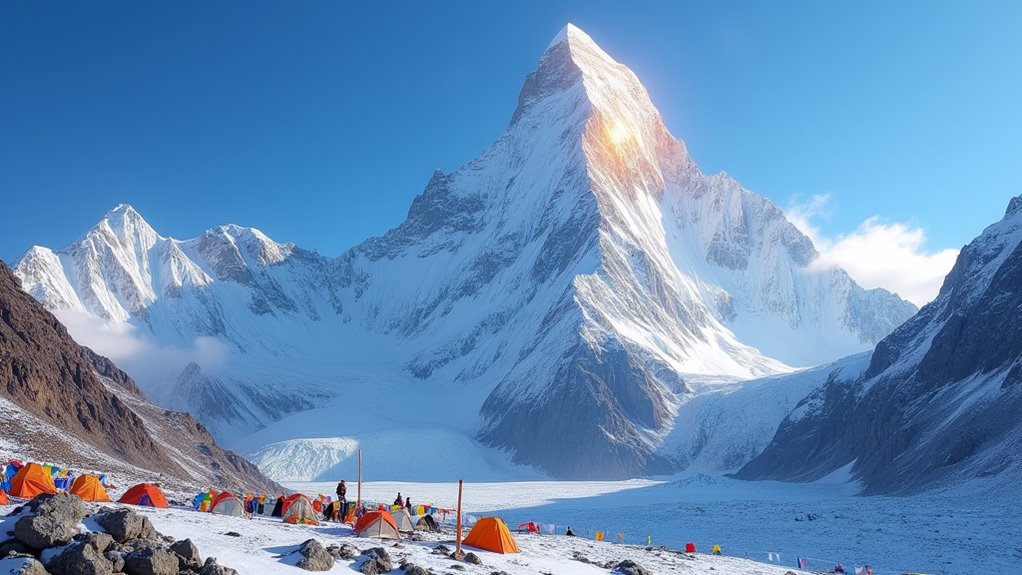
After soaking up Bolivia’s cultural treasures around Lake Titicaca, you’ll likely crave a physical challenge that matches the country’s dramatic landscape. Huayna Potosí delivers exactly that—a legitimate 6,088-meter summit just 25 kilometers from La Paz, making it one of the world’s most accessible 20,000-foot peaks.
Don’t let the “beginner-friendly” marketing fool you. This glaciated mountain demands respect, featuring crevassed terrain, an ice wall section, and exposed ridge climbing.
The standard three-day program costs 850-1,000 Bolivianos and includes technical gear rental.
Your summit attempt starts at midnight, targeting sunrise on top. La Paz’s 3,600-meter elevation provides natural pre-acclimatization, but expect serious altitude effects, sub-freezing temperatures, and genuine mountain hazards. Plan for 4 nights in La Paz before your ascent to properly acclimatize and reduce altitude sickness risk.
Book during dry season (May-September) for ideal conditions.
Explore Sucre’s Colonial Streets and Rooftop Views
Bolivia’s constitutional capital unfolds like a living museum where you can actually touch 500-year-old stones and walk the same cobblestones where independence was declared. Start at Plaza 25 de Mayo, then explore the UNESCO World Heritage core’s 113-hectare grid of whitewashed buildings and red-tiled roofs.
Visit Casa de la Libertad where Bolivia’s independence was signed in 1825—the arcaded cloisters showcase perfect colonial patio architecture.
Don’t miss the rooftop terrace at San Felipe de Neri convent, offering the city’s best panoramic views. You’ll see the checkerboard street pattern, terracotta rooftops, and church towers against mountain backdrops. At this high altitude of 2,810 meters above sea level, the temperate climate keeps temperatures comfortable year-round between 14 to 22°C.
Time your visit for late afternoon when soft light illuminates the white facades. The Metropolitan Cathedral and colonial churches punctuate perfect walking routes through narrow streets lined with ornate wooden balconies.
Tour the Silver Mines of Potosí
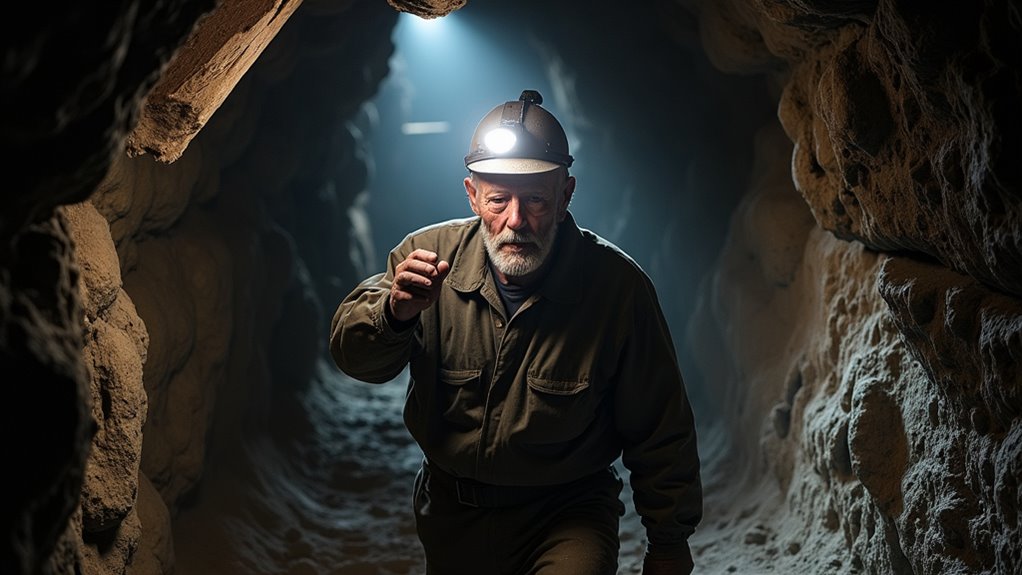
While most travelers visit reconstructed historical sites, you’ll descend into Cerro Rico’s active mines where Indigenous laborers have extracted silver for nearly 500 years using methods that haven’t fundamentally changed since 1545.
Your guide will lead you through narrow, hand-dug tunnels where cooperative miners still use pickaxes and dynamite to extract silver, tin, and zinc from the same veins that once produced 60% of the world’s silver.
You’ll witness miners making offerings of coca leaves and alcohol to “El Tío,” their protective deity, and see ore-sorting by hand. Approximately 15,000 miners descend into these tunnels daily, relying on this dangerous work for their livelihood despite the exhausted state of most mines.
The 4,000-meter altitude and dusty conditions make this challenging—bring water, expect low tunnels requiring helmets, and skip this if you have respiratory issues.
Purchase gifts like coca leaves for the miners you’ll meet underground.
Spot Flamingos at Laguna Colorada’s Red Waters
From Bolivia’s mineral-rich underground depths, you’ll find an entirely different natural spectacle at Laguna Colorada, where thousands of flamingos feed in blood-red waters that stretch across the southwestern altiplano. This shallow saline lake at 4,300 meters altitude hosts three flamingo species, with James’s flamingos being most abundant.
The lake’s crimson coloration comes from red algae and sediments—the same carotenoid-rich plankton that turns flamingos pink.
Visit during December through April for peak congregations when rainy season brings ideal water levels. You’ll witness thousands of birds during breeding season, creating stunning contrasts between pink plumage and red waters.
The lake sits within Eduardo Avaroa National Reserve, making it accessible through organized tours from Uyuni that combine salt flat visits with flamingo viewing. Despite the seemingly inhospitable environment of desolate rocks and salt deposits, the area supports diverse wildlife including Andean foxes, cats, pumas, llamas, and alpacas.
Search for Jaguars in Madidi National Park
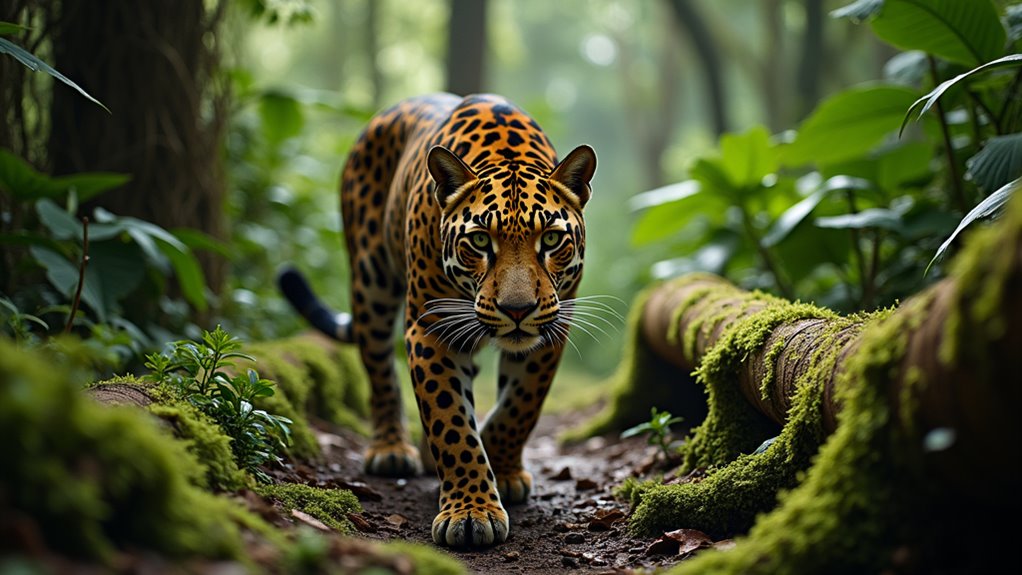
Deep in the Amazon rainforest where the Andes meet the lowlands, Madidi National Park shelters Bolivia’s largest jaguar population—an estimated concentration within the country’s most biodiverse landscape. You’ll have your best chances in Alto Madidi and Alto Heath, where camera traps have recorded the highest jaguar densities in Bolivia.
Focus your search along river beaches and sandbanks during dry season months, when jaguars use these corridors as travel routes and visibility improves.
Access the park through Rurrenabaque or Ixiamas, both gateways to jaguar territory. While searching, you’ll encounter white-lipped peccaries, spider monkeys, giant otters, and capybaras sharing this megafauna stronghold.
Choose conservation-focused operators who maintain strict no-harassment protocols and support local ranger efforts protecting these apex predators from trafficking threats. Thanks to collaborative conservation efforts with the indigenous Tacana people, the park maintains low deforestation rates that preserve critical jaguar habitat.
Soak in Natural Hot Springs Under Andean Stars
At 4,300 meters above sea level, Polques hot springs offer Bolivia’s most spectacular combination of thermal soaking and stargazing—where you’ll slip into 29°C mineral waters while sub-freezing air creates crystal-clear conditions for viewing the Milky Way.
Located in Eduardo Avaroa Andean Fauna National Reserve, these remote pools eliminate light pollution completely. You’ll access Polques via 4×4 tours from Uyuni, often combined with visits to Laguna Colorada and Sol de Mañana geysers.
Pack warm, quick-dry clothing since nighttime temperatures plummet below freezing. The volcanic-heated waters contain high mineral concentrations, so limit sessions if you’ve got sensitive skin. The geothermal waters amid breathtaking desert landscapes create an otherworldly soaking experience.
Best stargazing happens during the dry season (May-October) when cloud cover disappears across the southern Altiplano.
The Sum Up
You’ll want at least two weeks to tackle these highlights properly. Book Uyuni tours during dry season for salt patterns, wet season for mirrors. Don’t attempt Huayna Potosí without acclimatization—spend three days in La Paz first. Pack layers for extreme altitude changes and bring coca leaves for soroche. Consider hiring local guides in Madidi; they’ll spot wildlife you’d miss. Most importantly, you’ll need yellow fever vaccination for jungle regions.