
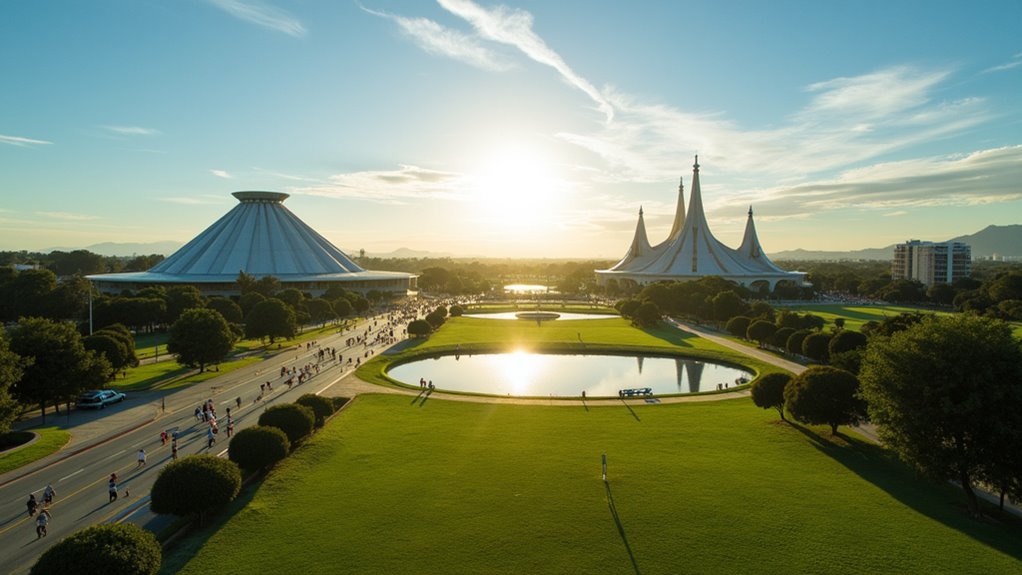
You’ll find Brasília’s modernist architecture absolutely mesmerizing, starting with the Cathedral’s 16 concrete columns and stunning stained glass that creates underwater-like atmospheres. Tour the National Congress with its distinctive twin towers and domes, then stand in Three Powers Plaza where Brazil’s government branches converge. Don’t miss the Itamaraty Palace’s floating arches, the TV Tower’s panoramic views of the city’s airplane layout, and sunset walks around Lake Paranoá. Explore further to uncover hidden gems and practical insider tips.
- Marvel at the Cathedral of Brasília’s Concrete Curves and Stained Glass
- Tour the National Congress to See Brazilian Politics in Action
- Stand in Three Powers Plaza Where Brazil’s Government Converges
- Visit Itamaraty Palace for Oscar Niemeyer’s Finest Architecture
- Climb the TV Tower for Views of Brasília’s Airplane-Shaped Layout
- Explore Santuário Dom Bosco’s Blue Stained Glass Symphony
- Drive or Bike the Length of the Monumental Axis
- Take a Sunset Walk Around Lake Paranoá and the JK Bridge
- Discover Brazilian History at the Juscelino Kubitschek Memorial
- Escape to Brasília National Park for Cerrado Landscapes and Natural Pools
- The Sum Up
Marvel at the Cathedral of Brasília’s Concrete Curves and Stained Glass
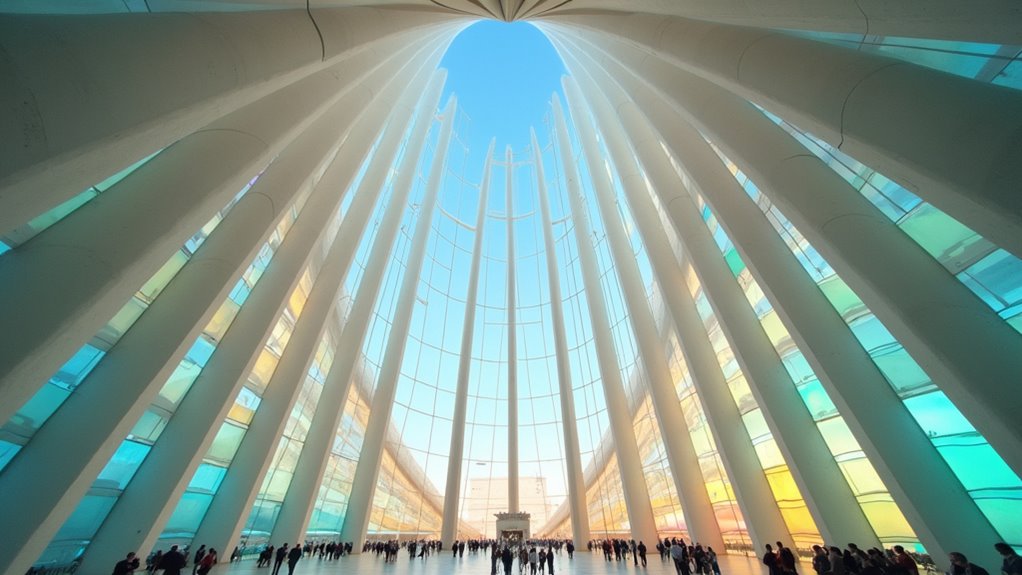
When you approach Brasília’s Cathedral along the Esplanade, sixteen massive concrete columns rise from below street level like hands reaching toward heaven, forming one of architect Oscar Niemeyer‘s most striking achievements.
Each 90-ton column creates a crown-like silhouette 131 feet high, enclosing a 230-foot circular plan through dramatic hyperbolic curves that reject traditional right angles.
Inside, triangular stained-glass panels between concrete ribs transform harsh Brazilian sunlight into an underwater-like atmosphere using blue, green, white, and brown hues. This colored glazing, completed in 1990, represents a postmodern intervention in Niemeyer’s modernist shell.
Don’t miss the three suspended aluminum angels by Alfredo Ceschiatti and the four bronze Evangelist statues at the entrance, which complete this architectural marvel dedicated to Our Lady of Aparecida. Construction began with the cornerstone laid in September 1958, though the cathedral wasn’t consecrated until 1968.
Tour the National Congress to See Brazilian Politics in Action
At the heart of Brazil’s political landscape stands the National Congress, where Oscar Niemeyer’s twin 28-story towers and contrasting domes create one of modernist architecture’s most recognizable silhouettes. You’ll discover the concave Senate dome and convex Chamber of Deputies dome represent democratic balance in this 1964 masterpiece anchoring Three Powers Plaza.
Book your free 60-minute guided tour through the “Visit the Congress Program.” On Mondays and Fridays, you can walk in, but Tuesdays through Thursdays require advance reservations. Tours operate in Portuguese, English, and Spanish, taking you through ceremonial halls, committee rooms, and legislative chambers. Groups are limited to 50 visitors on weekdays and 70 on weekends and holidays.
You’ll learn how Brazil’s bicameral system functions while exploring Roberto Burle Marx’s landscaping and permanent political exhibitions that complement this architectural and democratic showcase.
Stand in Three Powers Plaza Where Brazil’s Government Converges
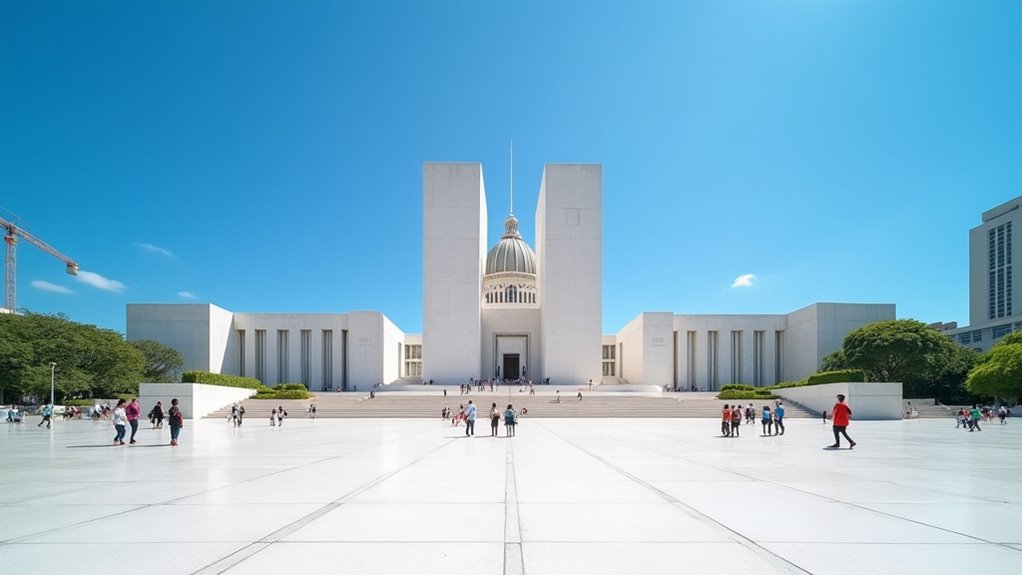
Where Brazil’s three branches of government converge in perfect modernist symmetry, you’ll find yourself standing at the nation’s democratic epicenter in Praça dos Três Poderes. This elevated plaza positions you between the National Congress’s distinctive twin towers and inverted domes, the Presidential Palace’s floating concrete canopies, and the Supreme Court’s colonnaded facade.
Walk across the stone-paved expanse to appreciate how Lúcio Costa and Oscar Niemeyer designed this space to embody democratic balance—each branch facing the others in architectural dialogue.
Visit the central Museum of the Foundation of Brasília for historical context, then explore the Pantheon of Liberty at the plaza’s southern end. The plaza terminates the city’s civic-centered axis, emphasizing its role as the symbolic heart of Costa’s urban plan.
The wide pedestrian areas and shaded walkways make this political heart surprisingly accessible and human-scaled.
Visit Itamaraty Palace for Oscar Niemeyer’s Finest Architecture
Among Oscar Niemeyer’s architectural masterpieces in Brasília, Itamaraty Palace stands as his most refined achievement—a stunning synthesis of modernist audacity and diplomatic elegance that houses Brazil’s Ministry of Foreign Affairs.
Known as the “Palace of the Arches,” this 1970 landmark features a glass box wrapped by monumental concrete arches with 30-meter spans, creating the illusion of floating above reflecting pools.
Inside, you’ll discover a grand column-free ceremonial hall anchored by Niemeyer’s signature sculptural spiral staircase.
The building showcases Brazilian art integration, including Bruno Giorgi’s “Meteoro” sculpture and Athos Bulcão’s marble treatments. The architectural design is enhanced by landscape elements created by Roberto Burle Marx.
Located at the Monumental Axis’s eastern end, it breaks Costa’s standardized ministry design, establishing itself as architectural poetry in concrete and glass.
Climb the TV Tower for Views of Brasília’s Airplane-Shaped Layout
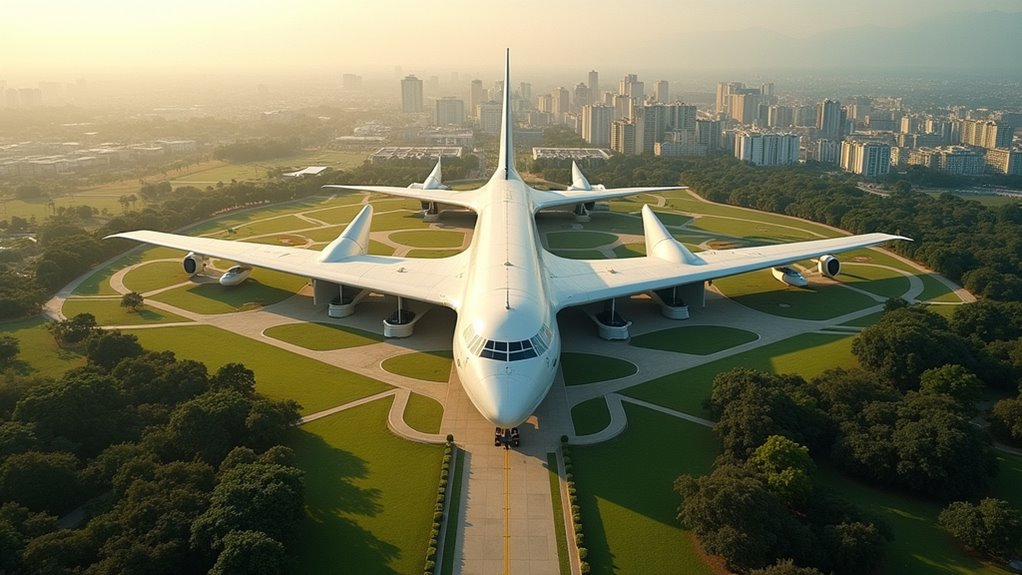
Rising 224 meters above the Monumental Axis, Brasília’s TV Tower offers the city’s most accessible vantage point for grasping Lúcio Costa’s audacious airplane-shaped urban design.
You’ll take a free elevator ride to the observation deck at 75 meters, where 360-degree panoramic views reveal the Esplanade of Ministries forming the airplane’s “fuselage” and the hotel sectors of Asa Norte and Asa Sul creating the “wings.”
The deck accommodates 150 visitors and provides clear sightlines to National Congress, Paranoá Lake, and the National Stadium.
Visit Tuesday through Sunday from 9:00–19:00, bringing your passport for access control.
Combine your visit with the weekend fountain shows and browse the Tower Fair’s handicraft stalls below. Don’t miss the Museum of Gems on the second floor, which showcases an impressive collection of Brazilian gemstones.
Explore Santuário Dom Bosco’s Blue Stained Glass Symphony
What transforms a simple white modernist box into one of Brazil’s most spiritually moving architectural experiences? Step inside Santuário Dom Bosco, where architect Carlos Alberto Naves created a masterpiece of light and color.
The sanctuary’s blue stained glass symphony, designed by Cláudio Naves and crafted by Belgian artisan Hubert van Doorne, bathes the interior in ethereal indigo tones that shift throughout the day. The windows incorporate elegant Murano glass techniques that add depth and brilliance to the overall design.
You’ll find yourself immersed in an atmosphere reminiscent of a starry night or underwater cathedral. The blue light reflects off polished marble floors, creating a “sky floor” effect that extends the stained-glass experience downward.
Purple corner windows add chromatic contrast to the dominant blue palette. Visit during different times to witness how changing light transforms the nave’s mood from bright contemplation to soft twilight meditation.
Drive or Bike the Length of the Monumental Axis
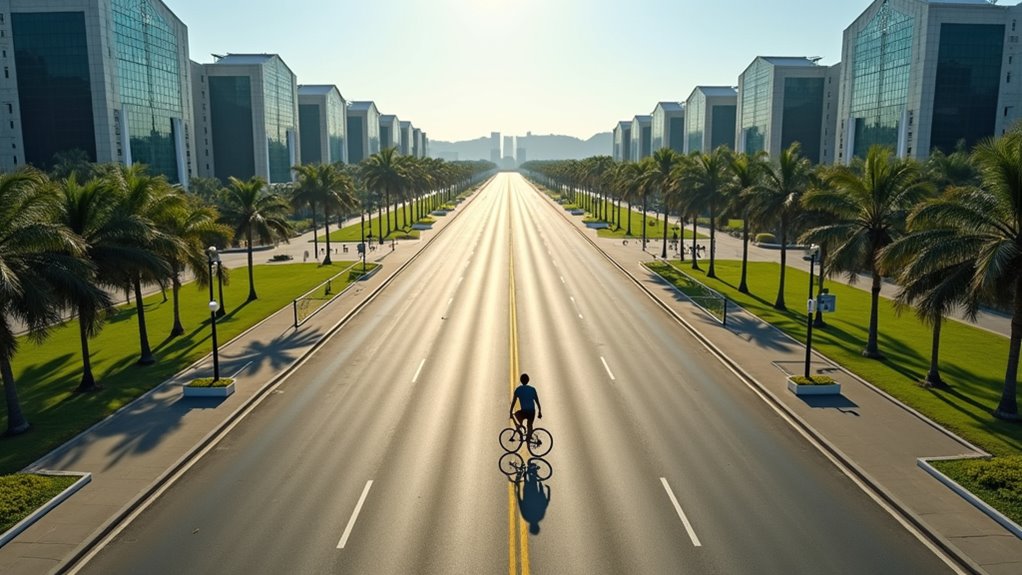
From the intimate blue-lit sanctuary, expand your perspective to embrace Brasília’s grandest architectural statement: the Monumental Axis stretches 16 kilometers of pure urban theater from the central bus station to Praça dos Três Poderes.
You’ll drive through Guinness World Records’ widest avenue, spanning 250 meters across twelve lanes and landscaped medians. The route showcases modernist masterpieces—ministry blocks lining Esplanada dos Ministérios, the hyperboloid Cathedral, and the twin-towered National Congress complex.
For cycling, stick to park strips and side paths flanking the main carriageways. Early morning or late afternoon offer ideal conditions with cooler temperatures and lighter traffic. This grand avenue was conceived by Lúcio Costa as the “primary gesture” of his 1957 Pilot Plan, designed to symbolize Brazil’s national identity through monumental architecture.
You can complete the full drive in under 30 minutes during off-peak hours, or segment your bike ride into manageable 3-5 kilometer sections between major landmarks.
Take a Sunset Walk Around Lake Paranoá and the JK Bridge
While the Monumental Axis showcases Brasília’s architectural ambitions, Lake Paranoá reveals the city’s natural beauty through Brazil’s largest artificial lake stretching 48 kilometers with maximum depths of 38 meters.
You’ll find prime sunset viewpoints at Ermida Dom Bosco and Dom Bosco Ecological Park, both offering unobstructed views across the water toward the JK Bridge‘s three asymmetrical arches. The chapel’s distinctive pyramid architecture creates a striking silhouette against the evening sky, making it one of the most photographed landmarks during golden hour.
Walk the 18-kilometer continuous waterfront path, particularly along Orla do Deck Sul and Pontão do Lago Sul promenades. You’ll encounter herons, egrets, and capybaras while enjoying the lake’s cooling microclimate.
Consider booking an hour-long boat tour from Royal Tulip Hotel for R$30, providing sunset views of JK Bridge, Alvorada Palace, and Don Bosco Sanctuary from the water.
Discover Brazilian History at the Juscelino Kubitschek Memorial
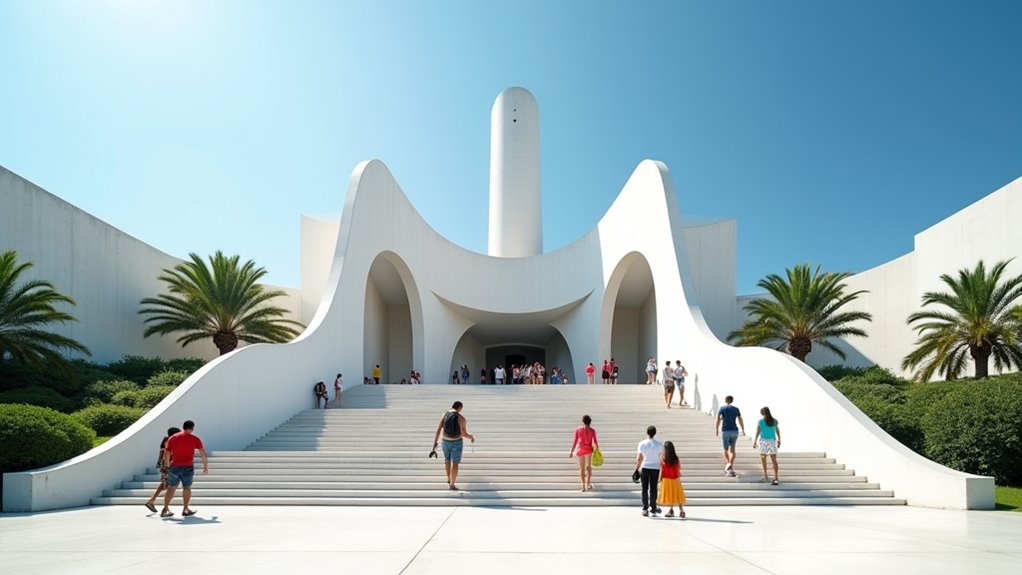
Beyond Lake Paranoá’s natural beauty, you’ll discover Brazil’s political transformation at the Juscelino Kubitschek Memorial, where Oscar Niemeyer’s striking curved architecture houses the tomb and legacy of Brasília’s visionary founder.
The 30-meter statue of JK symbolically salutes his greatest achievement—this modernist capital city.
Inside, you’ll explore extensive exhibits documenting Brasília’s construction and Kubitschek’s ambitious “50 years in 5” development program. Interactive multimedia totems let you research digitized documents, while a holographic projection of JK narrates key episodes from his presidency.
The memorial preserves his 3,000-volume personal library, presidential artifacts, and even his 1973 Ford Galaxie. The white marble exterior creates a minimalist facade that reflects Niemeyer’s architectural philosophy.
The dim, reverent interior creates a contemplative atmosphere perfect for understanding how Brasília reshaped Brazil‘s national integration.
Plan 1-2 hours for this essential cultural experience.
Escape to Brasília National Park for Cerrado Landscapes and Natural Pools
Just twenty-five kilometers north of Brasília’s modernist core, Brasília National Park unfolds across 423 square kilometers of pristine Cerrado savanna—South America’s largest tropical grassland ecosystem. You’ll traverse rolling hills reaching 1,050 meters above sea level, discovering diverse habitats from open grasslands to dense cerradão brush and gallery forests that ribbon along waterways.
The park’s crown jewel is the Água Mineral pools—crystal-clear, spring-fed swimming areas surrounded by native vegetation. These natural pools provide invigorating respite after hiking trails that showcase the Cerrado’s remarkable biodiversity, home to one-third of Brazil’s species.
You’ll cross multiple plant communities and altitudinal gradients while exploring headwaters of the Santa Maria and Torto rivers, essential sources for Brasília’s water supply. The park serves as a vital refuge for threatened species like the maned wolf and giant anteater, both struggling with habitat loss across the Cerrado biome.
The Sum Up
You’ll discover Brasília isn’t just Brazil’s political capital—it’s an architectural masterpiece waiting to be explored. From Niemeyer’s concrete curves to the vast cerrado wilderness, you’ve got endless opportunities to experience this UNESCO World Heritage city. Don’t rush through the highlights; take time to appreciate the modernist vision that shaped this unique urban landscape. Whether you’re drawn to politics, architecture, or nature, Brasília will exceed your expectations and leave you planning your return visit.