
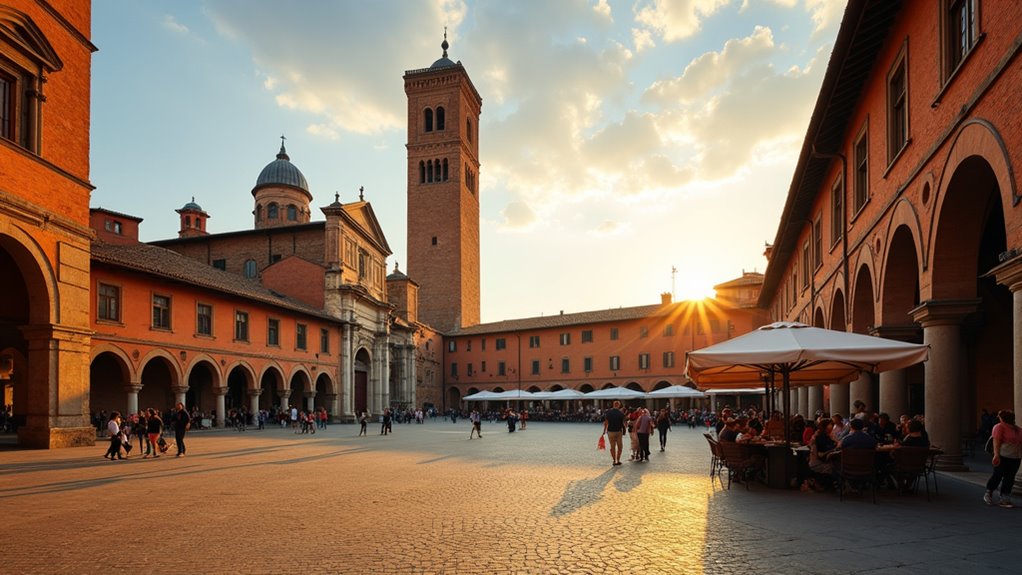
You’ll find Bologna isn’t just another Italian city on your tourist checklist—it’s a living museum where ancient porticos shelter bustling markets, medieval towers pierce crimson skylines, and underground ruins whisper stories from Rome’s golden age. Whether you’re scaling the leaning Asinelli Tower or hunting for perfect tortellini in cobblestone alleys, this Renaissance jewel offers experiences that’ll challenge everything you thought you knew about Italian destinations. Here’s what awaits when you step beyond the guidebook basics.
- Stand in Awe at Piazza Maggiore, Italy’s Most Perfect Medieval Square
- Climb the Asinelli Tower for Bologna’s Best Rooftop Views
- Walk the World’s Longest Portico to San Luca Sanctuary
- Hunt for Tortellini and Mortadella in the Quadrilatero Market
- Marvel at the Unfinished Basilica Di San Petronio
- Discover Ancient Roman Ruins Below Salaborsa Library
- Explore the Seven Churches of Santo Stefano Complex
- Study Renaissance Anatomy at the Archiginnasio Theatre
- Wander Through Bologna’s Endless Covered Walkways
- Browse World-Class Art at the National Gallery and MAMbo
- Watch the Fountain of Neptune Come Alive at Sunset
- The Sum Up
Stand in Awe at Piazza Maggiore, Italy’s Most Perfect Medieval Square
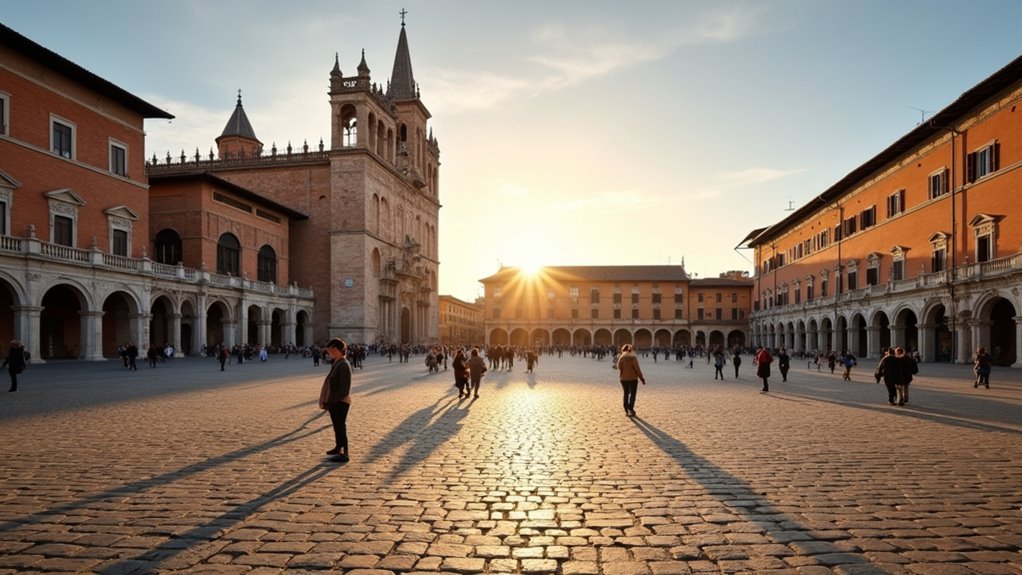
When you first step into Piazza Maggiore, you’ll understand why it’s considered Italy’s most perfect medieval square. Established in the 13th century, this expansive space represents one of medieval Italy’s most ambitious urban projects, designed to centralize government and market activities after the Roman Empire’s fall.
You’ll find yourself surrounded by architectural treasures spanning centuries. The Gothic Palazzo d’Accursio houses Bologna’s current city hall, while the ancient Palazzo del Podestà dates to 1200. Don’t miss the unfinished Basilica of San Petronio, whose incomplete facade tells stories of papal conflicts and funding struggles.
The magnificent Fountain of Neptune commands attention with Giambologna‘s Renaissance masterpiece symbolizing Bologna’s civic pride. The square was historically known as il Pavaglione for centuries, serving as a bustling hub for the silkworm trade. Today, you’ll experience the square’s living heritage as locals gather here just as they’ve done for over 700 years.
Climb the Asinelli Tower for Bologna’s Best Rooftop Views
After soaking in the grandeur of Piazza Maggiore, you’ll want to gain a bird’s-eye perspective of the medieval cityscape you’ve just explored. The Asinelli Tower, Italy’s tallest leaning medieval tower at 97.2 meters, offers Bologna’s most spectacular rooftop views.
You’ll climb 498 wooden steps through narrow, sometimes humid conditions to reach the summit—a physically demanding but rewarding ascent.
From the top, you’ll enjoy 360-degree panoramic views over Bologna’s historic center, including the Quadrilatero district and the city’s remaining medieval towers. The experience is best on clear days when visibility extends across the surrounding landscape. The climb is organized in groups, ensuring you won’t experience crowding on the narrow medieval stairs.
Located at Piazza di Porta Ravegnana, entrance costs €3-5. Be cautious on humid days when handrails become slippery, and remember the local legend that students who climb never graduate!
Walk the World’s Longest Portico to San Luca Sanctuary
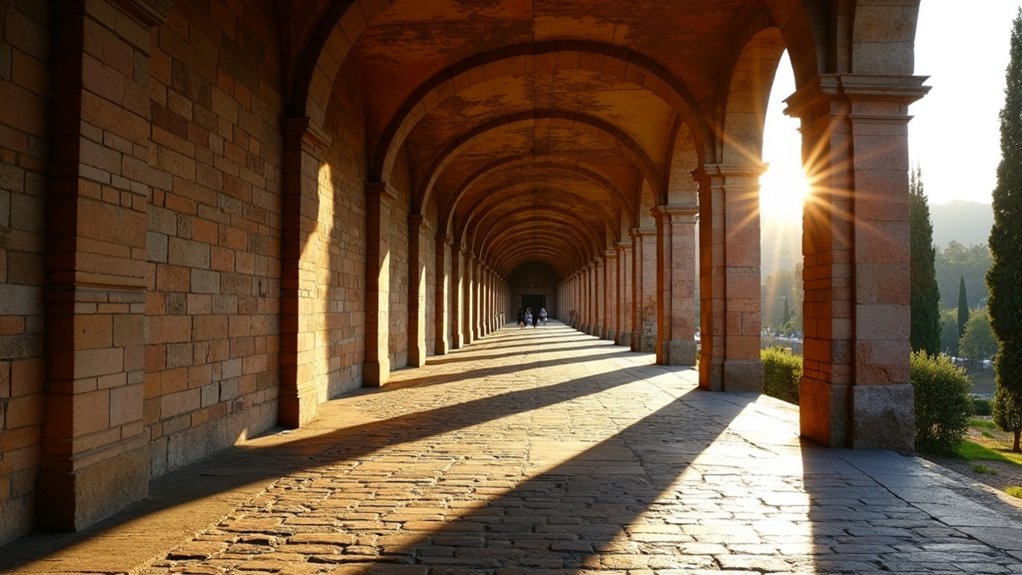
Though you’ve already conquered Bologna’s tallest tower, the city’s most remarkable architectural achievement awaits on its outskirts—the Portico di San Luca, the world’s longest covered walkway stretching 3.8 kilometers uphill to a stunning hilltop sanctuary.
Starting at Porta Saragozza, you’ll walk beneath 666 arches that wind up Colle della Guardia like a symbolic snake. The first half feels manageable, but expect a moderate workout as the incline steepens considerably. Budget 75-105 minutes for the complete journey, passing 15 small chapels along the way.
At the summit, you’ll reach the baroque Sanctuary housing the revered Black Madonna. Built between 1674-1793 to protect pilgrims carrying sacred icons, this covered pathway offers year-round shelter and remains Bologna’s most spiritually significant walk. Since 2021, this magnificent portico joined Bologna’s other historic walkways as a UNESCO World Heritage Site, recognizing its extraordinary cultural and architectural value.
Hunt for Tortellini and Mortadella in the Quadrilatero Market
Back in Bologna’s historic center, your appetite for authentic flavors leads you straight to the Quadrilatero Market, where the city’s most celebrated foods—tortellini and mortadella—await discovery in centuries-old shops.
Navigate the medieval streets of Via Clavature, Via Pescherie Vecchie, Via Drapperie, and Via degli Orefici, where family-run businesses have preserved culinary traditions for generations. Stop at Salsamenteria Tamburini, operating since 1860, for premium mortadella sliced to perfection.
Watch artisans at Paolo Atti e Figli craft handmade tortellini using recipes passed down through families.
You’ll find shopkeepers enthusiastic to share their expertise—ask for recommendations on the best mortadella cuts or fresh pasta varieties. Sample aged cheeses at La Vecchia Malga, then grab aperitivos while surrounded by the market’s distinctive medieval architecture and bustling atmosphere. The stores maintain their original interior design elements, creating an authentic atmosphere that transports visitors back through centuries of Bolognese commercial heritage.
Marvel at the Unfinished Basilica Di San Petronio
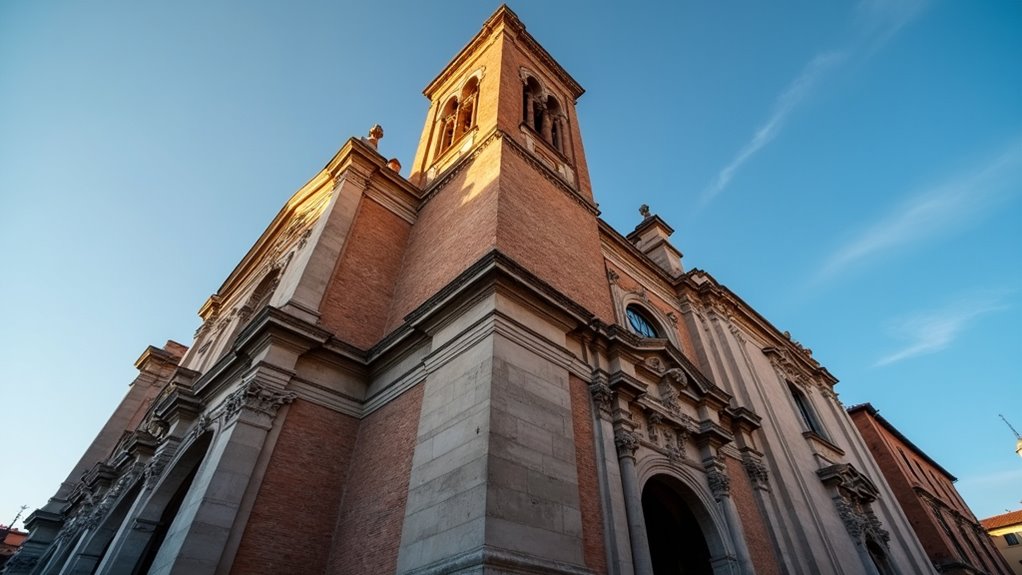
While you’re still savoring the flavors from your market adventure, Bologna’s architectural crown jewel beckons just steps away—the magnificent yet perpetually unfinished Basilica di San Petronio. You’ll immediately notice its striking facade—elegant marble covering the lower half while exposed brick dominates above, creating a fascinating dichromatism that tells Bologna’s tumultuous history.
Step inside this Gothic masterpiece to discover soaring 44-meter vaulted ceilings and 22 ornately decorated chapels featuring Renaissance works by Francesco Francia and Lorenzo Costa. Look down as you walk through the nave to spot the remarkable 67-meter bronze meridian line created by astronomer Giovanni Domenico Cassini in 1655, which tracks the sun’s position throughout the year.
The basilica’s ambitious original plans would’ve surpassed St. Peter’s Basilica, but financial constraints and political upheavals halted construction for centuries.
Don’t miss the 62-meter bell tower, where ‘la scolara’ bell once summoned university students to lectures, perfectly embodying Bologna’s blend of civic pride and scholarly tradition.
Discover Ancient Roman Ruins Below Salaborsa Library
After marveling at Bologna’s Gothic grandeur above ground, you’ll discover an equally mesmerizing journey awaits beneath your feet at the Salaborsa Library. Located in historic Palazzo d’Accursio on Piazza Maggiore, this modern library sits atop ancient Roman ruins from the 2nd-3rd centuries BC.
You’ll walk across crystal-clear glass floors revealing remarkably preserved archaeological remains below. Descend the stairs to explore the excavated area up close, where metal walkways guide you past a Roman domus, public baths, three ancient wells, and an intricate sewage system.
The stratified layers showcase continuous habitation from Villanovan civilization through Etruscan Felsina to Roman Bononia. The deepest layers may reveal evidence of settlements that predate Bologna’s official Roman founding.
Bilingual signs explain each discovery, while the timeline exhibition provides essential historical context for this unique blend of ancient heritage and contemporary library services.
Explore the Seven Churches of Santo Stefano Complex
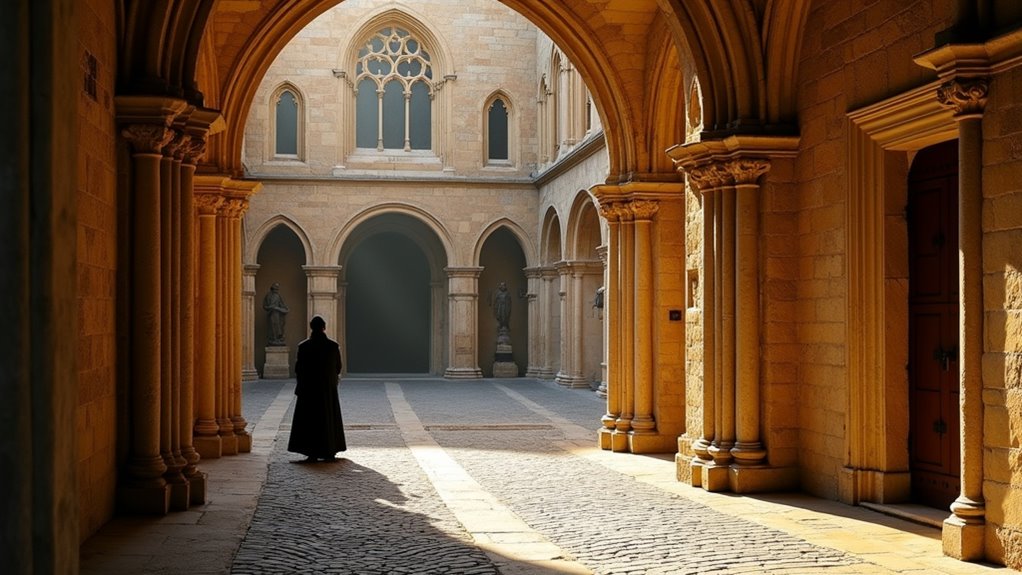
From the underground marvels beneath Salaborsa, you’ll find another extraordinary layered experience awaits just a short walk away at the Santo Stefano complex.
You’ll discover Bologna’s “little Jerusalem” – a remarkable fusion of seven churches built over Roman temple ruins dedicated to the goddess Isis. The polygonal Church of the Holy Sepulchre mirrors Jerusalem’s sacred site, while the Church of Saints Vitale and Agricola houses Bologna’s first martyrs from 305 A.D.
Walk through the medieval “Basin of Pilate” courtyard and explore the two-level cloister with its haunting Romanesque-Gothic capitals. You’ll witness over a millennium of architectural evolution, from 8th-century foundations to 13th-century additions. The complex features distinctive cubic Lombard-style capitals and colorful mosaic patterns that showcase centuries of artistic craftsmanship.
Medieval frescoes depicting Saint Stephen’s martyrdom create an immersive pilgrimage experience without leaving Bologna.
Study Renaissance Anatomy at the Archiginnasio Theatre
Where else can you witness centuries of medical history carved into wood while standing in Europe’s most stunning Renaissance anatomy theater? You’ll discover the Archiginnasio Theatre, where medical students once crowded into tiered wooden seats to observe dissections on the central white marble table.
Look up at Apollo surrounded by constellation carvings on the coffered ceiling, then admire twelve life-size statues of legendary physicians like Hippocrates and Galen lining the walls. Don’t miss the famous “Spellati”—eerily realistic skinned figures sculpted by Ercole Lelli that support the professor’s canopy.
Built in 1637 by Antonio Levanti, this spruce wood amphitheater perfectly captures Renaissance ideals where art and science beautifully merged into unforgettable educational theater. The theatre was meticulously rebuilt after WWII damage using original pieces carefully recovered from the rubble.
Wander Through Bologna’s Endless Covered Walkways
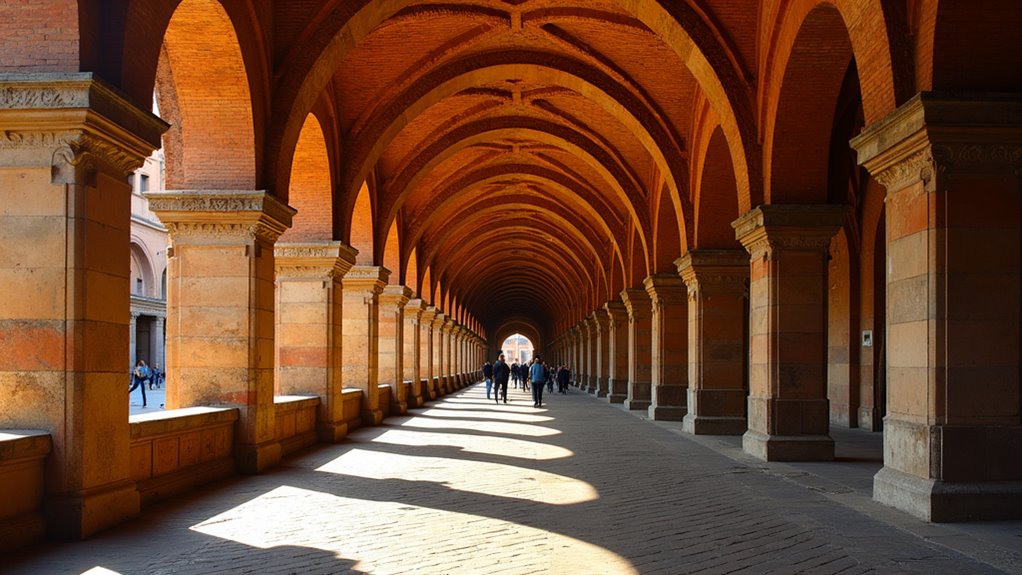
When you step onto Bologna’s streets, you’ll find yourself beneath one of the world’s most extraordinary urban features—nearly 62 kilometers of covered walkways that have sheltered residents and visitors for over nine centuries. These porticoes began in the 11th century when the University of Bologna’s growing student population needed more housing.
Clever residents extended their upper floors over the streets while maintaining public walkways below. You’ll discover remarkable architectural variety as you wander—from medieval wooden arches to ornate stone designs and modern concrete structures.
The walkways protect you from rain and blazing sun while connecting cafes, shops, and historic sites. These magnificent porticoes have earned Bologna recognition as a UNESCO World Heritage site for their exceptional cultural and architectural significance. Don’t miss the legendary Portico di San Luca, stretching nearly four kilometers with 666 arches leading to a hilltop sanctuary—the world’s longest portico.
Browse World-Class Art at the National Gallery and MAMbo
After exploring Bologna’s architectural wonders beneath the porticoes, you’ll want to discover the city’s vibrant art scene at two exceptional museums. MAMbo stands out as Italy’s leading experimental contemporary art hub, housed in a renovated bakery building since 2007.
You’ll find Italian post-war movements like Arte Povera alongside works by international artists including Keith Haring and Marina Abramović.
Don’t miss the world’s largest Giorgio Morandi collection, featuring over 250 works spanning his entire career. The museum regularly rotates temporary exhibitions, from installation art to multimedia performances, keeping each visit fresh.
With your Bologna Welcome Card, admission’s free, making it an accessible cultural experience. The friendly staff and educational programs enhance your understanding of Italy’s artistic evolution from 1945 to today. The museum also features a dedicated section called Rilevamenti darchivio that showcases international performance art from the late 1970s and early 1980s.
Watch the Fountain of Neptune Come Alive at Sunset
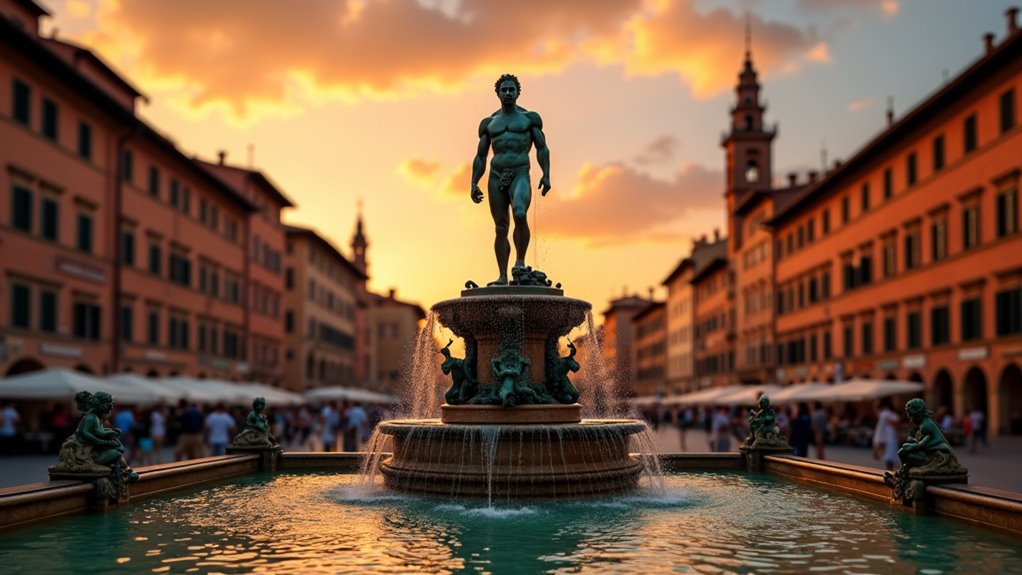
As evening light begins to fade across Piazza del Nettuno, Bologna’s magnificent Fountain of Neptune transforms into one of Italy’s most mesmerizing sunset spectacles. You’ll watch as golden light dances across Giambologna’s towering bronze Neptune, casting dramatic shadows that bring the 16th-century masterpiece to life.
The intricate details become more pronounced—water jets from the four Nereids sparkle like liquid amber, while cherubs holding dolphins catch the dying light.
Position yourself on the fountain’s eastern side for ideal viewing as dusk approaches. The interplay between Renaissance artistry and natural lighting creates an unforgettable atmosphere that draws both locals and visitors. The water originally flowed from the Remonda spring near San Michele in Bosco, connecting this urban masterpiece to Bologna’s natural landscape.
This isn’t just sightseeing—you’re experiencing Bologna’s civic heart where papal symbolism meets Mediterranean romance, making sunset the perfect time to appreciate this Mannerist treasure.
The Sum Up
You’ll discover that Bologna rewards curious travelers who dig beneath its surface. Don’t rush through the highlights—take time to get lost in those covered walkways, linger over aperitivo near the fountain, and strike up conversations with locals in the markets. You’re experiencing a city that’s managed to preserve its medieval soul while embracing modern life. Pack comfortable walking shoes and bring your appetite for both food and history.