
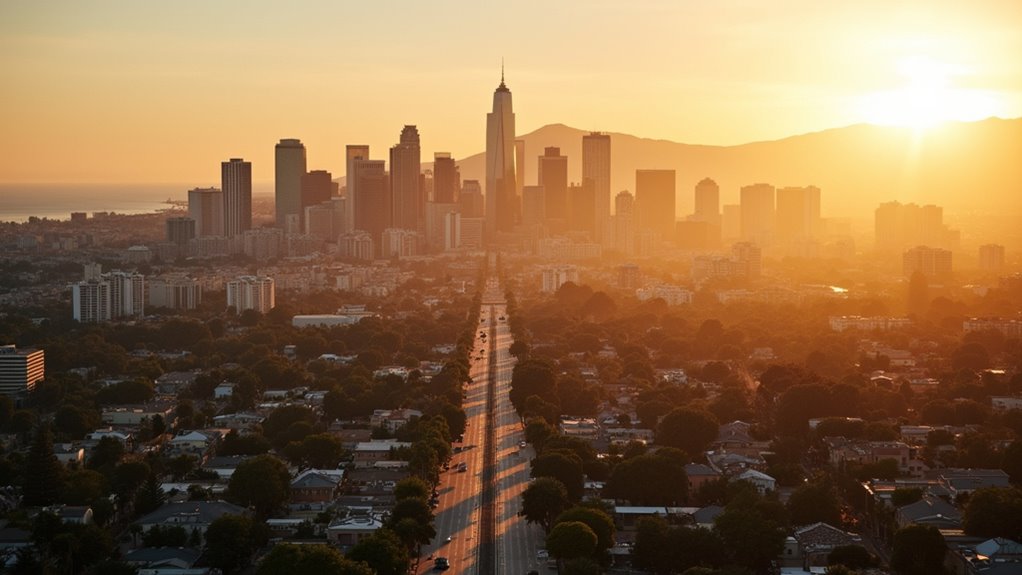
You’ll experience LA’s authentic character by watching paleontologists excavate 50,000-year-old fossils at La Brea Tar Pits, hiking behind the Hollywood Sign at sunrise from Lake Hollywood Park, and riding Santa Monica Pier’s solar-powered Pacific Wheel at sunset. Don’t miss the free telescopes at Griffith Observatory, morning workouts at Venice’s Muscle Beach, and exploring the hidden Venice Canals‘ peaceful waterways. These insider spots reveal the city’s true spirit beyond typical tourist attractions.
- Griffith Observatory and Its Free Telescopes After Dark
- Hiking to the Hollywood Sign From Lake Hollywood Park
- Santa Monica Pier’s Pacific Wheel at Sunset
- Venice Beach’s Morning Muscle Beach Scene
- Getty Center’s Architecture and City Views
- LACMA’s Urban Light Installation for Photos
- Universal Studios’ Backlot Tour Behind the Scenes
- Hollywood Walk of Fame’s TCL Chinese Theatre Forecourt
- La Brea Tar Pits’ Active Fossil Excavation
- Grand Central Market’s Downtown Food Scene
- The Original Farmers Market’s Historic Food Stalls
- Rodeo Drive’s Window Shopping and People Watching
- Venice Canals’ Hidden Waterway Neighborhood
- The Sum Up
Griffith Observatory and Its Free Telescopes After Dark
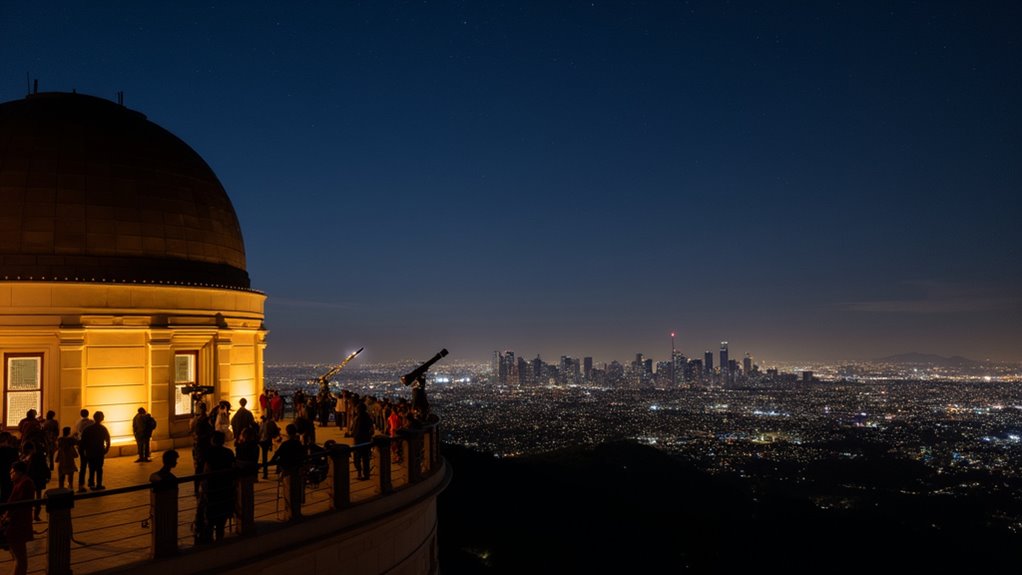
Why spend hundreds on fancy stargazing tours when you can peer through professional-grade telescopes for free? Griffith Observatory offers complimentary telescope viewing every evening it’s open, weather permitting. You’ll access their historic 12-inch Zeiss refracting telescope, installed in 1935, plus up to four portable telescopes on clear nights.
Arrive by 7:00 p.m. when public observing begins, but don’t wait too long—lines cut off around 9:30 p.m. You’ll see the Moon, visible planets, and bright deep-sky objects through high-quality optics that can serve 600 visitors nightly. Even during overcast conditions, you can still visit the Zeiss telescope as an exhibit.
Parking’s paid and limited, so consider rideshare. The building closes at 10:00 p.m., with knowledgeable demonstrators operating all instruments. The observatory maintains wheelchair-accessible telescopes to ensure all visitors can enjoy the celestial experience.
Hiking to the Hollywood Sign From Lake Hollywood Park
Though countless travelers snap photos from Griffith Observatory’s distant viewpoints, you’ll get dramatically closer to those iconic white letters by hiking the Mount Lee trail from Lake Hollywood Park.
Start at 3160 Canyon Lake Drive, where you’ll find free street parking and the closest legal frontal view of the sign.
The moderately challenging 4.6-mile round trip takes 2-3 hours with 1,700 feet of elevation gain.
Walk uphill on Innsdale Drive, pass through the pedestrian gate (open sunrise to sunset), and follow Mount Lee Drive’s paved service road to the summit behind the Hollywood Sign.
Bring water and start early—there’s little shade on the exposed upper sections. For the most rewarding experience, arrive around 5 am to witness the sunrise behind the sign in peaceful solitude.
You’ll enjoy panoramic city views and that perfect behind-the-sign photo opportunity.
Santa Monica Pier’s Pacific Wheel at Sunset
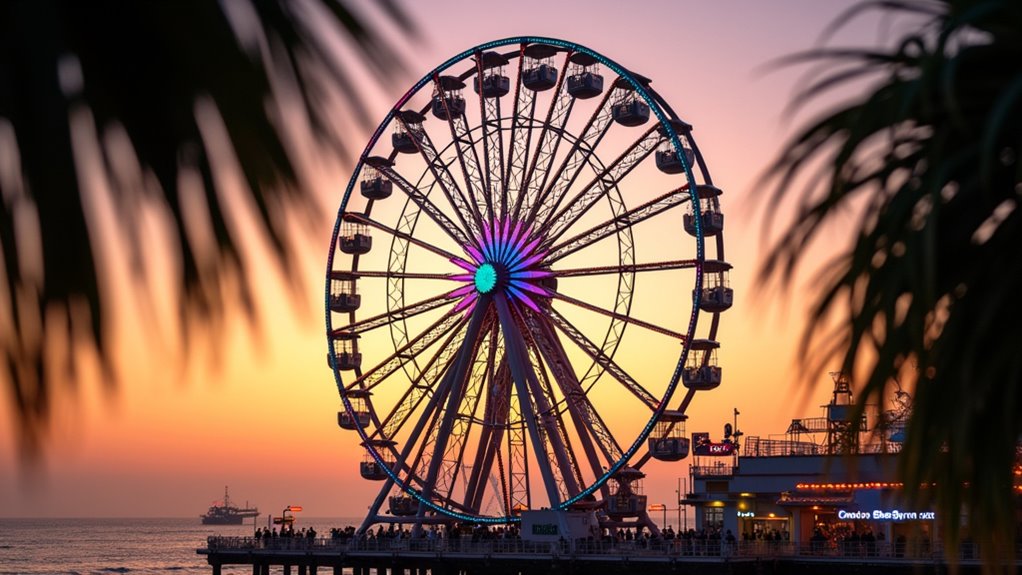
While countless attractions compete for your attention along Santa Monica Pier, the Pacific Wheel offers the best sunset views on the entire coastline. This 85-foot observation wheel lifts you 130 feet above the pier, providing unobstructed views of Santa Monica Bay and the Pacific Ocean.
Time your visit around sunset when the wheel’s 160,000 LED lights create dynamic shows against the colorful sky.
The wheel operates on solar power, making it environmentally friendly and cost-effective for extended hours. Each gondola holds up to six adults, and you’ll need at least 42 inches in height to ride. The wheel can accommodate up to 800 riders per hour, ensuring steady movement through the queue even during busy periods.
At $1.5-1.8 million to build, this isn’t just a carnival ride—it’s a premium experience that’s become an iconic symbol of LA’s coastline.
Venice Beach’s Morning Muscle Beach Scene
Before the Venice Beach boardwalk erupts into its famous chaos of street performers and vendors, you’ll discover the authentic heart of California’s fitness culture at Muscle Beach Venice. Hit this iconic outdoor gym between 6:30-9:30 a.m. when serious athletes dominate the weight pen and marine layer fog creates perfect workout conditions.
You’ll train alongside locals using free weights, squat racks, and the adjacent calisthenics area with its pull-up bars and rings.
The morning’s cooler temperatures (mid-50s to mid-60s) and quieter atmosphere let you focus without tourist crowds. Since 1951, this fenced outdoor facility has housed legendary bodybuilders like Schwarzenegger. This legendary spot serves as a living community where fitness enthusiasts continue the decades-old tradition of strength training by the ocean.
Grab a day pass through LA Recreation and Parks – it’s budget-friendly access to bodybuilding history.
Getty Center’s Architecture and City Views
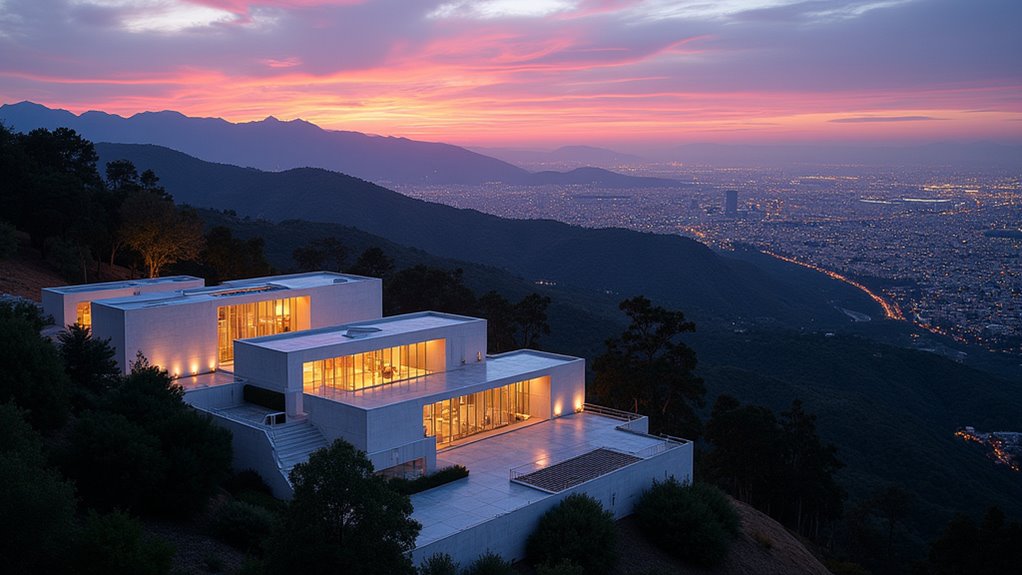
After working up a sweat at Venice Beach, you’ll want to head inland and upward to the Getty Center, where Richard Meier’s architectural masterpiece sits 900 feet above the 405 freeway like a modern-day acropolis.
You’ll immediately notice the travertine stone and curved aluminum panels that create striking geometric forms across the hilltop campus.
The five museum pavilions are arranged chronologically—start at the North Pavilion with older works and move toward the West Pavilion for newer pieces.
Don’t miss the computer-controlled skylights that bathe the upper galleries in natural light.
The outdoor terraces and glass bridges offer spectacular views of Los Angeles and the Santa Monica Mountains, making this free museum experience unforgettable. The entire complex is built on two intersecting grids that follow the natural ridgelines, creating a harmonious blend of architecture and landscape.
LACMA’s Urban Light Installation for Photos
Since LACMA’s Urban Light installation sits right on Wilshire Boulevard and costs nothing to visit, you’ll want to make this your next stop for one of LA’s most Instagram-worthy photo opportunities.
This forest of 202 restored 1920s street lamps creates stunning photos day or night, but evening shots are spectacular when all 309 bulbs illuminate at dusk.
You’ll find 16 different lamppost designs with varied ironwork perfect for close-ups, while the dense arrangement creates shifting patterns depending on your angle. The authentic lamps were collected from neighborhoods across Southern California and carefully restored by artist Chris Burden.
The LED bulbs provide consistent white light that’s ideal for portraits.
Since it’s one of LA’s most photographed landmarks, arrive early evening for the best lighting and fewer crowds competing for that perfect shot.
Universal Studios’ Backlot Tour Behind the Scenes
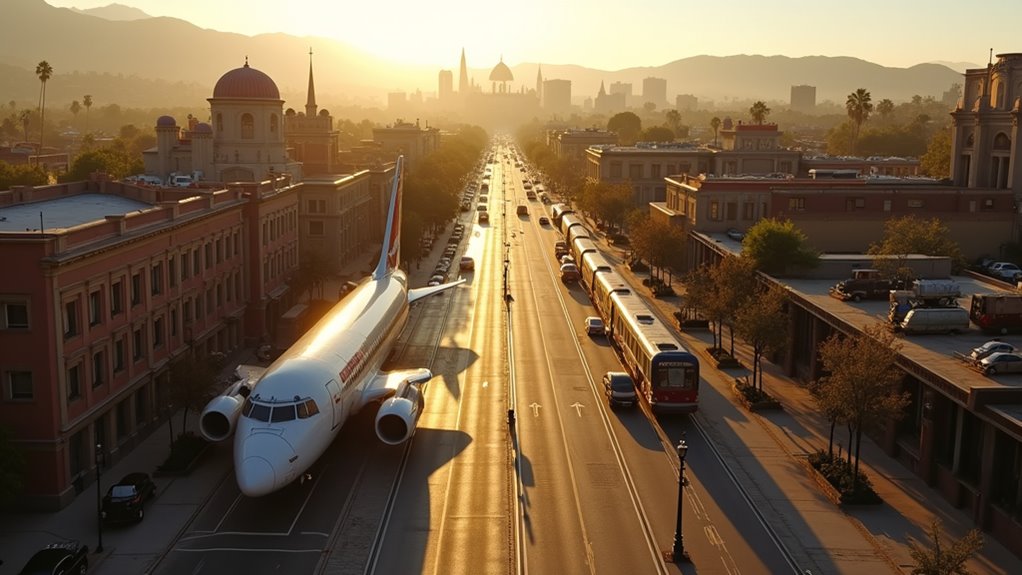
Want to peek behind Hollywood’s movie magic without breaking the bank? Universal Studios’ Backlot Tour delivers authentic behind-the-scenes access that’s included with your general admission—no extra fees required. This 45-60 minute tram ride takes you through active soundstages where real movies and TV shows are filming.
You’ll recognize iconic sets like Hill Valley’s courthouse from *Back to the Future* and the Psycho house. The tour features practical effects demonstrations including King Kong 360 3-D, earthquake simulations, flash floods, and the classic Jaws encounter.
Don’t miss the massive plane crash set from *War of the Worlds* and the newly-added Jupiter’s Claim western set from *Nope*. The studio tour has been operating since 1915, making it one of Hollywood’s longest-running attractions.
Since it’s a working studio, each tour varies based on current productions, making every visit unique.
Hollywood Walk of Fame’s TCL Chinese Theatre Forecourt
Moving from soundstages to sidewalks, you’ll find Hollywood’s most photographed pavement just a few miles away at TCL Chinese Theatre’s forecourt. This free attraction showcases nearly 200 celebrity handprints, footprints, and signatures dating back to 1927.
You’ll spot icons like Marilyn Monroe, Tom Hanks, and Judy Garland immortalized in cement blocks across the forecourt.
The tradition began when Norma Talmadge accidentally stepped into wet cement, inspiring what’s become Hollywood’s most enduring tourist magnet.
Beyond typical handprints, you’ll discover unique imprints like Betty Grable’s legs, Jimmy Durante’s nose, and even hoofprints from famous horses like Roy Rogers’s Trigger.
The 40-foot curved walls frame this open-air museum perfectly, making it an essential stop that won’t cost you anything. The theatre itself features elaborate Chinese-style architecture designed by Sid Grauman when it originally opened in 1927.
La Brea Tar Pits’ Active Fossil Excavation
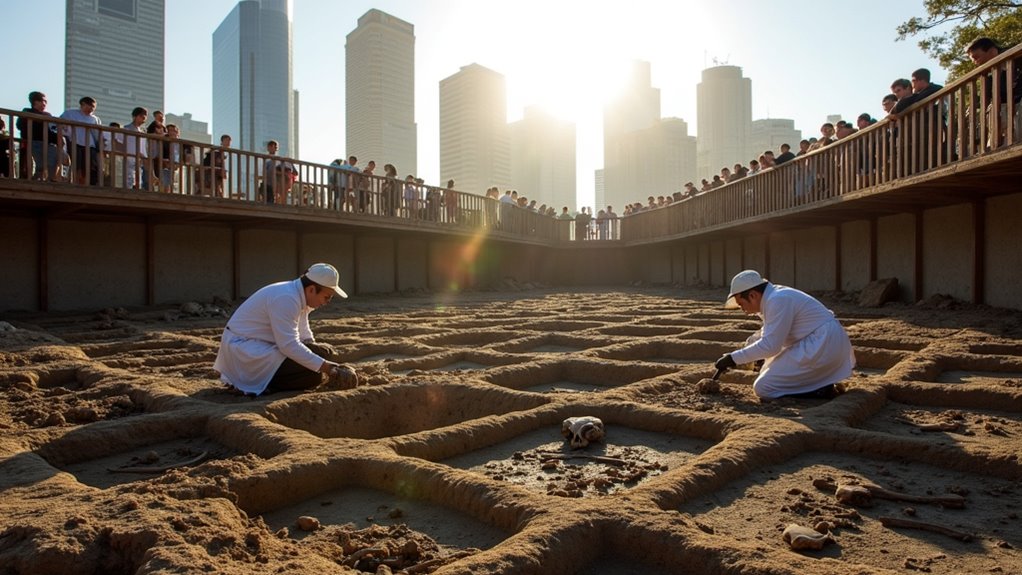
While most museums display fossils behind glass, La Brea Tar Pits lets you watch paleontologists uncover Ice Age treasures in real time. You’ll find two active dig sites: Pit 91 and Project 23, both viewable from designated observation areas in central LA’s Hancock Park.
Watch excavators use dental picks and small brushes to slowly expose 10,000-50,000-year-old bones from dense asphalt. They’re working through 23 massive crates of fossil deposits discovered during parking garage construction—finds expected to double the museum’s already impressive 4-million-specimen collection.
You’ll witness careful grid mapping as crews record each discovery’s exact position. The painstaking process reveals dire wolves, saber-toothed cats, and mammoths that fell into ancient asphalt traps, creating one of the world’s richest Ice Age fossil sites. The site’s discoveries have proven so significant that the Rancholabrean geological period is actually named after this location.
Grand Central Market’s Downtown Food Scene
Since 1917, Grand Central Market has anchored downtown LA’s food scene as a bustling hub where you’ll find 40+ vendors serving everything from traditional Mexican tamales to chef-driven seasonal fare.
Located in the historic Homer Laughlin Building at 317 South Broadway, this 80,000-square-foot market showcases LA’s multicultural culinary landscape through open kitchens and counter seating that encourages communal dining.
You’ll discover legacy produce stalls alongside modern concepts like Sticky Rice’s Thai street food.
The market’s fast-casual format works perfectly for travelers and downtown workers alike. The building itself was LA’s first fireproofed structure, emphasizing the safety and durability that has allowed it to serve the community for over a century.
Parking costs $5 for the first 90 minutes, or you can easily reach it via LA Metro.
The market’s central location puts you within walking distance of other downtown attractions, making it an ideal lunch stop during your Historic Core exploration.
The Original Farmers Market’s Historic Food Stalls
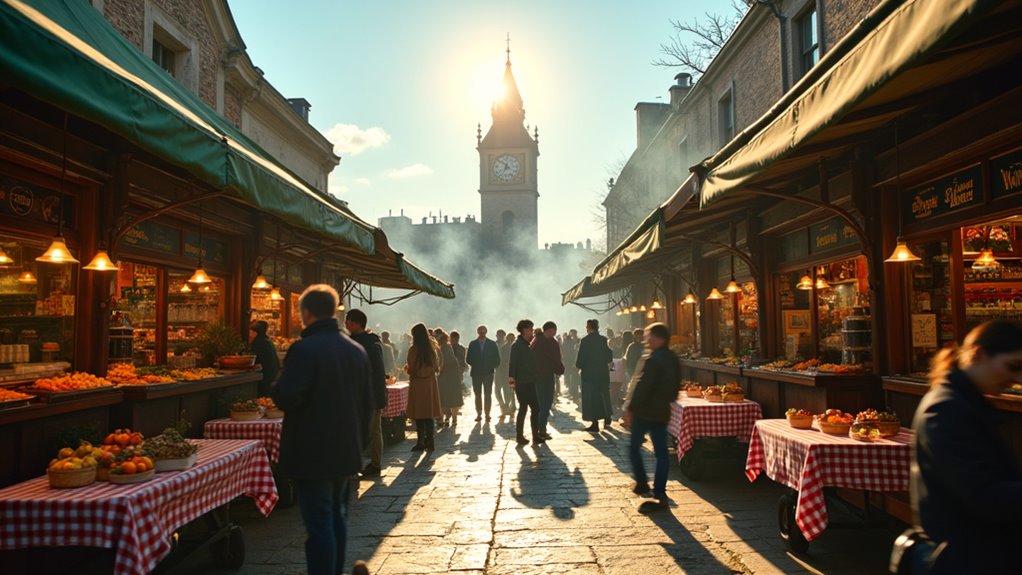
Though it started with just a dozen farmers selling produce from trucks in July 1934, the Original Farmers Market at 3rd and Fairfax has evolved into one of LA’s most enduring culinary destinations.
You’ll find nearly 100 vendors today, from multi-generation family businesses to international food counters. Don’t miss Du-par’s Restaurant & Bakery, serving their famous hotcakes and pies since 1938.
The market’s open-air walkways connect produce stands, butcher shops, bakeries, and casual eateries under colorful shed-style roofs. It’s both tourist attraction and local hangout where you can grab everyday staples alongside exotic ingredients.
The site originally functioned as a dairy farm owned by Arthur Gilmore in the 1880s before transforming into the beloved food destination it is today.
The iconic 1948 Clock Tower marks this “carnival” of food that still draws thousands daily.
Rodeo Drive’s Window Shopping and People Watching
From the bustling food stalls of the Original Farmers Market, you can shift gears entirely and head to Beverly Hills’ Rodeo Drive, where window shopping becomes pure entertainment. You don’t need to spend a dime to enjoy this three-block luxury corridor between Wilshire and Santa Monica Boulevard.
You’ll spot dramatic window displays from Chanel, Louis Vuitton, and Cartier that change seasonally like outdoor art galleries. The people-watching rivals any show—international travelers snap photos while luxury cars cruise past and paparazzi hover around celebrity sightings.
Head to Two Rodeo Drive’s cobblestone passages for Instagram-worthy backdrops, or grab coffee at nearby cafés to watch the spectacle unfold. The palm-lined sidewalks buzz with multiple languages and designer shopping bags, creating LA’s most concentrated dose of glamour. These flagship stores primarily serve as high-cost billboards rather than traditional profit centers, designed to showcase brand prestige and marketing power.
Venice Canals’ Hidden Waterway Neighborhood
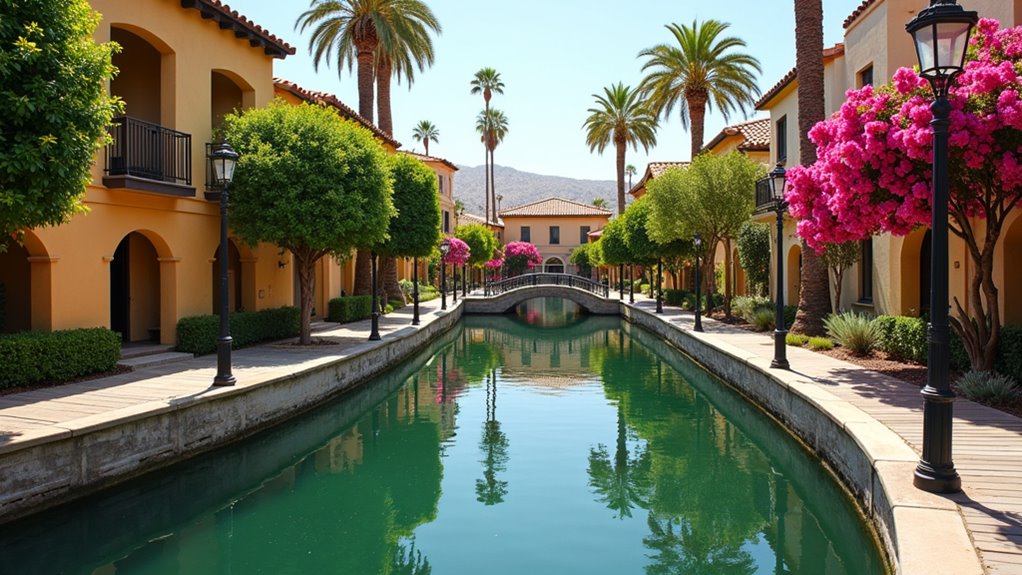
While most visitors flock to Venice Beach’s crowded boardwalk, you’ll discover one of LA’s best-kept secrets just a few blocks inland—the Venice Canals Historic District. These six remaining waterways from the original 1905-1906 development offer a peaceful escape that won’t cost you anything to explore.
You can stroll the pedestrian walkways and cross charming bridges while watching ducks and shorebirds in these tidal wetlands.
The narrow paths wind between architect-designed homes with private docks, creating an unexpectedly serene neighborhood atmosphere. After major restoration in the 1990s, the canals showcase how residential development can integrate beautifully with urban waterways. The canals are naturally refreshed by tidal cycles, with water entering through sea gates and being trapped for about three days before the next cycle.
It’s free, easily walkable, and provides excellent photo opportunities of this unique California coastal community that few travelers know exists.
The Sum Up
You’ve got an incredible mix of free and low-cost experiences waiting for you in LA. Don’t try cramming everything into one trip—you’ll burn out fast. Pick three or four spots that genuinely interest you and take your time exploring them. Pack snacks, wear comfortable shoes, and remember that many of LA’s best attractions won’t cost you a dime. Your wallet and your feet will thank you later.