
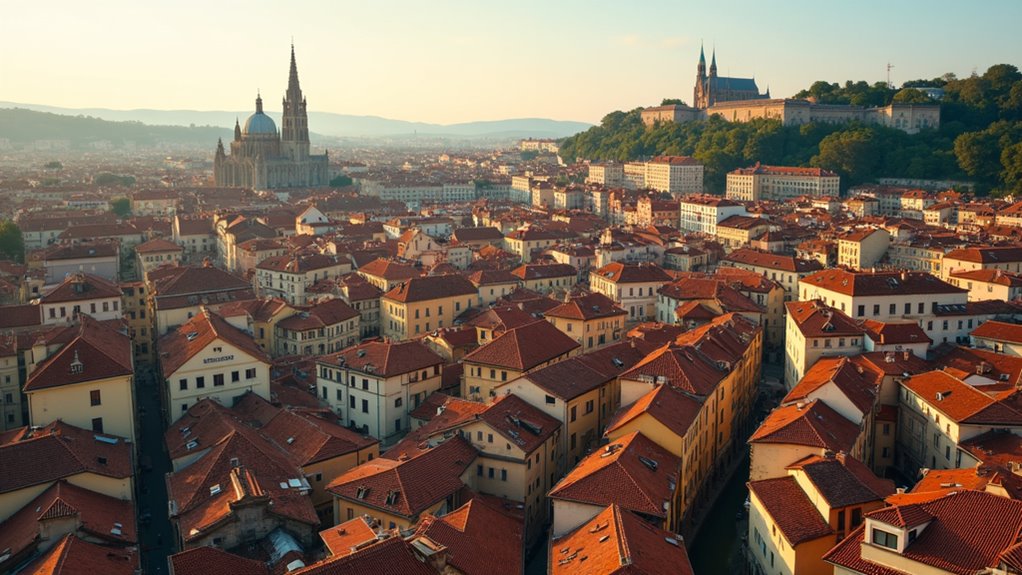
You’ll find Lyon sitting at the crossroads of France’s most enthralling eras—where Roman amphitheaters share space with Renaissance courtyards and cutting-edge museums. This UNESCO World Heritage city doesn’t just showcase its 2,000-year history; it lives and breathes it through hidden passageways, silk-weaving traditions, and culinary innovations that shaped French gastronomy. Whether you’re drawn to ancient stones or modern marvels, Lyon’s got something that’ll surprise you at every turn.
- Wander Through the Renaissance Streets of Vieux Lyon
- Climb Fourvière Hill to See Lyon’s Roman Past
- Step Inside the Basilique Notre-Dame De Fourvière
- Hunt for Traboules in the Old Town
- Explore the Ancient Roman Theaters
- Visit the Striking Musée Des Confluences
- Stroll Across Place Bellecour, Europe’s Largest Pedestrian Square
- Discover Art Treasures at the Musée Des Beaux-Arts
- Relax in Parc De La Tête D’or
- See the Bartholdi Fountain at Place Des Terreaux
- Tour the Gothic Cathédrale Saint-Jean-Baptiste
- Browse Local History at Musée Gadagne
- The Sum Up
Wander Through the Renaissance Streets of Vieux Lyon
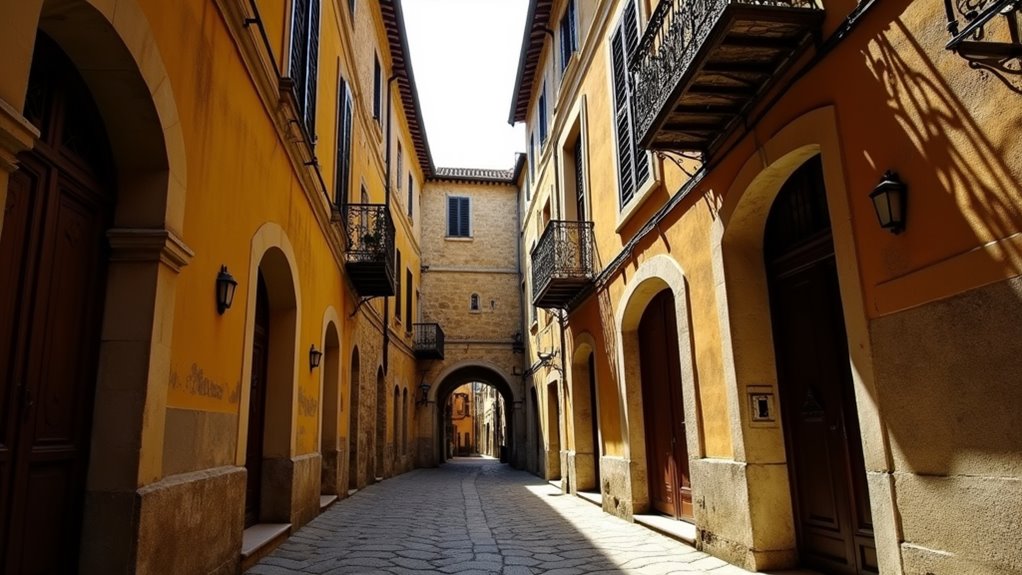
When you step into Vieux Lyon, you’re entering Europe’s largest Renaissance district, where pastel-colored façades and intricate stonework tell the story of 15th and 16th-century prosperity.
You’ll discover three distinct neighborhoods: Saint-Jean, centered around the Gothic cathedral and home to clergy; Saint-Paul, where wealthy Italian bankers built grand hôtels particuliers; and Saint-Georges, the riverside quarter of silk weavers and artisans.
Don’t miss exploring the traboules—hidden passageways that wind through buildings and courtyards. These Renaissance-era shortcuts connected streets and facilitated merchant trade.
About 215 still exist today, featuring Roman-inspired patios with galleries and spiral staircases.
Visit Place du Change to see where Renaissance financiers conducted business, making Lyon one of France’s most important commercial centers. This historic district earned recognition as a UNESCO World Heritage Site in 1998 for its exceptional cultural and architectural heritage.
Climb Fourvière Hill to See Lyon’s Roman Past
Though Vieux Lyon showcases Renaissance splendor, Fourvière Hill above reveals Lyon’s much deeper roots as the mighty Roman capital of Lugdunum. You’ll discover extensive ruins from this 43 BCE settlement that once minted Rome’s gold coins and served as Gaul’s political heart.
Start at the remarkably preserved ancient amphitheater, built under Emperor Augustus around 15-20 AD, which seated 10,000 spectators. The nearby Odeon offers another architectural gem worth exploring. Today, both ancient venues host the summer Les Nuits de Fourvière festival, where modern performances take place amid the historic Roman seats.
Wander among remnants of Roman streets, public baths, and massive aqueduct reservoirs that once supplied the thriving city.
Don’t miss the Tombeau de Turpio, showcasing intricate 1st-century stone carvings and Roman burial practices. Red and yellow blocks mark where early Christian basilicas once stood, highlighting Fourvière’s evolution from pagan Roman center to Christian stronghold.
Step Inside the Basilique Notre-Dame De Fourvière
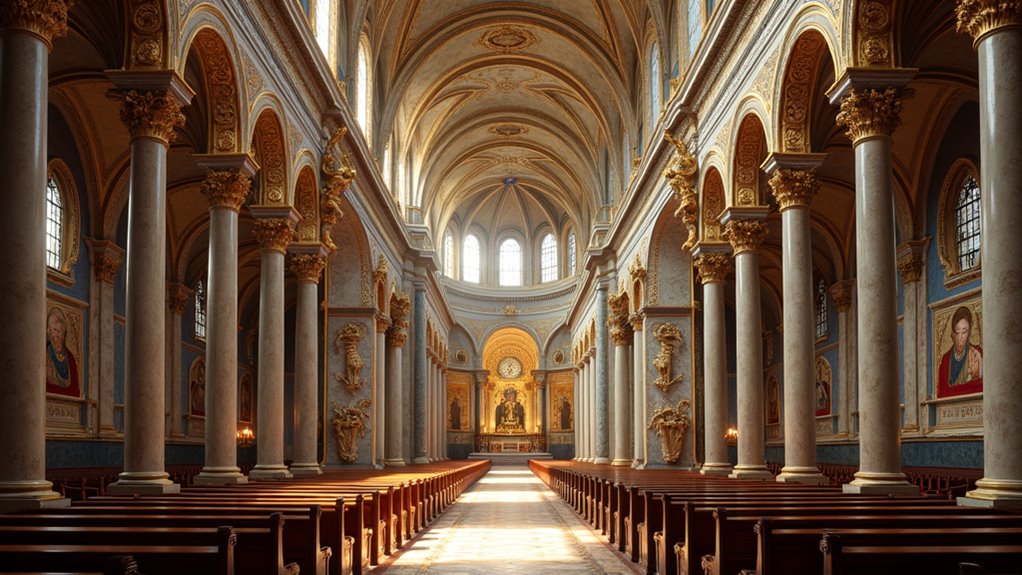
After exploring the Roman ruins scattered across Fourvière Hill, you’ll find Lyon’s most iconic landmark crowning the summit—the magnificent Basilique Notre-Dame de Fourvière. Built between 1872 and 1884 as a thank-you gesture to the Virgin Mary for protecting Lyon during the Franco-Prussian War, this Neo-Byzantine masterpiece offers much more than Instagram-worthy views.
Don’t miss the unique two-level design—start in the atmospheric crypt dedicated to Saint Joseph, then climb the monumental “Escalier de la Sagesse” to reach the upper basilica. You’ll move symbolically from darkness to light, experiencing architect Pierre Bossan’s spiritual journey concept.
Inside, marvel at Joseph Belloni’s intricate mosaics and sixteen polychrome columns from Sieix. The interior’s rich Byzantine-style decorations took decades to complete, making every surface worth examining. The basilica also houses a treasure room located within one of its towers, enhancing the site’s educational and cultural value for visitors.
Hunt for Traboules in the Old Town
As you descend from Fourvière Hill into Vieux Lyon, you’ll discover one of the city’s best-kept secrets hiding in plain sight—traboules, mysterious passageways that tunnel through Renaissance buildings like architectural rabbit holes. These hidden corridors, dating back to the 4th century, originally helped silk workers transport delicate fabrics while staying dry.
Start your hunt in the Saint-Jean, Saint-Paul, and Saint-Georges neighborhoods, where about 40 traboules remain publicly accessible. Look for discreet doorways—many appear locked but open with a gentle push.
You’ll find stunning spiral staircases, elegant galleries, and courtyards that showcase Lyon’s Renaissance wealth. These same passages sheltered French Resistance fighters during WWII, making your exploration both architecturally rewarding and historically profound. This remarkable district spans 424 hectares between Fourvière hill and the Saône River, representing Europe’s most extensive Renaissance neighborhood.
Explore the Ancient Roman Theaters
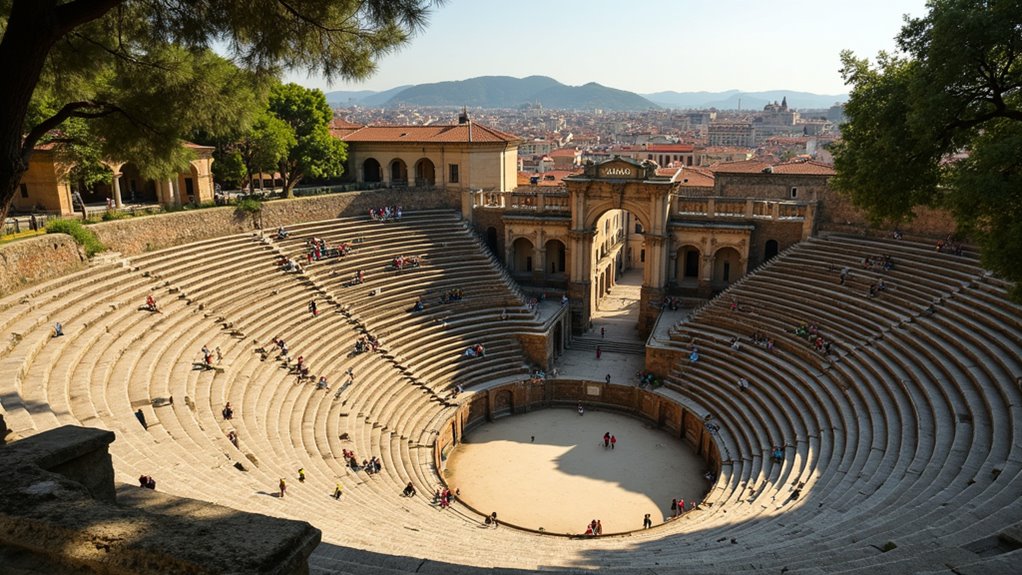
Your journey through Lyon’s hidden passageways naturally leads you back up Fourvière Hill, where Rome’s theatrical legacy awaits in spectacular fashion. The Grand Roman Theatre, built by Emperor Augustus around 17-15 BC, remains France’s oldest Roman theatre and can still seat 10,000 spectators—five times the Garnier Opera’s capacity.
You’ll discover two ancient venues: the massive theatre with its 108-meter diameter and the smaller odeon used for intimate musical performances. Walk the original limestone seating where Romans watched tragedies and comedies nearly 2,000 years ago.
The 30-meter stage wall, decorated with imperial columns, showcases Roman engineering prowess. Behind the theatre, you can explore ruins that possibly belonged to the Temple of Cybele, adding another layer to this remarkable archaeological site.
Today, these UNESCO World Heritage sites host the annual “Les Nuits de Fourvière” festival, proving that great venues never go out of style.
Visit the Striking Musée Des Confluences
When you descend from Fourvière Hill’s ancient stones, Lyon’s most audacious architectural marvel awaits at the city’s watery heart—the Musée des Confluences. This deconstructivist “floating crystal cloud” rises where the Rhône and Saône rivers merge, creating a stunning gateway to Lyon’s reinvented Confluence district.
You’ll discover four permanent exhibitions spanning everything from the Big Bang to human beliefs about eternity. The museum’s 22,000 square meters house dinosaurs, mummies, and samurai armor alongside rotating temporary displays.
Don’t miss the building’s multiple facets—there’s no single “front,” so walk around for constantly shifting perspectives. The structure’s reflective metal casing captures the surrounding sky, water, cityscape, and greenery in its surface, creating an ever-changing visual experience.
Take the metro to Confluence stop for easy access. Your full-day ticket covers all exhibitions, making it perfect for spending an entire afternoon exploring this architectural and cultural gem.
Stroll Across Place Bellecour, Europe’s Largest Pedestrian Square
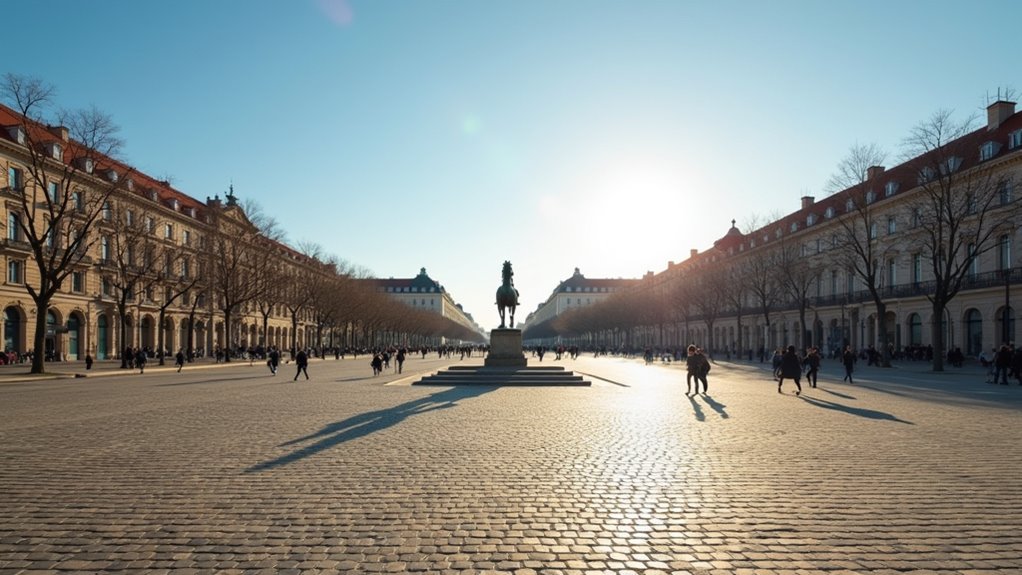
After exploring Lyon’s architectural marvels, you’ll find yourself drawn to the heart of the Presqu’île peninsula, where Place Bellecour stretches before you like a vast red-clay ocean. This pedestrian paradise spans 62,000 square meters, making it Europe’s largest car-free square.
You’ll discover the majestic equestrian statue of King Louis XIV commanding the center, surrounded by elegant 18th-century facades that frame your wandering.
Don’t rush your visit—the sheer size demands comfortable shoes and time to absorb the atmosphere. During December’s Fête des Lumières, the square transforms into a magical light canvas.
Year-round, you’ll find street performers, seasonal markets, and locals relaxing in deck chairs. The square serves as a cultural hub connecting various districts throughout Lyon. It’s Lyon’s social heartbeat, where daily life intersects with tourism seamlessly.
Discover Art Treasures at the Musée Des Beaux-Arts
Once you’ve soaked in the grandeur of Place Bellecour, head to the Musée des Beaux-Arts, where Lyon’s most spectacular art treasures await in a stunning 17th-century former Benedictine abbey.
You’ll discover nearly 2,000 paintings spanning six centuries, from medieval masterpieces to contemporary works. Don’t miss the exceptional Impressionist collection featuring Renoir, Manet, and Monet—one of France’s earliest and most significant holdings.
The museum’s encyclopedic approach groups artists by nationality, making it easy to trace European artistic movements. Look for the Venetian masters like Tintoret and Veronese, plus vibrant Flemish works by Rubens that once inspired Lyon’s silk designers.
The antiquities collection adds fascinating archaeological depth to your cultural journey. As you explore, admire the monumental staircase decorated by P. Puvis de Chavannes in 1881, which serves as a stunning artistic centerpiece of the museum’s architecture.
Relax in Parc De La Tête D’or
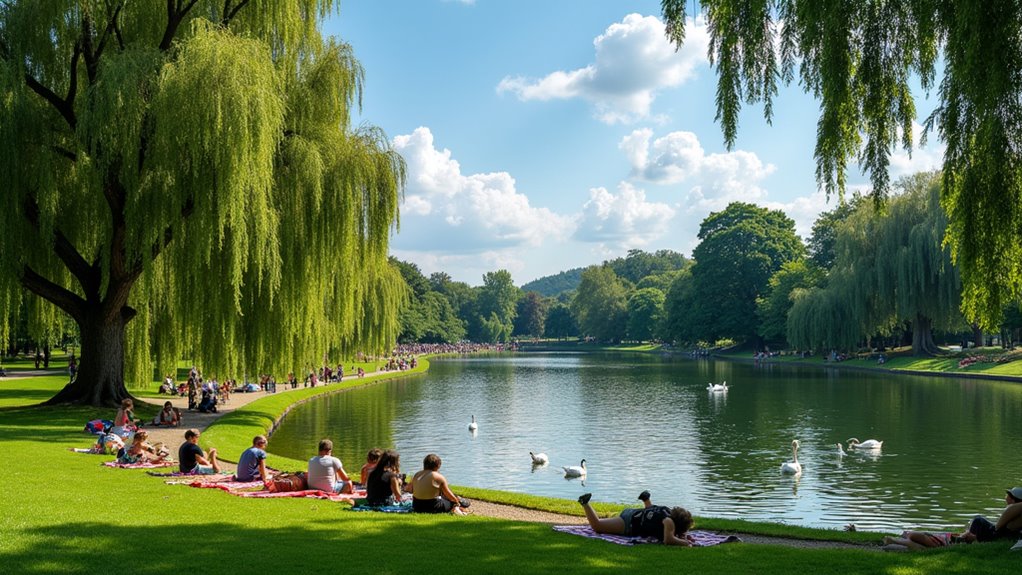
While Lyon’s museums showcase incredible art, you’ll find a different kind of masterpiece at Parc de la Tête d’Or—117 hectares of green sanctuary that’s become the city’s beloved outdoor living room.
You can paddle across the central lake’s 16 hectares, spotting swans and exploring two wooded islands by boat. The free zoo lets you observe giraffes and primates without spending a euro, while the botanical gardens house France’s largest plant collection—20,000 species spread across magnificent 19th-century greenhouses.
Bring the kids for miniature train rides, playgrounds, and traditional Guignol puppet shows. Sports enthusiasts can use the velodrome or boules courts. The park also features La Plaine Africaine, a sprawling African habitat where 130 animals roam in semi-freedom across savannah and wetland zones.
Located in the 6th arrondissement, it’s easily reached via bus lines C1 and C5, making this northern retreat perfectly accessible.
See the Bartholdi Fountain at Place Des Terreaux
Beyond the park’s tranquil greenery, you’ll discover one of Lyon’s most magnificent artistic treasures at Place des Terreaux—the dramatic Bartholdi Fountain that commands attention with its powerful bronze horses and flowing water.
Created by the same sculptor who designed the Statue of Liberty, this stunning fountain depicts France as a woman driving a chariot pulled by four wild horses. While originally designed for Bordeaux, Lyon’s gain is your artistic reward.
Visit during evening hours when the lighting system illuminates the sculpture’s dynamic movement. The fountain’s lead construction creates remarkable realism that restoration experts praised for “bringing life to metal.” This impressive sculpture weighs approximately 21 tonnes and stands as a testament to Bartholdi’s innovative construction techniques.
Located opposite the Museum of Fine Arts, it’s perfectly positioned for combining cultural experiences in Lyon’s vibrant city center.
Tour the Gothic Cathédrale Saint-Jean-Baptiste
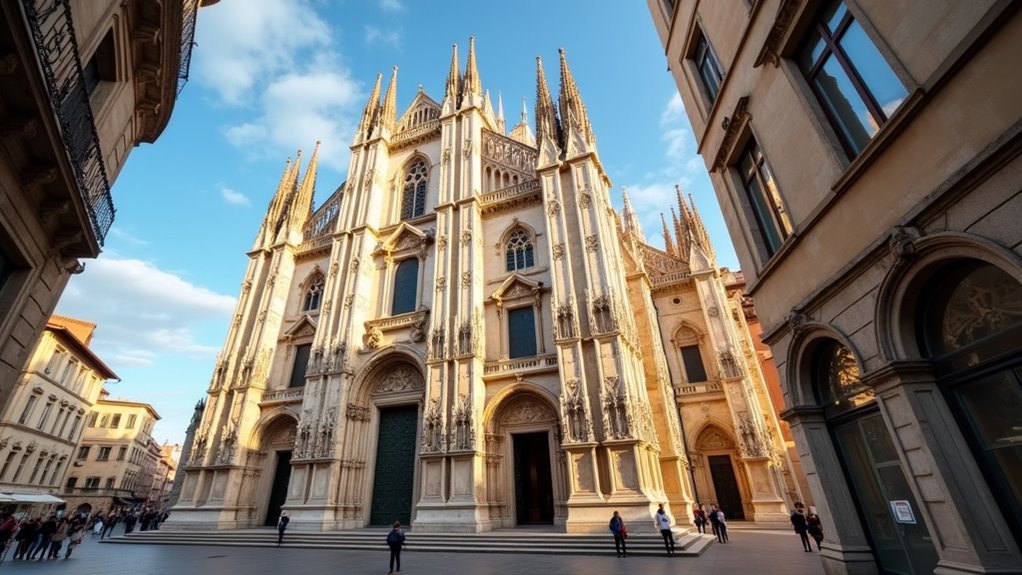
From the artistic grandeur of Place des Terreaux, make your way to Lyon’s spiritual heart at the Gothic Cathédrale Saint-Jean-Baptiste.
Here, over four centuries of construction created one of France’s most architecturally fascinating churches. You’ll discover a stunning blend of Romanesque and Gothic styles, with the Romanesque apse contrasting beautifully against the Gothic nave and façade.
Don’t miss the remarkable 14th-century astronomical clock that displays religious feast days. Explore the exquisite Bourbon Chapel, considered a masterpiece of 15th-century sculpture.
The cathedral’s medieval stained glass windows create spectacular illumination, particularly during spring visits. As a UNESCO World Heritage site and former seat of the “Primate of All the Gauls,” this cathedral offers profound historical significance alongside architectural beauty in Lyon’s charming Vieux Lyon district. The cathedral was built over three earlier churches, with ancient ruins still visible behind the main structure.
Browse Local History at Musée Gadagne
After exploring Lyon’s spiritual heritage, learn about the city’s complete historical narrative at Musée Gadagne. This museum complex occupies Lyon’s largest Renaissance palace.
You’ll discover 80,000 artifacts spanning from ancient Lugdunum through the 19th century across 30 rooms and four floors.
The Museum of Lyon History showcases archaeological treasures, sculptures, and paintings that chronicle the city’s evolution.
Plus, the World Puppet Museum celebrates Lyon’s famous Guignol tradition.
Don’t miss the building itself—this 16th-century Hôtel Gadagne features stunning Renaissance courtyards and galleries. The museum is housed in a historic building that was home to the Gadagne brothers, a wealthy Florentine family who redesigned the palace in 1545.
Take advantage of the rooftop hanging gardens for panoramic views, and use the interactive audioguides to enhance your understanding.
Educational workshops and guided city walks connect museum discoveries with Lyon’s living heritage outside.
The Sum Up
You’ll discover Lyon perfectly balances its ancient Roman heritage with modern French sophistication. Don’t rush through the traboules—they’re living pieces of history where locals still work and live. Save energy for Fourvière Hill‘s climb by taking the funicular, and always carry a reusable water bottle since Lyon’s fountains offer fresh drinking water. The city’s compact size means you can easily walk between major sites, making it ideal for spontaneous exploration and authentic cultural encounters.