
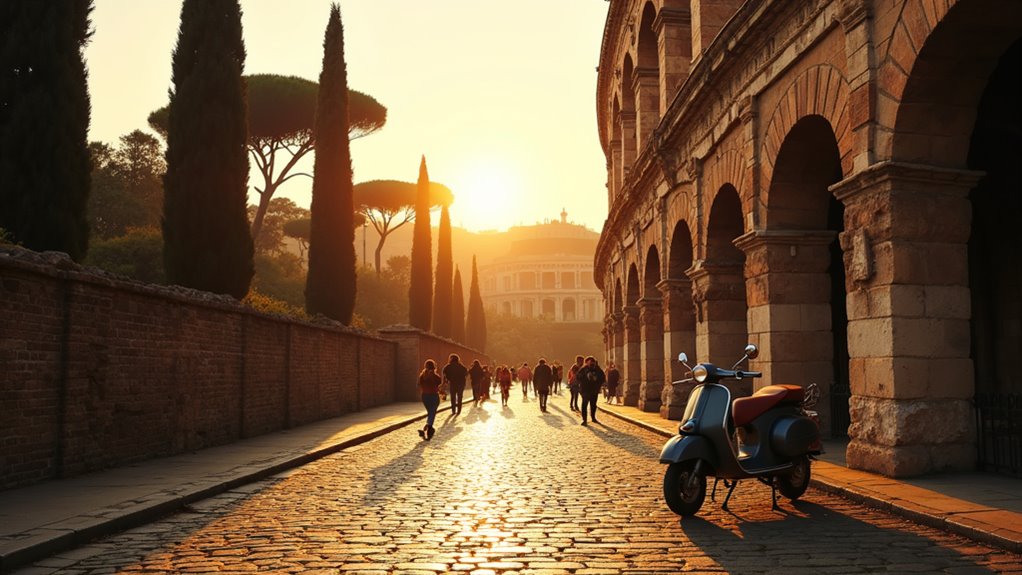
You’ve probably seen Rome’s greatest hits in countless photos, but experiencing them firsthand reveals layers most travelers miss entirely. The city’s ancient stones hold secrets that guidebooks can’t capture—from hidden underground chambers beneath the Colosseum to quiet morning moments in the Vatican before crowds arrive. There’s an art to maneuvering Rome like a local, and it starts with knowing exactly when and how to visit each landmark for maximum impact.
- Walk Through the Colosseum’s Underground Chambers and Arena Floor
- Wander the Roman Forum at Your Own Pace
- Climb Palatine Hill for the Best Views Over Ancient Rome
- Book a Morning Entry to the Vatican Museums and Sistine Chapel
- Stand Under the Pantheon’s Perfect Dome
- Toss a Coin at Trevi Fountain Before 8 AM
- People-Watch in Piazza Navona Over an Aperitivo
- Climb the Spanish Steps to Trinità Dei Monti
- Explore Trastevere’s Narrow Medieval Streets
- Take the Metro to San Giovanni in Laterano
- Visit the Baths of Caracalla Without the Crowds
- Walk Through Villa Borghese to Galleria Borghese
- Discover the Catacombs of San Callisto
- End Your Day at a Local Osteria in Testaccio
- The Sum Up
Walk Through the Colosseum’s Underground Chambers and Arena Floor
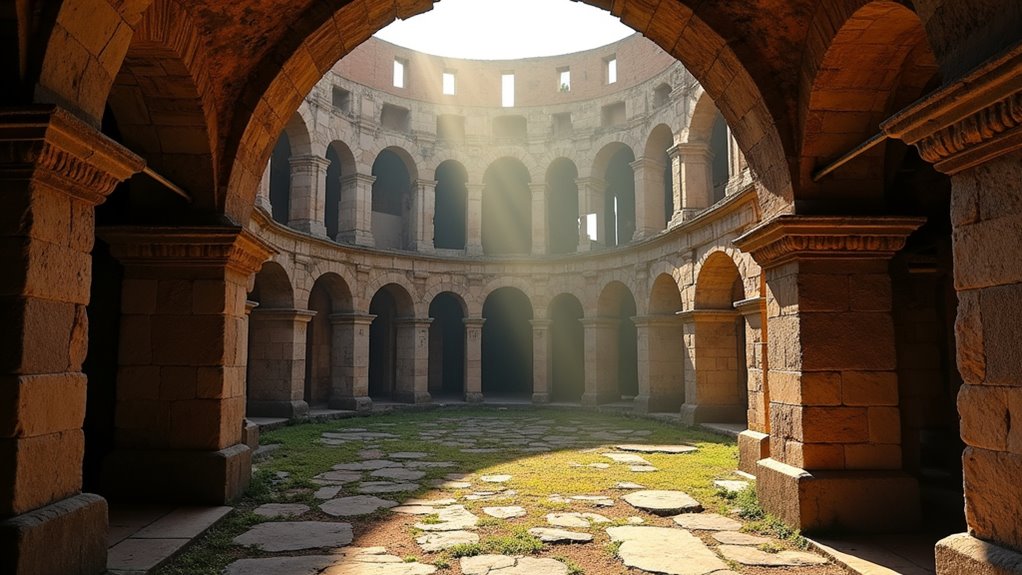
While most travelers admire the Colosseum from its upper tiers, you’ll discover the amphitheater’s most enthralling secrets by descending into the hypogeum—the vast underground network that once pulsed with the energy of gladiators preparing for battle and exotic animals awaiting their dramatic arena entrances.
You’ll walk through 15 restored corridors where over 80 elevators once lifted combatants through trapdoors for surprise appearances. The 160-meter path reveals holding cages and tunnels, including a 200-meter passage connecting to the nearby Ludus Magnus gladiator training school.
Standing on the reconstructed arena floor through the Gladiator’s Gate, you’ll experience the amphitheater from where fighters faced 50,000 roaring spectators. You’ll discover that about 90% of gladiators actually survived their fights due to their extensive training and skill.
These exclusive guided tours require special tickets and typically last 90 minutes to three hours.
Wander the Roman Forum at Your Own Pace
After experiencing the Colosseum’s dramatic underground world, you’ll find the Roman Forum offers a completely different perspective on ancient Rome—one where you can explore at your own rhythm without time constraints.
Your combined ticket grants access to this sprawling archaeological site between Capitoline and Palatine Hills, where Julius Caesar’s funeral occurred and victorious generals celebrated triumphal processions.
Start at Basilica Aemilia, then navigate toward the remarkably preserved Temple of Divine Romulus and impressive Temple of Antoninus and Faustina. The Forum served as Rome’s central hub for over a millennium, functioning as the commercial, civic, and religious heart of the ancient world.
The uneven terrain demands sturdy footwear, and sparse signage means downloading a detailed map beforehand pays off.
Budget 2-3 hours for thorough exploration, covering roughly 1-2 kilometers along Via Sacra.
Skip expensive guided tours—this experience shines when you’re controlling the pace.
Climb Palatine Hill for the Best Views Over Ancient Rome
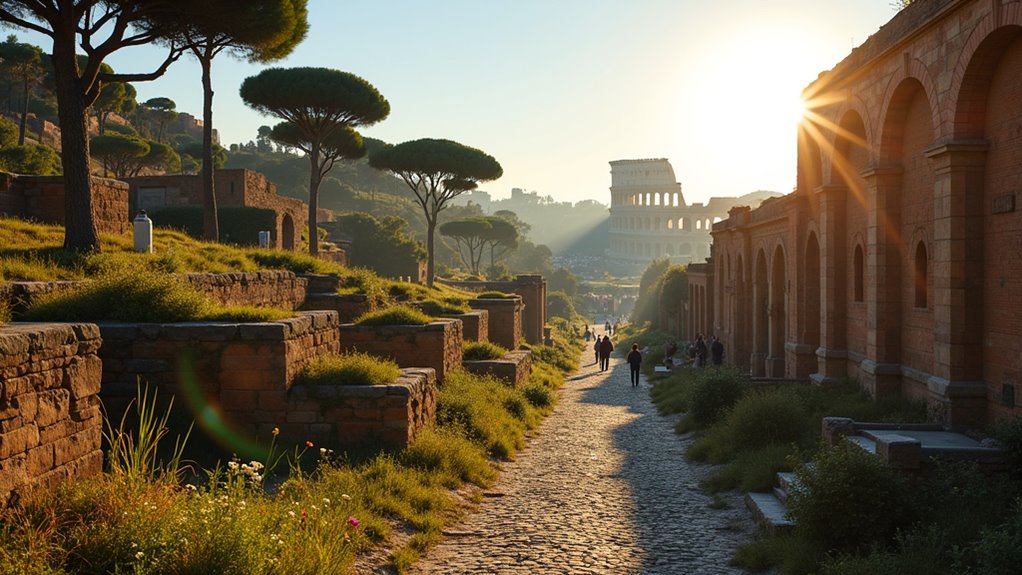
Once you’ve explored the Forum’s ruins at ground level, Palatine Hill beckons with Rome’s most spectacular elevated perspectives over the ancient world. This legendary hill where Rome began offers unmatched panoramic views over the Colosseum, Forum, and Circus Maximus from 40 meters above the city.
You’ll walk through imperial history among the ruins of Augustus’s and Domitian’s palaces, plus the reconstructed Hut of Romulus marking Rome’s mythical birthplace. The word palace itself derives from this very hill, influencing architectural terms across languages. Don’t miss the Neronian Cryptoporticus’s stunning underground frescoes or the House of Livia’s original wall paintings.
Your combined ticket covers both Forum and Palatine access for two days. Enter via Via di San Gregorio to avoid Colosseum crowds, and head to the central terrace near the Palatine Museum for the most commanding Forum views.
Book a Morning Entry to the Vatican Museums and Sistine Chapel
From exploring ancient Rome’s heights, you’ll want to secure your spot at Vatican City’s crown jewel before the tourist masses arrive. Book early access tickets starting around 7:30 AM—they’ll cost €124-€129 but save you 2-3 hours of waiting and deliver an incredibly peaceful experience in the Sistine Chapel.
You’ll join small groups led by art historians who’ll guide you through the Raphael Rooms and Gallery of Maps before reaching Michelangelo’s masterpieces. The near-silence lets you actually study “The Creation of Adam” without elbowing through crowds.
Book 3-4 weeks ahead through official vendors, and choose tours including St. Peter’s Basilica access. Remember that photography is prohibited inside the Sistine Chapel regardless of your ticket type. The higher price pays for itself in time saved and atmosphere gained.
Stand Under the Pantheon’s Perfect Dome
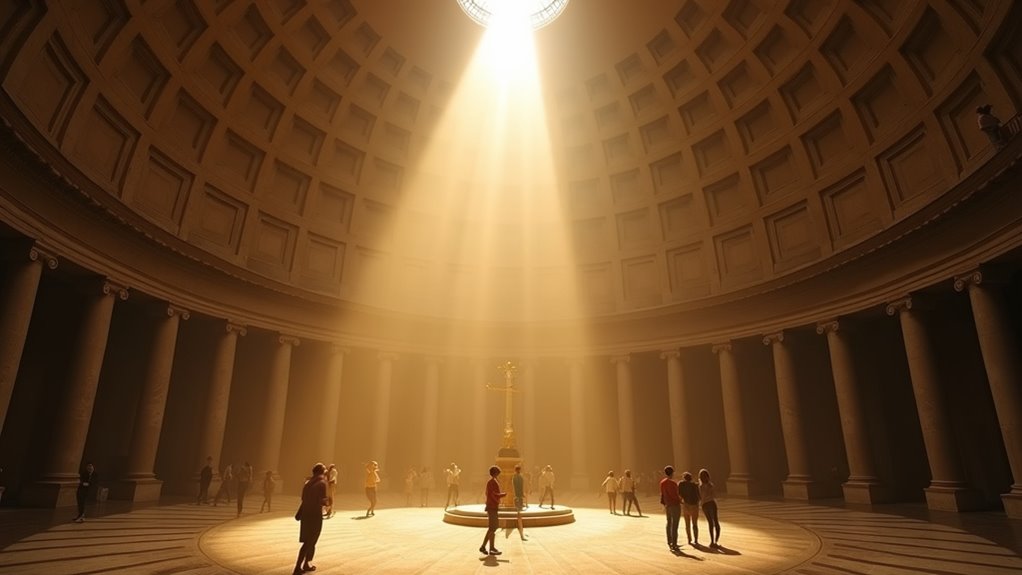
Two thousand years after its construction, the Pantheon remains Rome’s most breathtaking architectural achievement—and you’ll feel it the moment you step beneath its impossibly perfect dome.
Stand directly in the center and look up at the nine-meter oculus—the only light source creating dramatic patterns across the coffered ceiling. You’re inside a perfect mathematical sphere where the 43.3-meter diameter equals the interior height, making this the world’s largest unreinforced concrete dome.
Visit on April 21st at noon when sunlight perfectly aligns with the entrance, marking Rome’s founding date.
Don’t worry about rain—the floor’s designed with drainage slopes.
The 140 coffers once held bronze rosettes, creating a starry firmament effect that connected earth to heaven. This extraordinary structure influenced architects for centuries, most notably inspiring Brunelleschi’s dome in Florence during the Renaissance.
Toss a Coin at Trevi Fountain Before 8 AM
Beat the crowds and make your wish count—arrive at Trevi Fountain before 8 AM when you’ll have Rome’s most famous fountain practically to yourself. The early morning light creates a serene ambiance that enhances this ancient ritual’s personal significance.
Here’s the proper technique: stand with your back to the fountain, then use your right hand to toss your coin over your left shoulder into the central basin. One coin guarantees your return to Rome, a second brings love with an Italian, and a third leads to marriage.
Your coins join the €3,000 collected daily—all donated to Caritas for Rome’s poor. This practice connects to the ancient belief that water holds divine power, making your wishes more meaningful when cast into this sacred source. This early timing lets you follow the tradition without distractions, connecting you to centuries-old beliefs about sacred water sources while avoiding the tourist chaos.
People-Watch in Piazza Navona Over an Aperitivo
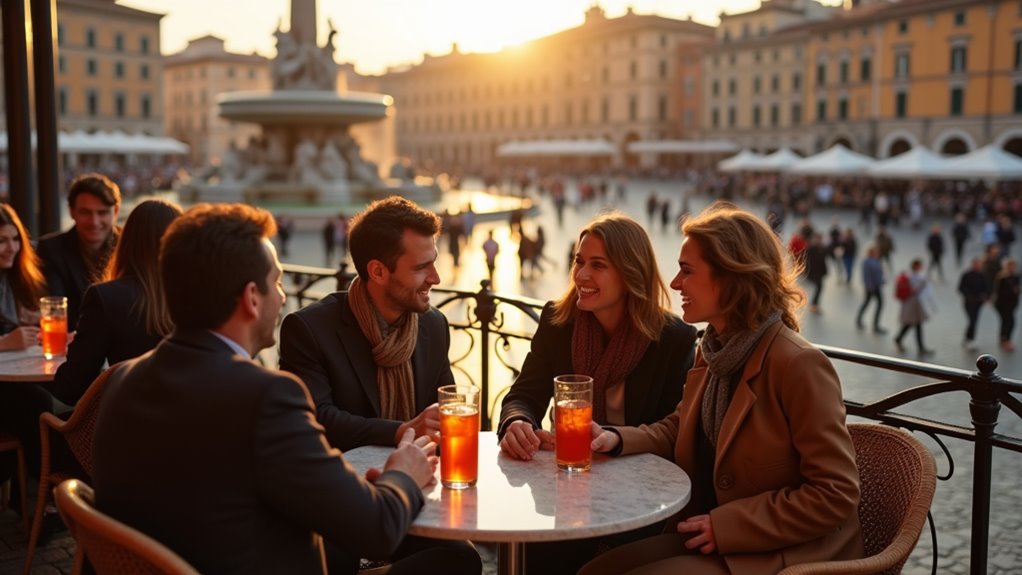
While travelers rush between monuments, you’ll discover Rome’s true rhythm by settling into Piazza Navona with an aperitivo as the afternoon light begins to soften.
This elegant Baroque square transforms into Rome’s finest people-watching theater, where locals mix with visitors against Bernini’s stunning fountains. Built on the site of the ancient Stadium of Domitian, the piazza’s distinctive oval shape creates natural viewing angles perfect for observing the daily Roman spectacle.
Grab a Spritz at Bar della Pace or splurge for rooftop views at Terrazzo Borromini.
You’ll witness the daily parade: street artists sketching portraits, families gathering around the Fountain of the Four Rivers, and Romans conducting animated conversations over wine.
Time your visit for early evening when golden light bathes the piazza and crowds thin slightly.
Choose outdoor seating slightly off the main fountain clusters for prime viewing angles without tourist chaos overwhelming your relaxed aperitivo experience.
Climb the Spanish Steps to Trinità Dei Monti
After soaking up Rome’s social energy at street level, you’ll want to gain some elevation for a different perspective on the Eternal City. The Spanish Steps offer Europe’s longest and widest staircase climb—135 travertine steps spanning 12 ramps that’ll take you from Piazza di Spagna to the stunning Trinità dei Monti church above.
Built between 1723-1725 in elegant Rococo style, these steps aren’t just a workout—they’re a scenic journey. You’ll spot carved fleurs-de-lis and papal eagles as you ascend, plus multiple viewing spots for photographing the cityscape below.
At the top, explore the 16th-century French church with its twin bell towers and masterpieces by Daniele de Volterra. It’s a perfect blend of architectural grandeur and panoramic rewards.
Before beginning your ascent, take a moment to admire the charming Fontana della Barcaccia at the base, which depicts a submerged boat with cascading water that adds a whimsical touch to the scene.
Explore Trastevere’s Narrow Medieval Streets
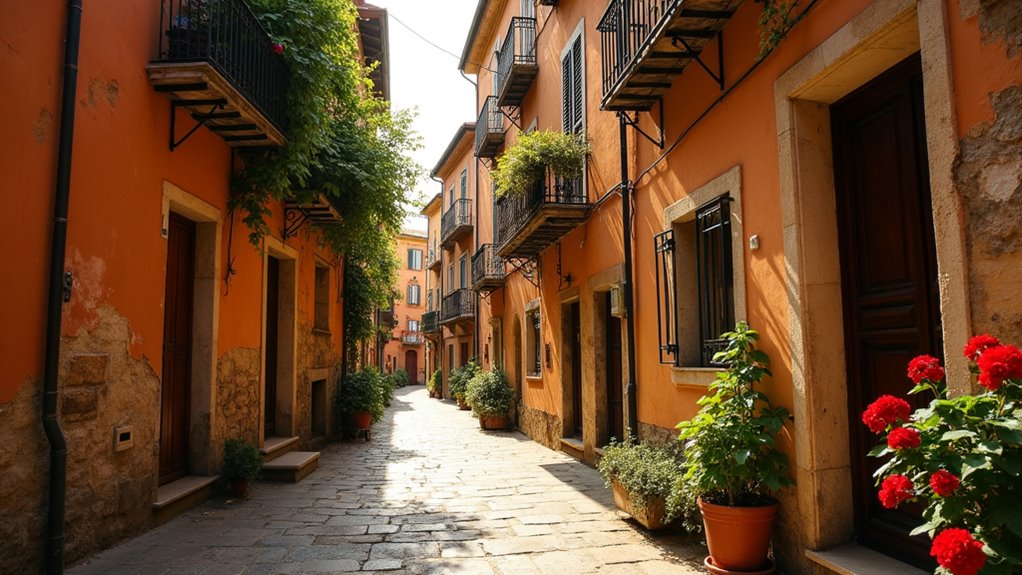
Once you’ve conquered the Spanish Steps, head across the Tiber River to Trastevere, where Rome’s most authentic neighborhood unfolds through a labyrinth of narrow cobblestone streets that haven’t changed much since medieval times.
You’ll find yourself wandering through vicoli (alleyways) lined with ivy-covered walls, street shrines, and laundry hanging between buildings—this is Rome as locals live it.
Start at Piazza Trilussa and lose yourself in the maze. Don’t miss Via Titta Scarpetta, an open-air archaeological museum with ancient Roman fragments embedded in building walls.
Hunt for Vicolo della Luce, the “Alley of Light,” made famous by 19th-century paintings. The neighborhood’s name comes from the Latin “trans Tiberim,” meaning “beyond the Tiber,” reflecting its historic location on the river’s west bank.
Wear comfortable shoes—these uneven cobblestones will test your ankles, but the village atmosphere is worth every step.
Take the Metro to San Giovanni in Laterano
Rome’s metro system gets you to one of Christianity’s most important sites faster than any taxi could navigate the traffic-clogged streets. The San Giovanni station serves as your gateway to the Archbasilica of St. John Lateran, the Pope’s official ecclesiastical seat and Rome’s actual cathedral – not St. Peter’s as most travelers assume.
You’ll find this interchange station connects Line A (orange) and Line C (green), making it easily accessible from anywhere in the city. The underground space itself doubles as Rome’s first “museum station,” displaying archaeological finds from prehistoric times through the Renaissance. The station features a remarkable ancient water basin from the 1st century AD that held over 4 million liters and was part of an early Imperial agricultural estate.
Once you emerge, it’s under a five-minute walk to the basilica. You’re also positioned perfectly for reaching the Colosseum and Roman Forum, both about twenty minutes away on foot.
Visit the Baths of Caracalla Without the Crowds
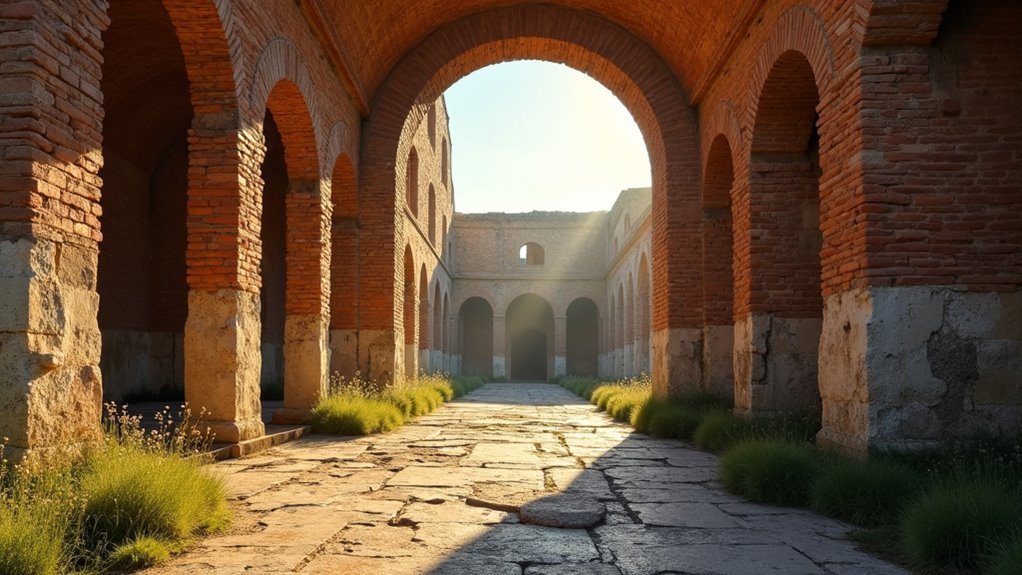
While most travelers battle crowds at the Colosseum, you’ll discover one of Rome’s best-preserved ancient sites practically to yourself at the Baths of Caracalla. Visit Tuesday through Wednesday mornings when the site opens at 9:00—you’ll avoid the 11:00-15:00 rush entirely.
Skip weekends and arrive 15 minutes early to be first inside.
Here’s your insider route: enter from Viale delle Terme di Caracalla near Circo Massimo metro, then immediately turn left to explore the underground Mithraeum before crowds arrive. Follow the ancient bathing sequence through calidarium, tepidarium, frigidarium, and natatio for natural flow. The complex once accommodated up to 1,600 bathers simultaneously, making it one of ancient Rome’s most impressive social hubs.
Your €8 ticket grants access to remarkably intact mosaics and towering walls. Bring water and sun protection—much of the complex lacks shade, but you’ll have golden-hour lighting if visiting after 16:00.
Walk Through Villa Borghese to Galleria Borghese
Transform your afternoon into a perfect blend of nature and art by strolling through Villa Borghese’s tree-lined paths to reach Rome’s most exclusive gallery. Start at Piazza del Popolo’s steps, ascending to Piazzale Napoleone Primo for stunning city views.
Your 15-20 minute walk winds past Piazza di Siena’s historic oval and the charming Museo Pietro Canonica before reaching Galleria Borghese. The nearly 5 km route through the park offers multiple scenic viewpoints and can easily fill a couple of hours if you choose to explore all the highlights.
Here’s the insider tip: book your timed tickets weeks ahead—walk-ins aren’t accepted. The gallery houses masterpieces by Bernini, Caravaggio, and Raphael in an intimate 17th-century villa setting.
After your two-hour visit, you can exit through Porta Pinciana near the ancient Aurelian Walls or loop back via the scenic Pincio promenade.
This route perfectly combines Rome’s natural beauty with world-class art.
Discover the Catacombs of San Callisto
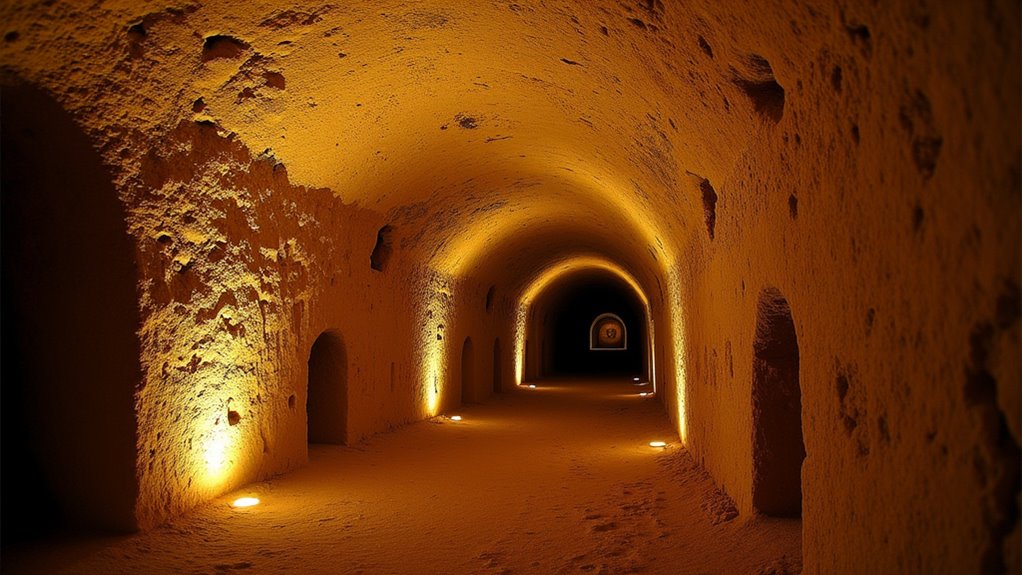
Beneath Rome’s bustling Appian Way lies one of Christianity’s most sacred underground worlds—the Catacombs of San Callisto. You’ll descend into 20 kilometers of tunnels spanning four levels, where over half a million early Christians found their eternal rest.
Created in the 2nd century, these catacombs served as Rome’s official Christian cemetery for centuries. You’ll explore the legendary Crypt of the Popes, where nine pontiffs were buried, and admire 3rd-century frescoes depicting early Christian symbols and sacraments.
Don’t miss the Crypt of Saint Cecilia, featuring stunning artwork and historical inscriptions. Giovanni Battista de Rossi rediscovered this “little Vatican” in 1854, revealing treasures that illuminate Christianity’s persecuted early days. These sacred symbols served as coded messages for persecuted Christians to express their faith and hope during times of intense societal hostility.
Book a guided tour to fully appreciate this archaeological masterpiece.
End Your Day at a Local Osteria in Testaccio
After exploring Rome’s ancient underground treasures, you’ll want to cap off your day in Testaccio, where authentic Roman cuisine thrives in neighborhood osterias that locals have cherished for generations.
Book ahead at Felice a Testaccio for Rome’s finest cacio e pepe, or head to Flavio al Velavevodetto inside Monte Testaccio for generous portions and exceptional tiramisù. Osteria degli Amici offers creative takes on classics with extensive vegetarian options, while Checchino dal 1887 serves elevated quinto quarto dishes showcasing the neighborhood’s culinary heritage.
You’ll find rustic atmospheres, homemade pasta, and seasonal ingredients throughout these establishments. Check opening days—Pecorino closes Mondays, Osteria degli Amici closes Tuesdays. The convivial neighborhood vibe perfectly captures Roman dining culture, making reservations essential at popular spots. Don’t miss the Testaccio Market for fresh local ingredients if you’re staying nearby and want to experience authentic Roman food shopping culture.
The Sum Up
You’ve got enough here to keep you busy for days, but don’t try to cram everything into one trip. Rome’s not going anywhere, and you’ll burn yourself out rushing between sites. Pick three or four experiences that genuinely interest you, book your skip-the-line tickets in advance, and leave time to get lost in the side streets. That’s where you’ll find the Rome that locals actually live in.