
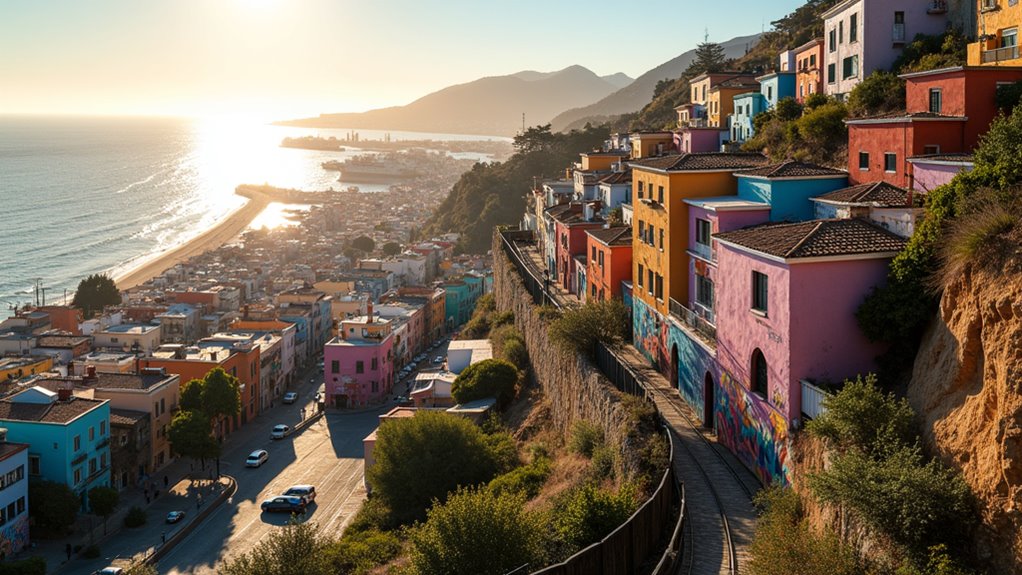
You’ll discover Valparaíso’s charm through its historic funiculars connecting hillside neighborhoods, vibrant street art in Cerro Bellavista, and Pablo Neruda’s La Sebastiana house museum. Explore German-influenced architecture in Cerro Concepción, enjoy panoramic views from Paseo 21 de Mayo, and experience naval heritage at Plaza Sotomayor. Watch sea lions at Caleta Portales, join brewery walking tours through cobblestone streets, and take day trips to Viña del Mar’s beaches for a complete coastal experience that reveals Chile’s artistic soul.
- Ride the Historic Funiculars Between Port and Hills
- Explore Cerro Concepción’s German-Influenced Architecture
- Hunt for Street Art in Cerro Bellavista’s Open-Air Museum
- Visit Pablo Neruda’s La Sebastiana House Museum
- Take in Panoramic Views From Paseo 21 De Mayo
- Wander the Colorful Streets of Cerro Alegre
- Experience Plaza Sotomayor and the Naval Heritage
- Watch Sea Lions at Caleta Portales Fishing Harbor
- Discover Local Breweries on a Beer Walking Tour
- Take a Day Trip to Nearby Viña Del Mar Beaches
- The Sum Up
Ride the Historic Funiculars Between Port and Hills
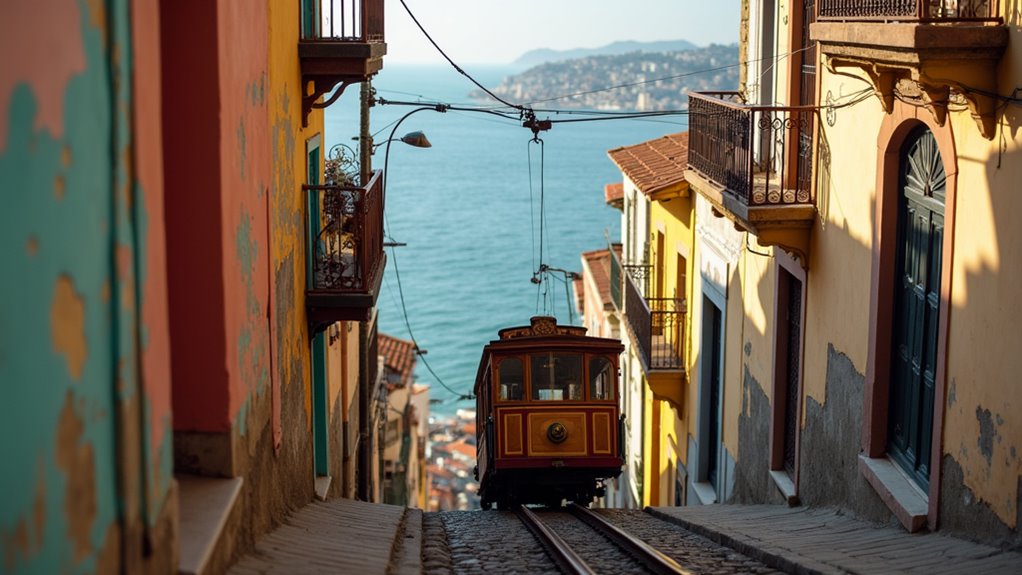
When you step off a ship or stroll through Valparaíso’s bustling port district, the city’s historic funiculars offer the most authentic way to ascend the steep hills that define this UNESCO World Heritage site. These nineteenth-century engineering marvels connect the lower port with residential cerros through oblique parallel rails and counterbalancing cars.
You’ll find must-ride lines like Concepción (1883), the network’s oldest elevator, and Artillería, which delivers panoramic bay views. The electric-powered Barón (1909) and recently restored Cordillera provide reliable access to densely populated hillside neighborhoods.
Each upper station features promenades and viewpoints overlooking the amphitheater-like cityscape. The most dramatic ascent belongs to the Reina Victoria funicular, which climbs at a steep 57º gradient where carriages pass each other during operation.
With fourteen elevators designated as National Monuments, these funiculars serve as both practical public transport and living museums of Valparaíso’s urban heritage.
Explore Cerro Concepción’s German-Influenced Architecture
As you ascend Cerro Concepción via the historic funicular, you’ll immediately notice how German and English immigrants transformed this hillside into Valparaíso’s most architecturally cohesive neighborhood during the late 19th century.
The carefully planned layout features terraced plots, narrow passages, and elegant mansions with flowered gardens that follow European bourgeois residential models adapted to steep topography.
You’ll find the crown jewel in the Lutheran Church of the Holy Cross, completed in 1897 with neo-Gothic architecture and a 115-meter bell tower dominating the skyline. Its hand-carved Oregon pine interior showcases Central European craftsmanship. The area’s remarkable European ambiance had already been established by 1840, setting the foundation for the architectural heritage that would earn this neighborhood its UNESCO World Heritage Site designation.
Don’t miss the former German School, now being converted into the Immigrant Museum, which operated from 1870 to 1985 before earthquake damage forced its closure.
Hunt for Street Art in Cerro Bellavista’s Open-Air Museum
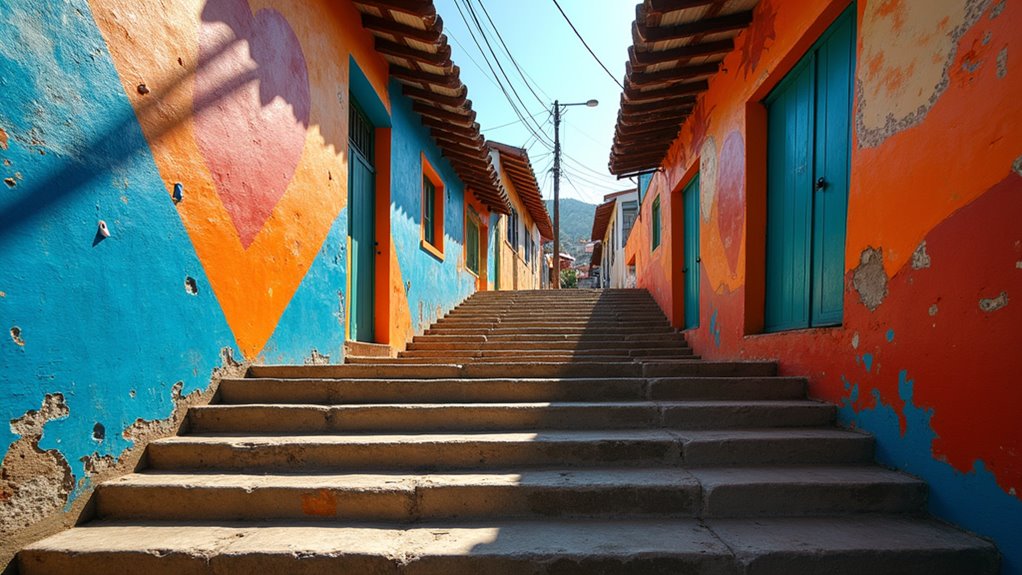
While Valparaíso’s street art has exploded across multiple neighborhoods, Cerro Bellavista stands apart as the deliberate birthplace of the city’s transformation into a living gallery. Created in the early 1990s under art historian Gastón Soublette’s curation, this open-air museum features 20-30 major murals by prominent Chilean artists along Héctor Calvo and Yerbas Buenas streets.
You’ll discover a continuous walking circuit connecting residential blocks through steep staircases and small plazas. The large-format works blend figurative, abstract, and surrealist styles, often addressing themes of democracy and post-dictatorship identity. Street art originated as anonymous protest graffiti during Pinochet’s dictatorship in the 1970s, setting the foundation for today’s vibrant artistic expression. Mosaic-tiled staircases and brightly painted doorways create photogenic details throughout.
Plan daytime visits for safety and ideal lighting. Wear comfortable walking shoes—the steep terrain and uneven pavement demand preparation for serious hill climbing.
Visit Pablo Neruda’s La Sebastiana House Museum
Your street art exploration on Cerro Bellavista leads naturally to one of the neighborhood’s most celebrated attractions: Pablo Neruda’s La Sebastiana house museum. This quirky four-story vertical house, perched dramatically on the steep hillside, showcases the Nobel Prize-winning poet’s eccentric personality through its labyrinthine layout and ship-like interiors.
The self-guided tour takes you through successive floors filled with Neruda’s original collections—old maps, naval paintings, music boxes, and a carved carousel horse. His top-floor writing study, where he penned works like *Hundred Love Sonnets*, offers stunning bay views that inspired his nautical fascination.
Located at Ferrari 692, the museum requires an uphill walk but rewards visitors with intimate glimpses into Neruda’s daily life and creative process. The house was restored in 1991 after being abandoned during the Pinochet dictatorship and officially opened to the public on January 1, 1992. Photography inside is restricted, so focus on absorbing the atmospheric details.
Take in Panoramic Views From Paseo 21 De Mayo
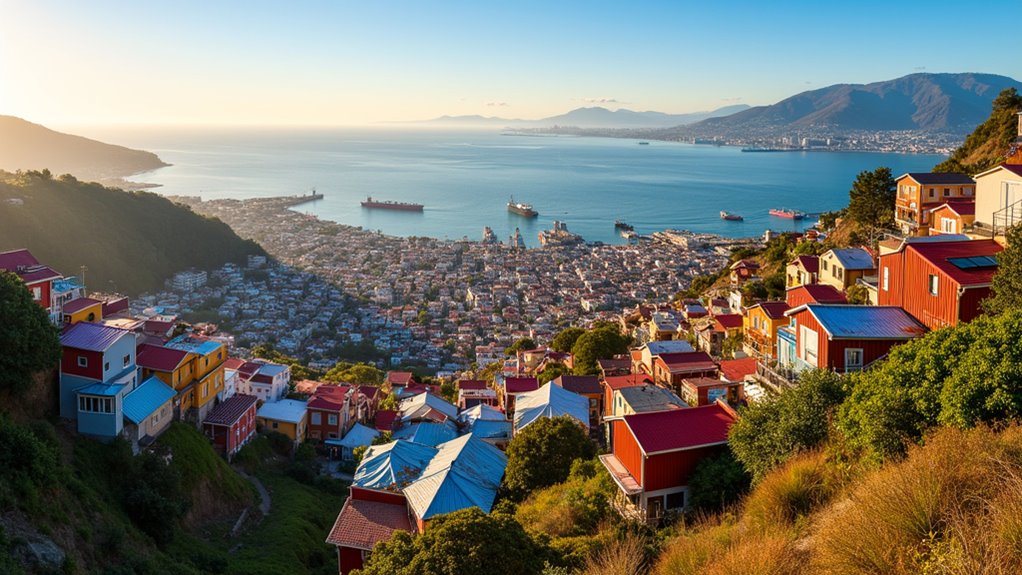
After exploring Neruda’s intimate house museum, climb higher up Cerro Artillería to reach Paseo 21 de Mayo, Valparaíso’s premier panoramic viewpoint perched 150 meters above sea level. This natural balcony delivers unobstructed views of the city’s amphitheater-style hills, colorful housing cascading down slopes, and the bustling port below with container terminals and ships.
On clear days, you’ll see coastline stretching toward Viña del Mar and Concón.
Visit during golden hour for dramatic lighting that enhances the multi-colored facades. The historic promenade features the Naval Maritime Museum, artisan stalls, and cafés oriented toward the bay views. The promenade itself is a public walkway with no entrance fee, making it accessible for all visitors.
Wear sturdy shoes for uneven pavement and steep approaches. While infrastructure shows wear, the spectacular vistas make this viewpoint essential for cityscape photography.
Wander the Colorful Streets of Cerro Alegre
Once you’ve absorbed the sweeping harbor views from Paseo 21 de Mayo, descend into the enchanting maze of Cerro Alegre, where narrow cobblestone streets and rainbow-painted stairways create Valparaíso’s most photogenic neighborhood.
Templeman Street serves as your main artery, lined with murals and harbor lookouts. Don’t miss the famous Escalera de Colores (Fischer Stair) with its rainbow steps and narrative murals—it’s the hill’s most Instagrammed spot.
Explore Paseo Dimalow for street art galleries and Pasaje Gálvez for high-impact graffiti. You’ll discover colorful corrugated-iron mansions, whimsical illustrations, and politically charged pieces covering every surface. Keep an eye out for “La mamie de Valparaíso”, a standout mural by Ella & Pitr that depicts a grandmother watching protectively over the city.
The area functions as an open-air gallery where slow wandering reveals hidden artistic treasures in doorways and forgotten corners.
Experience Plaza Sotomayor and the Naval Heritage
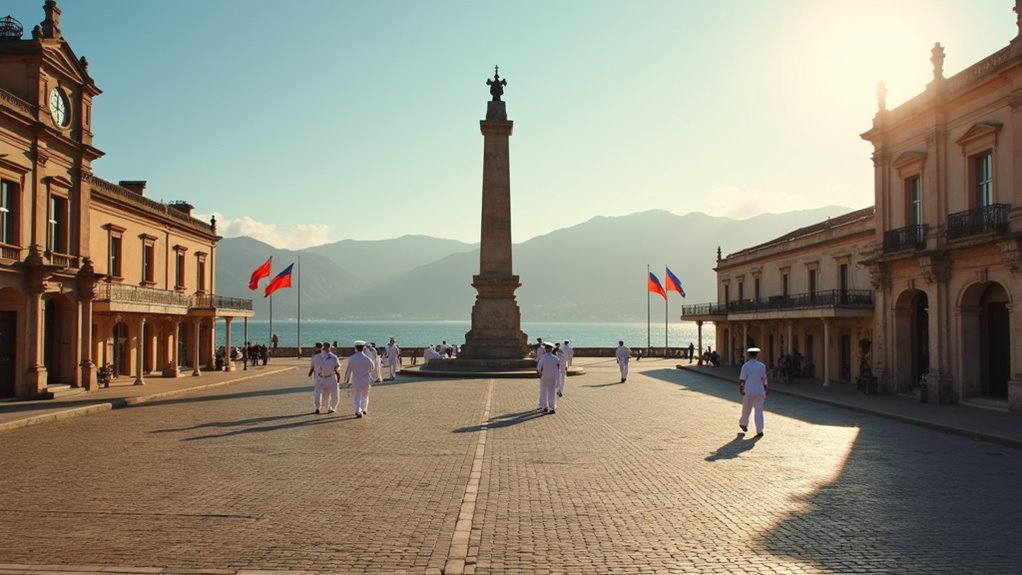
From Cerro Alegre’s artistic hillsides, make your way down to Plaza Sotomayor, Valparaíso’s largest civic center and the beating heart of the port district. You’ll find yourself surrounded by impressive neoclassical architecture, including the striking blue Edificio Armada de Chile, declared a Historic Monument in 1979.
At the plaza’s center stands the Monument to the Heroes of Iquique, crowned by a statue of naval hero Arturo Prat. The monument commemorates Chile’s War of the Pacific battles and houses Prat’s remains in its crypt below.
Walk north toward Muelle Prat to watch naval ships and colorful passenger boats offering bay tours. On weekends, browse the artisanal craft fairs where local vendors showcase handmade jewelry, crafts, and artwork unique to the region.
Time your visit for May 21st’s Glorias Navales celebrations, when naval parades transform this historic space into Chile’s premier military ceremony venue.
Watch Sea Lions at Caleta Portales Fishing Harbor
While Valparaíso’s hills showcase artistic expression, the working harbor at Caleta Portales reveals nature’s raw theater in action. You’ll find massive groups of South American sea lions hauled out on concrete platforms, jostling aggressively for prime sunbathing spots.
The chaos intensifies during fish market hours when sea lions converge in feeding frenzies around discarded scraps, competing with pelicans and gulls. The spectacle becomes even more dramatic after market closure when hundreds of sea lions gather to feast on the remaining fish scraps.
Catch the Metro to Portales Station, then head to the fish market by 7:00 a.m. for peak activity. Afternoon visits offer excellent photography light and dramatic sunset silhouettes.
Maintain safe distances from these powerful animals and watch your footing on damaged boardwalk planks. The sensory experience combines loud wildlife calls, strong fish odors, and continuous action between fishermen, seabirds, and battling sea lions.
Discover Local Breweries on a Beer Walking Tour
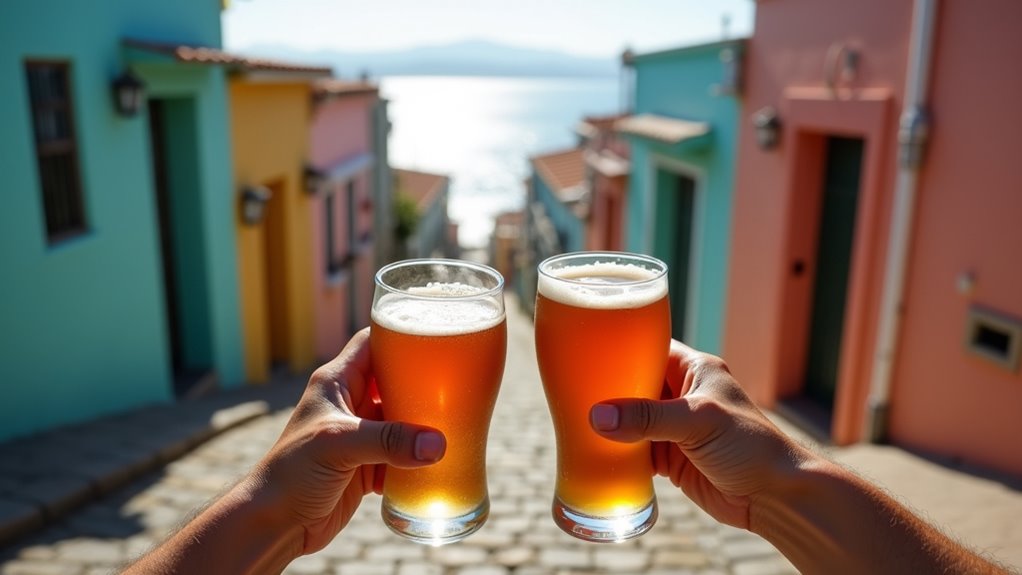
After witnessing Valparaíso’s natural spectacle at the harbor, you’ll discover the city’s equally vibrant craft beer scene that tells its own compelling story through hops and malt.
Walking beer tours lasting 3-4 hours guide you through historic neighborhoods like Cerro Alegre and Cerro Concepción, where local experts share Chile’s 200-year brewing heritage.
You’ll visit 3-4 specialized bars and pubs, sampling up to 12 craft beers including lagers, IPAs, and seasonal brews from breweries like Kross and Cervecería Nacional. These guided experiences combine culture with brewing traditions, offering insights into Chilean methodologies and the city’s rich beer history.
Tours start around 17:00, cost 25,000-40,000 CLP, and combine beer education with city exploration through cobblestone streets and historic alleys.
Book ahead and wear comfortable shoes for maneuvering Valparaíso’s characteristic hills and staircases.
Take a Day Trip to Nearby Viña Del Mar Beaches
When you’re ready to trade Valparaíso’s steep cobblestone streets for sandy coastline, Viña del Mar’s pristine beaches await just 9 kilometers away. You’ll reach this “Garden City” in 8-25 minutes via frequent local buses (every 10-20 minutes, $1) or the metro train (15 minutes, $3.50).
Head to Playa Acapulco and Playa El Sol for golden sand beaches with promenade access and nearby restaurants. Visit Playa Caleta Abarca to see the iconic flower clock, or explore Playa Blanca for excellent Pacific views.
While strong currents and cool water make swimming challenging, you’ll enjoy sunbathing, beach games, and dramatic wave-watching. The beaches feature rugged sand and cooler Pacific waters, with locals often playing in the sand while watching the impressive waves crash along the shore.
The contrast is striking—Viña’s flat, manicured boulevards and resort atmosphere provide easy walking compared to Valparaíso’s bohemian hillside character.
The Sum Up
You’ve now got the blueprint for an unforgettable Valparaíso adventure. Don’t try cramming everything into one day—you’ll miss the city’s laid-back charm. Instead, pick three to four experiences and savor them properly. Start early to beat crowds at popular spots like La Sebastiana, and always carry cash since many local vendors don’t accept cards. Most importantly, wear comfortable walking shoes—those steep cobblestone streets aren’t forgiving, but they’re absolutely worth every step.