
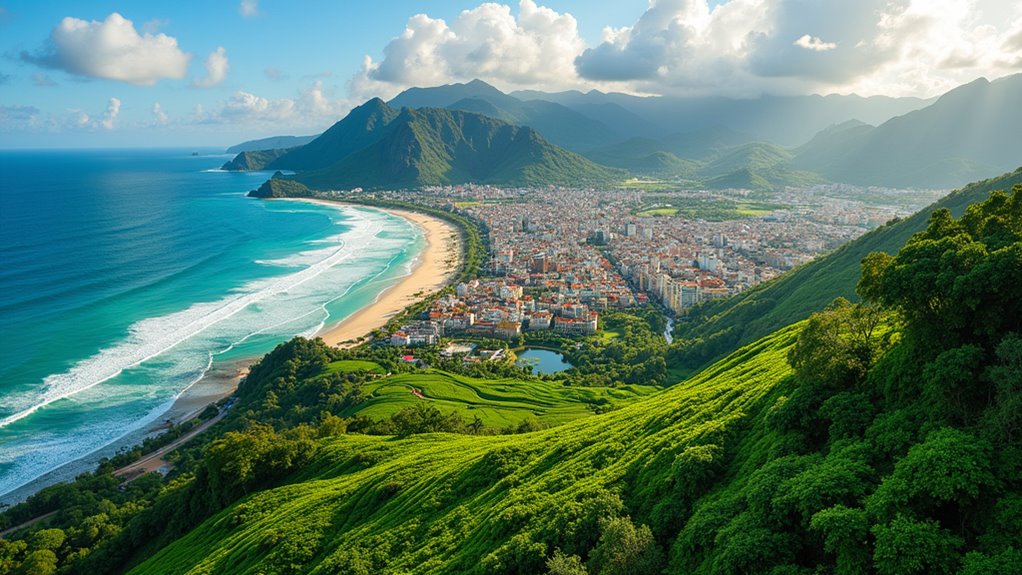
You’ll find Colombia’s most unforgettable experiences range from exploring Cartagena’s coral stone colonial walls and climbing the fortress Castillo San Felipe de Barajas to trekking through Cocora Valley’s towering 60-meter wax palms. Don’t miss the underground Salt Cathedral at Zipaquirá, the vibrant Caño Cristales “Liquid Rainbow” river, and UNESCO coffee farms where you’ll witness bean-to-cup processes firsthand. Add Tayrona’s pristine Caribbean beaches and San Agustín’s ancient megaliths for the complete Colombian adventure that awaits your discovery.
- Wander the Colonial Streets of Cartagena’s Walled City
- Explore the Underground Salt Cathedral at Zipaquirá
- Take the Cable Car Up Monserrate for Panoramic Views of Bogotá
- Tour Coffee Farms in the UNESCO-Protected Coffee Triangle
- Hike Among Giant Wax Palms in Cocora Valley
- Marvel at Pre-Columbian Gold at Bogotá’s Museo Del Oro
- Trek to La Ciudad Perdida Through Sierra Nevada Jungle
- Witness Medellín’s Urban Transformation in Comuna 13
- Stargaze in the Red Canyons of Tatacoa Desert
- Discover Ancient Megaliths at San Agustín Archaeological Park
- Experience Nature’s Color Show at Caño Cristales River
- Relax on Caribbean Beaches in Tayrona National Park
- The Sum Up
Wander the Colonial Streets of Cartagena’s Walled City
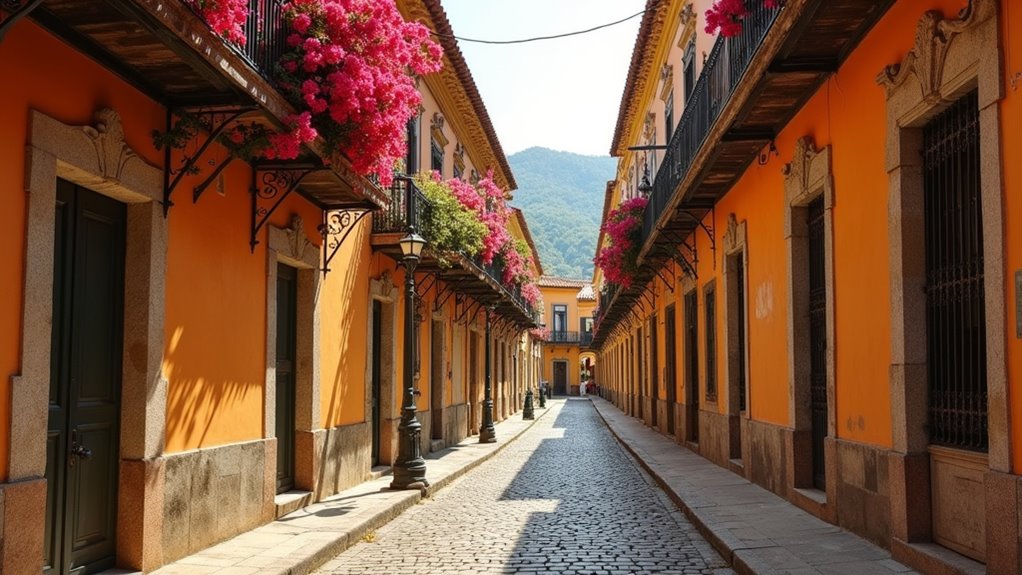
Within eleven kilometers of coral stone walls that took over two centuries to complete, Cartagena’s Walled City unfolds as one of South America’s most perfectly preserved colonial treasures. You’ll enter through the iconic Puerta del Reloj, where the Clock Tower Gate marks your passage into centuries of Spanish colonial history.
Navigate cobblestone streets lined with vibrant buildings adorned with ornate wooden doors and wrought-iron balconies overflowing with bougainvillea. Duck into hidden plazas where locals gather beneath towering churches.
Climb the weathered ramparts for harbor views, then explore the massive Castillo San Felipe de Barajas fortress that withstood countless pirate attacks. Browse Las Bóvedas, where former dungeon chambers now house artisan shops selling Colombian handicrafts and local artwork.
Time your visit for late afternoon when golden light bathes the coral stone walls, creating perfect conditions for photography while avoiding the midday Caribbean heat.
Explore the Underground Salt Cathedral at Zipaquirá
Beneath 180 meters of solid rock lies one of Colombia’s most extraordinary architectural achievements—the Zipaquirá Salt Cathedral, carved entirely from the walls of an active salt mine. You’ll descend through eucalyptus-lined tunnels into a labyrinth of illuminated chambers where 250,000 tons of salt were removed to create this underground marvel.
Follow the Via Crucis through 14 carved stations leading to three symbolic naves representing birth, life, and resurrection. The crystalline salt “waterfall” in the Nativity nave evokes the Jordan River, while the massive 16-meter cross dominates the resurrection chamber.
Don’t miss La Piedad sculpture featuring indigenous Muisca traits, honoring the pre-Columbian people who first mined here in the 5th century. The Museum of the Brine displays historical tanks and pump rooms that showcase the fascinating salt extraction processes used throughout the mine’s operational history. The innovative lighting creates an otherworldly glow against salt walls.
Take the Cable Car Up Monserrate for Panoramic Views of Bogotá

Towering 3,152 meters above Bogotá, Cerro de Monserrate offers the capital’s most spectacular panoramic views—and the fastest way up is the four-minute cable car ride that whisks you 460 meters skyward.
You’ll get sweeping 360-degree views of Bogotá’s sprawling cityscape and surrounding Andean ridges from the summit’s multiple viewpoints.
Visit early morning to avoid crushing Sunday crowds that can mean three-hour waits. Round-trip tickets cost 22,000 COP weekdays, dropping to 13,000 COP Sundays (though busier).
The hilltop features the Basilica del Señor de Monserrate, restaurants, and walking trails with over 80 bird species. For a different experience, consider taking the historic funicular railway, which has been operating since 1929 and offers a swift ascent through two bridges and a tunnel. Purchase tickets at the base station on Carrera 2E.
Clear weather days offer the best visibility—cloudy afternoons severely limit views.
Tour Coffee Farms in the UNESCO-Protected Coffee Triangle
Spanning three departments in Colombia’s Andes, the UNESCO-protected Coffee Cultural Landscape offers you access to nearly 96,000 working coffee farms where five generations of families still hand-pick arabica cherries on impossibly steep slopes. You’ll witness the complete bean-to-cup process during guided farm tours, from nursery seedlings through fermentation at the beneficio wet mill to final cupping sessions that highlight altitude’s impact on flavor profiles.
Base yourself in historic coffee towns like Salento or Filandia, where bahareque houses with clay tile roofs line cobblestone streets. Book half-day tours through certified cooperatives for authentic experiences that include harvesting participation. The region’s Cocora Valley showcases Colombia’s tallest wax palms rising from misty cloud forests, creating one of the country’s most iconic landscapes.
Stay overnight at traditional fincas surrounded by plantations, where you’ll drink tinto with muleteers wearing cowboy hats while learning sustainable shade-grown cultivation techniques.
Hike Among Giant Wax Palms in Cocora Valley
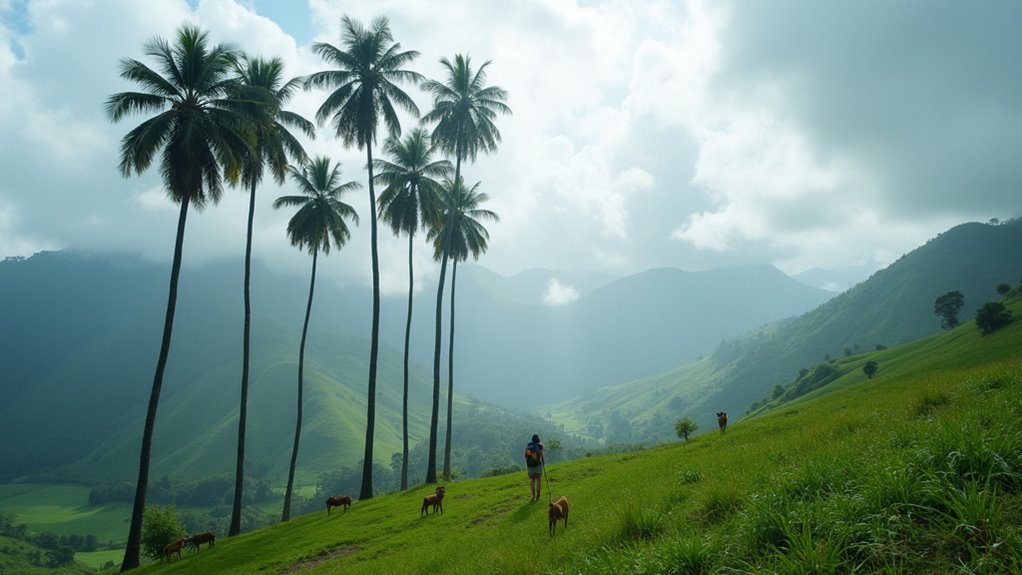
Sixty-meter wax palms—the world’s tallest palm species—create an otherworldly landscape across Cocora Valley’s rolling pastures at 5,900 feet above sea level. You’ll find Colombia’s national tree thriving in this protected sanctuary within Los Nevados National Natural Park, where these ancient giants can live over 200 years in cool, humid montane conditions.
Take a classic Willys jeep from Salento to reach the trailhead, then tackle the 12-kilometer loop hike requiring 5-7 hours. Your route winds through cloud forest, crosses rivers via hanging bridges, and traverses farmland before reaching dense palm concentrations. Don’t miss the detour to Acaime, where you can observe hummingbird feeding stations while enjoying hot chocolate and cheese at a local finca.
Choose clockwise for early forest views or counterclockwise for immediate palm vistas. A shorter 2.5-hour out-and-back option focuses solely on the iconic wax palm viewpoints.
Marvel at Pre-Columbian Gold at Bogotá’s Museo Del Oro
After exploring Colombia’s natural wonders, shift your focus to Bogotá’s crown jewel: the Museo del Oro, which houses the world’s largest collection of pre-Columbian gold artifacts—34,000 pieces that span millennia of indigenous craftsmanship.
You’ll encounter the legendary Balsa Muisca, a 14th-century tumbaga raft depicting the El Dorado ritual on Lake Guatavita. Don’t miss the iconic Poporo Quimbaya, a ceremonial lime container that’s featured on Colombian currency.
Navigate themed rooms showcasing Muisca, Quimbaya, and Tairona cultures, with bilingual labels explaining each piece’s significance. The dramatic Offering Boat Room presents artifacts under theatrical lighting. These artifacts reveal the profound role of gold in religious ceremonies and spiritual practices of Colombia’s ancient civilizations.
Located at Carrera 6 No. 15-82, admission costs just COP $4,000. Visit Tuesday-Saturday 9:00-18:00 for this essential introduction to Colombia’s pre-Hispanic heritage.
Trek to La Ciudad Perdida Through Sierra Nevada Jungle
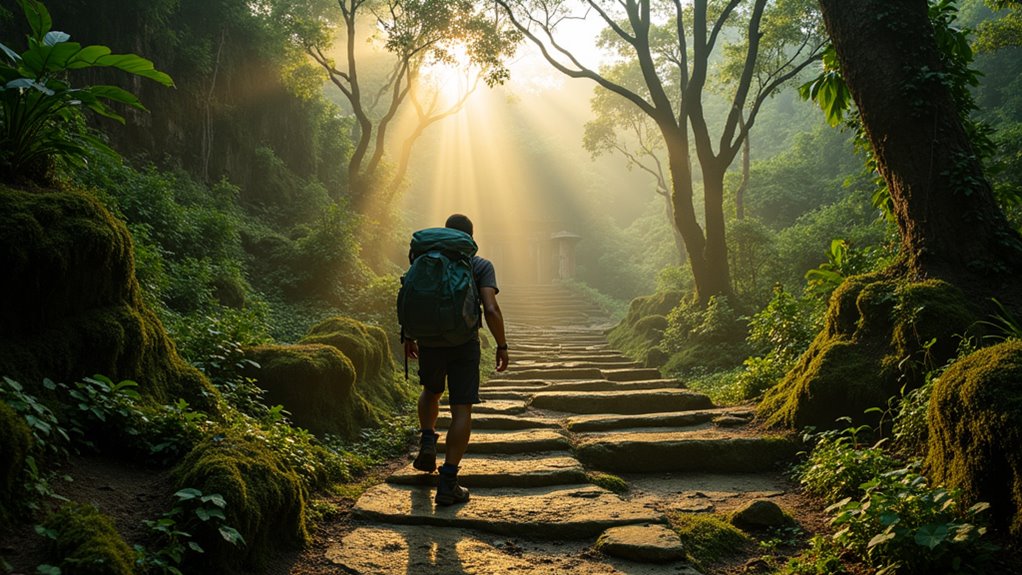
Deep within Colombia’s Sierra Nevada de Santa Marta mountains, you’ll undertake one of South America’s most challenging archaeological treks—a 4-5 day journey through dense jungle to reach Teyuna, the ancient Tayrona city known as Ciudad Perdida.
You must book through licensed operators who’ll transport you from Santa Marta to El Mamey trailhead via 4×4. Expect 5-7 hours daily hiking across 44-60 kilometers of steep, muddy trails through humid rainforest.
You’ll ford multiple rivers and climb 1,200 stone steps to reach the terraces. Nights are spent in basic jungle camps with bunk beds and cold showers. Pack light—about 6 kilograms of personal items.
This moderate-to-challenging trek demands good fitness, especially on compressed 3-day versions rated 10/10 difficulty. The journey includes visits to indigenous Kogui villages, providing culture alongside the archaeological exploration.
Witness Medellín’s Urban Transformation in Comuna 13
From Colombia’s ancient archaeological wonders, you’ll find equally compelling stories of modern resilience in Medellín’s Comuna 13. Here, one of South America’s most violent neighborhoods transformed into a symbol of urban innovation.
You’ll ride the Metrocable system connecting steep hillsides to downtown, then take the remarkable 400-meter outdoor escalators that replaced a grueling 30-minute climb with a 6-minute glide through the mountainous terrain.
The dense street art scene tells stories of past violence and future hope through massive murals covering building facades. Local hip-hop collectives perform throughout the neighborhood, while former gang members now work as tour guides sharing their transformation stories. These collective workshops involved residents in designing the innovative mobility solutions that would reshape their daily lives.
What started as infrastructure for residents has become one of Medellín’s most powerful examples of social urbanism in action.
Stargaze in the Red Canyons of Tatacoa Desert
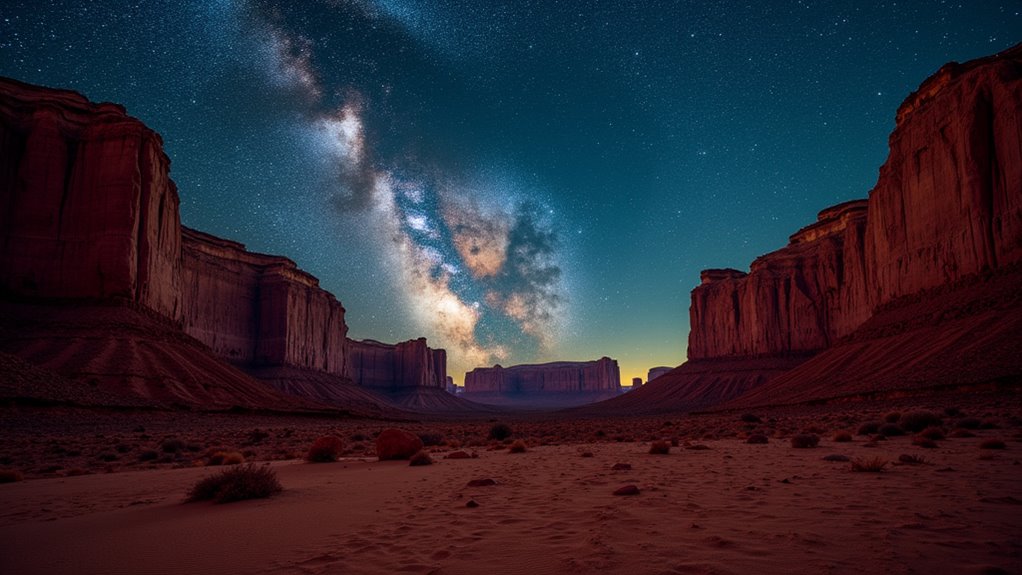
While Medellín showcases Colombia’s urban renewal, the Tatacoa Desert reveals the country’s celestial magnificence through some of South America’s darkest skies. Located 330 kilometers south of Bogotá, this 330-square-kilometer tropical dry forest offers unparalleled stargazing conditions due to minimal light pollution and frequent cloudless nights.
Head to the Cuzco sector’s red canyons, where iron-rich soil creates dramatic rust-colored formations that provide stunning foregrounds for astrophotography. The astronomical observatory near these crimson badlands offers telescopes and guided constellation tours, helping you spot planets, nebulae, and star clusters.
You’ll access both Northern and Southern Hemisphere constellations from this equatorial location. Take the 3.5-kilometer loop trail starting at sunset, then settle in for laser-guided sky explanations that’ll transform your understanding of Colombia’s celestial canvas. Avoid visiting during full moon phases when the bright lunar light diminishes visibility of fainter stars and celestial objects.
Discover Ancient Megaliths at San Agustín Archaeological Park
After contemplating Colombia’s cosmic wonders above, you’ll uncover equally mysterious forces carved in stone at San Agustín Archaeological Park. This UNESCO World Heritage site in Huila Department houses South America’s largest collection of megalithic statues—over 500 scattered across the Upper Magdalena Valley.
You’ll encounter haunting volcanic stone guardians depicting jaguars, serpents, shamanic figures, and composite beings that protected elite burials from the 1st-12th centuries CE.
Explore the main park’s 200 preserved statues alongside 20 monumental burial mounds, then venture to satellite sites like Alto de los Ídolos. The sculptures’ crocodile motifs reveal ancient trade connections despite no local species. Richard Cross’s archaeological photography documented not only these magnificent stones but also the skilled craftspeople whose labor brought them to life.
These towering sentinels once bore vivid red, yellow, and white pigments, creating a vibrant necropolis that reflected sophisticated Agustínian chiefdom beliefs about death and cosmic forces.
Experience Nature’s Color Show at Caño Cristales River
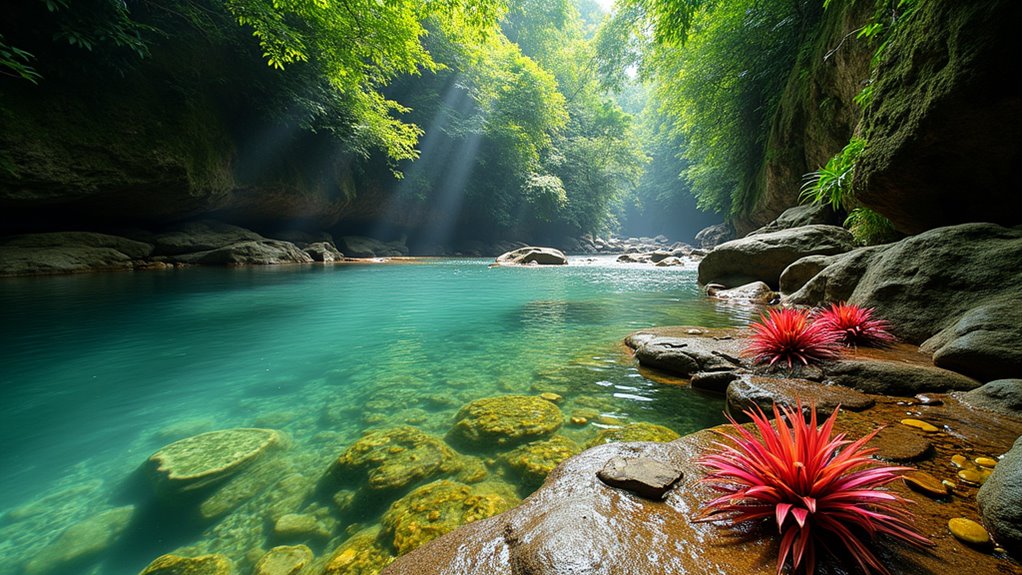
Between late June and November, you’ll witness one of Colombia’s most extraordinary natural phenomena at Caño Cristales, where the riverbed transforms into a living kaleidoscope of yellow, green, blue, black, and red hues. The endemic aquatic plant Macarenia clavigera creates this “Liquid Rainbow” effect when water levels drop after the rainy season, allowing sunlight to penetrate the crystal-clear waters.
Located in Serranía de la Macarena National Natural Park, this 100-kilometer tributary requires advance booking since only 170 visitors are permitted daily. You’ll need to join guided tours and follow strict environmental protocols—no sunscreen or repellent in the water.
The surrounding ecosystem merges Andes, Amazon, and Llanos regions, supporting over 420 bird species. Access improved considerably after 2009 when security concerns diminished. As you explore the riverbed, you’ll discover small, round formations called giants kettles carved out by rotating rocks and pebbles over time.
Relax on Caribbean Beaches in Tayrona National Park
Thirty kilometers of pristine Caribbean coastline await you at Tayrona National Natural Park, where jungle-backed beaches offer Colombia’s most spectacular coastal retreat.
You’ll discover safe swimming at protected spots like La Piscina, where offshore rocks create calm, deep water perfect for snorkeling. Cabo San Juan del Guía delivers Colombia’s most iconic beach experience with its white sand and palm-covered double-bay setting.
Plan a 1-2 hour jungle hike from El Zaino to reach the main beach belt, then explore interconnected coves via coastal trails. For quieter experiences, head to Neguanje Beach or isolated Bahía Chengue. Playa Cristal offers exceptional snorkeling with its vibrant coral reefs and crystal-clear waters, though daily visitor limits of 300 people require advance planning.
Remember that swimming’s prohibited at wave-exposed stretches like Arrecifes and Cañaveral due to dangerous currents. Book accommodations early, as daily visitor limits protect these fragile ecosystems.
The Sum Up
You’ve got nine incredible experiences mapped out, but Colombia’s depth runs much deeper. Don’t rush between destinations—stay longer in fewer places to truly absorb each region’s distinct character. Book domestic flights early; overland travel eats serious time. Pack layers regardless of your itinerary—altitude changes dramatically affect temperature. Most importantly, engage with locals at every stop. They’ll point you toward hidden gems that don’t make guidebooks but create the memories you’ll treasure most.