

You’ll find yourself torn between Ireland’s rugged coastlines and intimate village pubs, between ancient castles and vibrant modern cities. This emerald isle doesn’t just offer scenery—it delivers experiences that’ll reshape how you think about travel itself. From standing atop 700-foot cliffs where Europe meets the Atlantic to wandering through landscapes that inspired countless legends, Ireland’s thirteen most compelling adventures await your discovery.
- Stand on the Edge of Europe at the Cliffs of Moher
- Kiss the Blarney Stone for the Gift of Gab
- Marvel at the Giant’s Causeway’s Ancient Basalt Columns
- Explore Dublin’s Literary Pubs and Trinity College’s Book of Kells
- Drive the Ring of Kerry’s Dramatic Coastal Route
- Discover Ireland’s Brewing Heritage at the Guinness Storehouse
- Walk Through Medieval History at Kilkenny Castle
- Experience Traditional Irish Culture on the Dingle Peninsula
- Find Peace Among the Monastic Ruins of Glendalough
- Stroll Through Europe’s Largest City Park at Phoenix
- Uncover Ireland’s Revolutionary Past at Kilmainham Gaol
- Get Lost in the Otherworldly Landscape of the Burren
- Breathe in the Gardens and Grandeur of Powerscourt Estate
- The Sum Up
Stand on the Edge of Europe at the Cliffs of Moher
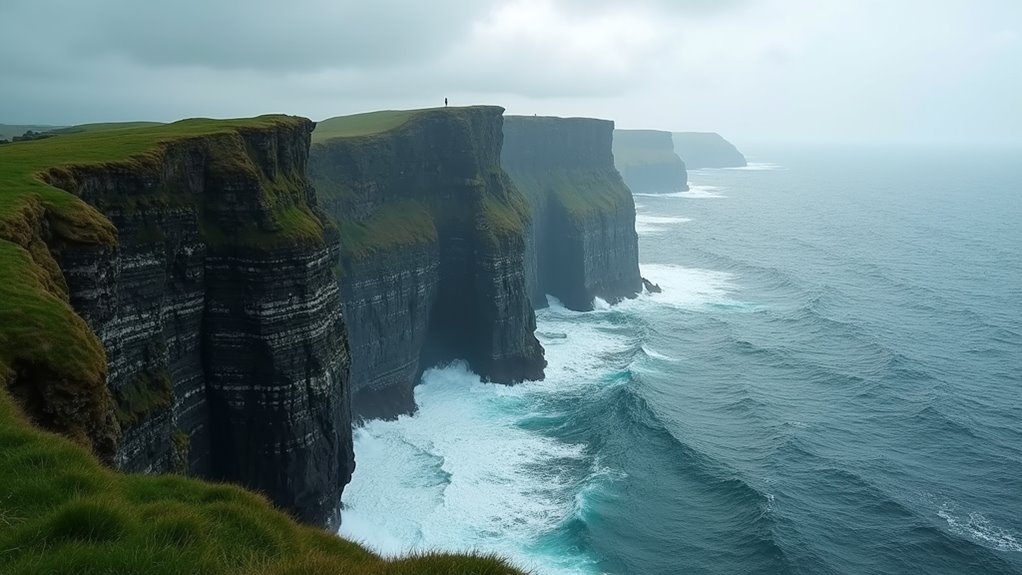
Standing 702 feet above the crashing Atlantic waves, you’ll find yourself at one of Europe’s most dramatic natural landmarks. The Cliffs of Moher stretch 8.7 miles along Ireland’s western coast, offering breathtaking panoramic views of the Aran Islands, Galway Bay, and distant mountain ranges.
You’ll be walking among Ireland’s largest mainland seabird colony, where over 30,000 breeding birds including Atlantic Puffins and Guillemots nest along the cliff faces. Pack binoculars for ideal bird watching, especially during puffin season starting in late March.
Visit O’Brien’s Tower for the best vantage point, then explore the award-winning visitor center built seamlessly into the landscape. The cliffs have served as a backdrop for major films including The Princess Bride and Harry Potter and the Half-Blood Prince. With 1.5 million annual visitors, you’ll understand why this UNESCO Global Geopark ranks as Ireland’s second most popular attraction.
Kiss the Blarney Stone for the Gift of Gab
From Ireland’s stunning coastal views, you’ll want to venture inland to Cork County for one of the country’s most legendary experiences. At Blarney Castle, just five miles northwest of Cork City, you’ll find the famous Blarney Stone embedded in the castle’s 15th-century battlements.
Legend says kissing this block of Carboniferous limestone grants you the “gift of gab” – eloquence, charm, and persuasive speaking abilities. You’ll need to climb to the castle’s top, then lean backward while gripping iron bars to reach the stone. Staff will assist you with this challenging position.
The castle itself has a rich history, with King Dermot McCarthy moving the stone into an enlarged castle in 1446.
Whether you believe in Irish goddess Clíodhna’s blessing or not, millions of visitors participate in this ritual annually, making it Ireland’s most iconic tourist tradition.
Marvel at the Giant’s Causeway’s Ancient Basalt Columns
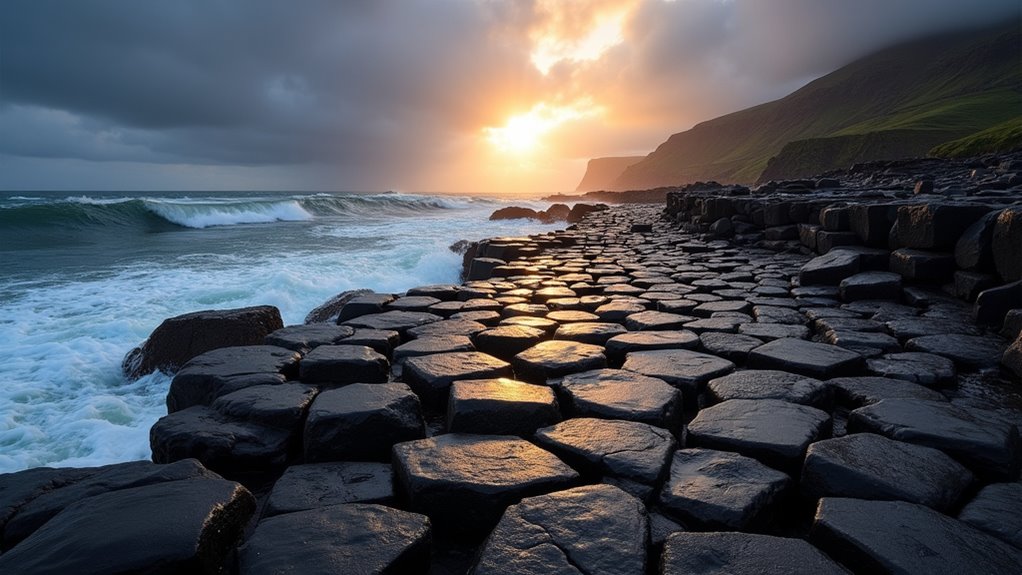
After exploring Cork’s medieval castle, head north to County Antrim where you’ll encounter one of Earth’s most spectacular geological wonders.
The Giant’s Causeway showcases 40,000 interlocking basalt columns formed 50-60 million years ago during intense volcanic activity. You’ll walk across these mostly hexagonal stepping stones that lead directly into the sea, marveling at nature’s geometric precision.
These columns resulted from slow-cooling lava that contracted and fractured into polygonal shapes. The tallest columns reach 40 feet high, creating a natural stairway that disappears underwater.
You’re experiencing a prime example of volcanic geology that helped prove 18th-century theories about igneous rock formation. The site’s dramatic coastline setting makes this ancient volcanic plateau one of Ireland’s most breathtaking natural monuments. This UNESCO World Heritage Site has welcomed over 998,000 visitors annually, establishing itself as Northern Ireland’s premier natural attraction.
Explore Dublin’s Literary Pubs and Trinity College’s Book of Kells
While Northern Ireland showcases nature’s geological artistry, Dublin reveals Ireland’s profound literary soul through its historic pubs and ancient manuscripts.
You’ll discover The Brazen Head, Dublin’s oldest pub dating to 1198, where Jonathan Swift once criticized the porter. Visit Davy Byrne’s on Duke Street, immortalized in Joyce’s “Ulysses,” where Leopold Bloom dined alongside the author himself.
Mulligan’s on Poolbeg Street welcomed Joyce and Brendan Behan, who famously called himself “a drinker with a writing problem.” The Palace Bar hosted 1930s literary gatherings, while Neary’s attracted theater performers from the nearby Gaiety Theatre. At Trinity College, you’ll witness the magnificent Book of Kells, a 9th-century illuminated manuscript that exemplifies Dublin’s medieval literary heritage.
Join a Dublin Literary Pub Crawl for immersive storytelling performances that bring these venues’ rich histories to life. You’ll experience authentic atmospheres where Ireland’s greatest writers crafted their masterpieces.
Drive the Ring of Kerry’s Dramatic Coastal Route
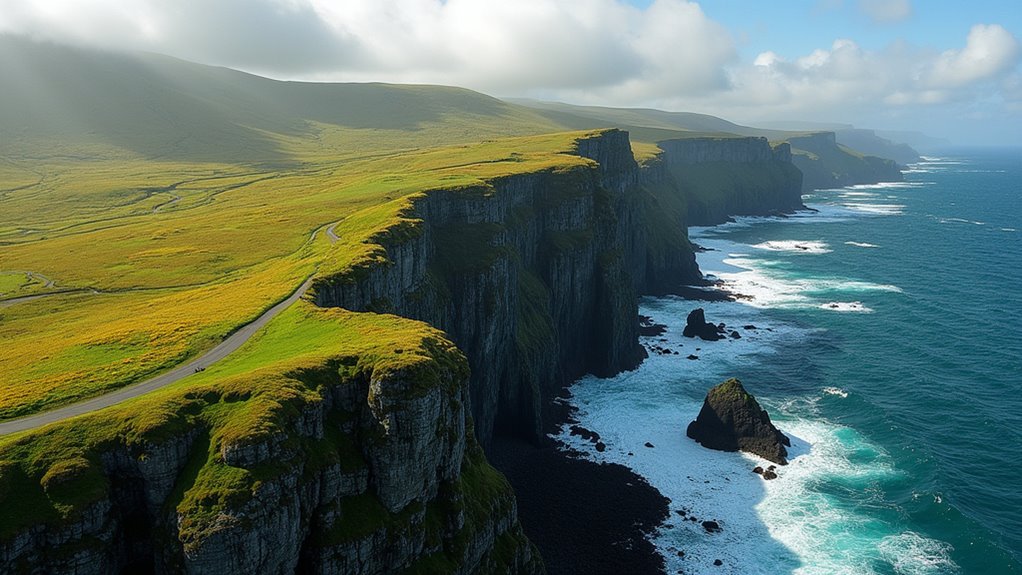
Ireland’s most spectacular driving experience awaits along the Ring of Kerry, where you’ll navigate 179 kilometers of dramatic coastline, ancient mountains, and emerald valleys around the Iveragh Peninsula.
Starting from Killarney, you’ll wind through charming villages like Sneem and Waterville while soaking in panoramic views of the Wild Atlantic Ocean.
Drive clockwise to easily pull over at scenic viewpoints, especially the towering Kerry Cliffs near Portmagee and Skellig Islands overlooks. The Kerry Cliffs are over 400 million years old and stand majestically at 1,000 feet high, making them Ireland’s most impressive coastal formations.
The route typically takes 7-10 hours with stops, so start early to avoid tourist buses.
Don’t miss Killarney National Park‘s lakes and forests, and keep your camera ready for puffins along the coastal sections.
Plan a full day to truly absorb this unforgettable Irish adventure.
Discover Ireland’s Brewing Heritage at the Guinness Storehouse
Since Arthur Guinness signed his legendary 9,000-year lease in 1759, St. James’s Gate Brewery has become the heart of Ireland’s brewing legacy. You’ll explore seven floors of interactive exhibits that bring 265+ years of Guinness history to life at Ireland’s top attraction for 15 consecutive years.
The Guinness Academy will certify you as a pint-pouring expert—join the 102,000 visitors who mastered this skill in 2024. You’ll discover the brewing process on the new Ingredients Floor before heading to the Gravity Bar for panoramic Dublin views. The attraction celebrated its 25th anniversary in 2024, marking a quarter-century of welcoming visitors to this iconic Dublin destination.
With 1.65 million annual visitors from over 200 countries, you’re experiencing more than a brewery tour. You’re connecting with Irish culture and heritage while enjoying fresh pints in an unforgettable setting.
Walk Through Medieval History at Kilkenny Castle
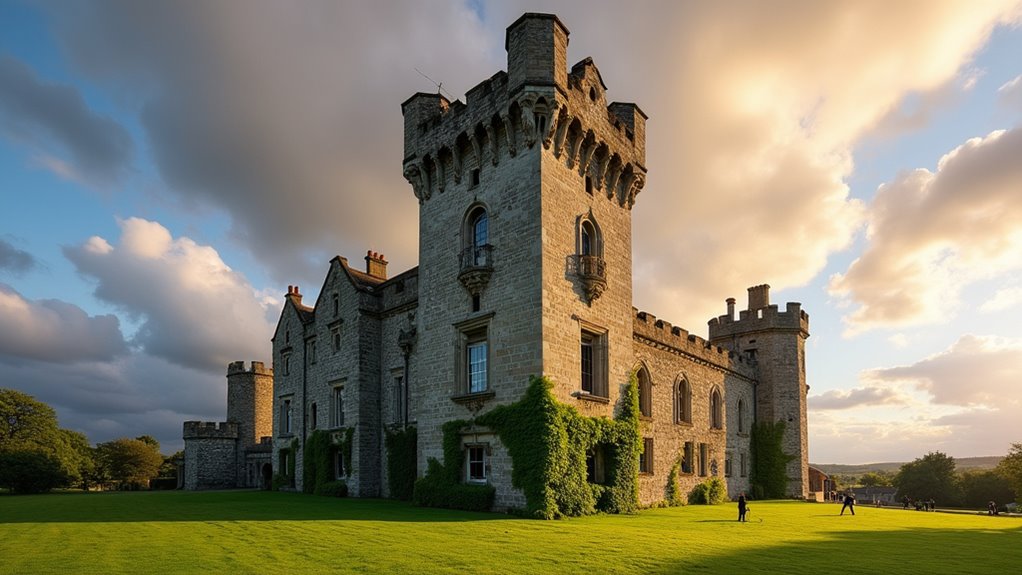
When you step through the gates of Kilkenny Castle, you’re entering nearly 850 years of Irish history that began with Richard de Clare’s wooden fortress in 1172. You’ll explore the stone castle that William Marshal built around 1209, featuring three surviving circular towers connected by massive curtain walls.
Unlike typical medieval castles, there’s no central keep here – instead, you’ll discover how overlapping defensive positions and a deep moat protected this Norman stronghold.
As you walk through the Butler family’s former seat, you’ll see 19th-century renovations alongside medieval architecture. The castle controlled the River Nore crossing for centuries and witnessed Cromwell’s siege in 1650. The Butlers maintained this fortress as their seat for over 600 years, creating one of Ireland’s most enduring noble legacies.
Today, you can experience both its military heritage and aristocratic grandeur in one unforgettable visit.
Experience Traditional Irish Culture on the Dingle Peninsula
Although you’ll find Irish culture throughout the country, the Dingle Peninsula offers something extraordinary – it’s a living Gaeltacht where Irish Gaelic still flows naturally in daily conversation. You’ll see bilingual signs everywhere and hear traditional music sessions spilling from cozy pubs in Dingle town.
Experience authentic farm life at sheepdog demonstrations, where locals still use Irish commands to guide their dogs. Hold newborn lambs during springtime visits, connecting directly with rural traditions.
Explore ancient sites like the 1,000-year-old Gallarus Oratory and medieval Fahan Beehive Huts that tell stories of early Irish Christianity. The Slea Head Drive takes you past clusters of these prehistoric dwellings along a scenic circular route showcasing the peninsula’s most dramatic landscapes.
Visit the Blasket Center to learn about island life before the 1950s evacuation. Join pottery courses with local artisans or browse the West Kerry Craft Guild’s traditional Irish arts and crafts in town.
Find Peace Among the Monastic Ruins of Glendalough
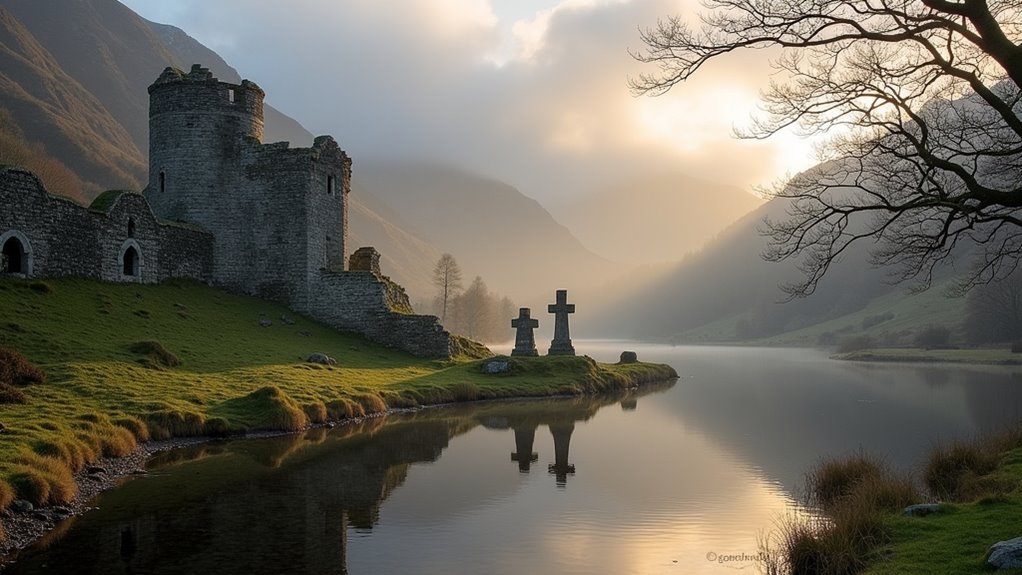
From the vibrant culture of Dingle, you’ll discover Ireland’s spiritual heritage takes on profound meaning at Glendalough, where ancient monastic ruins nestle in County Wicklow‘s glacial valley.
Founded by St. Kevin in the 6th century, this “Valley of the Two Lakes” flourished for 600 years as Ireland’s premier pilgrimage destination.
You’ll explore seven church ruins, including the impressive Cathedral of St Peter & St Paul, while the iconic Round Tower stands sentinel over the peaceful grounds.
Walk through Ireland’s only surviving monastic gateway, where granite arches mark the sacred boundary that once sheltered manuscripts and welcomed medieval pilgrims.
The settlement’s resilience shines through its survival of repeated Viking attacks during the 9th and 10th centuries, testament to the enduring faith of its monastic community.
The tranquil lakes and surrounding mountains create perfect conditions for reflection, connecting you to centuries of spiritual seekers who found solace in this remarkable valley.
Stroll Through Europe’s Largest City Park at Phoenix
After experiencing Ireland’s spiritual depths, you’ll find a different kind of sanctuary in Phoenix Park, where 707 hectares of rolling green space create Europe’s largest enclosed city park right in Dublin’s backyard. You can walk here from central Dublin in just 30 minutes, making it an easy escape from city life.
The park’s impressive scale becomes clear as you explore its 30 kilometers of footpaths and encounter the wild fallow deer herd that’s roamed these grounds since the 1660s.
You’ll discover major attractions like Dublin Zoo, the President’s residence at Áras an Uachtaráin, and the towering Wellington Monument. With 24 distinct habitats supporting 35% of Ireland’s species, every stroll reveals something new in this remarkable urban wilderness. The park maintains its natural character with only 7% coverage dedicated to buildings and roads, leaving vast expanses for wildlife to flourish.
Uncover Ireland’s Revolutionary Past at Kilmainham Gaol
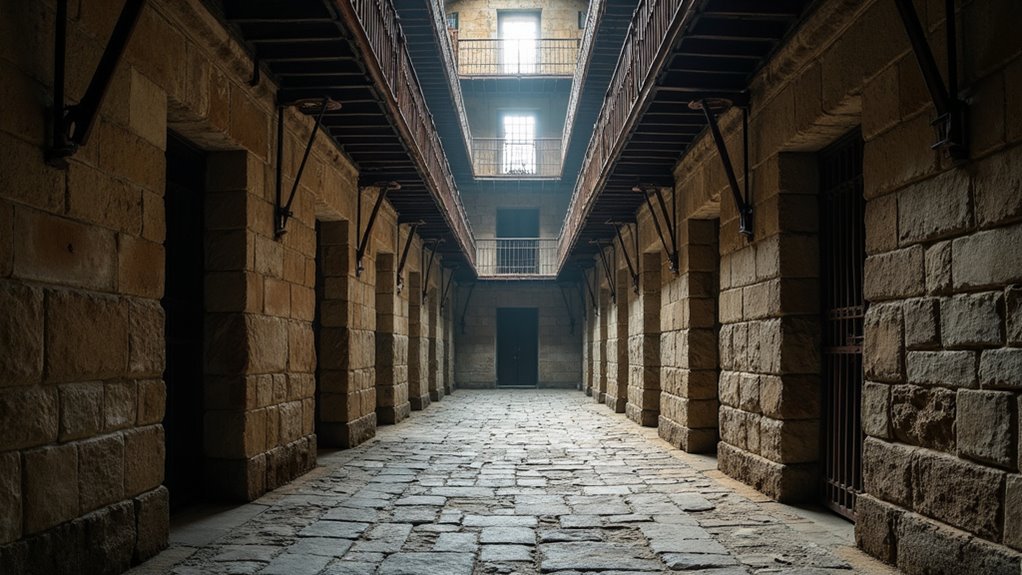
When you step through the imposing gates of Kilmainham Gaol, you’re entering what’s often called the “Irish Bastille” – a fortress-like prison that witnessed Ireland’s most pivotal moments from 1796 to 1924.
You’ll walk through the same corridors where revolutionary leaders from every major Irish uprising were held, from Robert Emmet in 1803 to the Easter Rising rebels of 1916.
The prison’s panopticon design allowed guards to watch prisoners continuously, creating an atmosphere you can still feel today.
You’ll visit the Stonebreaker’s Yard where fourteen Easter Rising leaders faced firing squads, and see the chapel where Joseph Plunkett married Grace Gifford hours before his execution.
This museum powerfully connects you to Ireland’s struggle for independence through authentic spaces where history unfolded. Many visitors and staff report experiencing paranormal phenomena during their time at the site, from unexplained footsteps to ghostly apparitions in period clothing.
Get Lost in the Otherworldly Landscape of the Burren
While Dublin’s Kilmainham Gaol reveals Ireland’s human story through stone walls and iron bars, County Clare‘s Burren unfolds an even more ancient tale written in limestone that’s 300 million years in the making.
You’ll discover a moonscape where glacial ice carved terraced hills and flat plains from Carboniferous rock. The karst terrain creates limestone pavements—flat stones called clints split by deep fissures known as grikes. These cracks harbor extraordinary botanical treasures where Arctic, alpine, and Mediterranean plants grow side by side.
Spring transforms this seemingly barren landscape into vibrant wildflower displays. You’ll find rare orchids nestled in rock crevices and gentians blooming in soil pockets. The region hosts an incredible three-quarters of Ireland’s 900 native plant species in this unique limestone environment. Start your exploration from Doolin village, then venture to Mullaghmore’s terraced hills for the full otherworldly experience.
Breathe in the Gardens and Grandeur of Powerscourt Estate
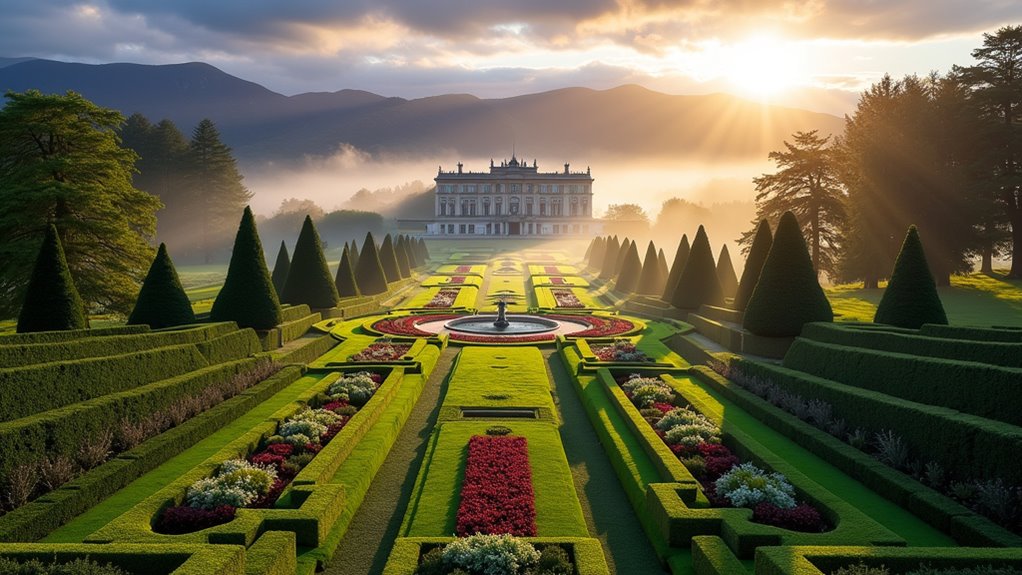
Twenty kilometers south of Dublin, you’ll find Ireland’s most spectacular garden estate where 300 years of aristocratic vision meets breathtaking natural beauty. Powerscourt Estate’s 47-acre gardens showcase elaborate terraces, ornamental lakes, and stunning statuary against the backdrop of the Wicklow Mountains.
You’ll wander through formal Italian-inspired sections and tranquil Japanese gardens, each meticulously designed in the 1840s by architect Daniel Robertson.
Don’t miss the magnificent Palladian mansion with its 68 rooms and baroque towers, transformed from a medieval castle by German architect Richard Cassels. The estate endured a devastating fire in 1974 but was carefully restored and reopened to visitors in 1996.
Complete your visit at Ireland’s highest waterfall, plunging 398 feet through the estate’s deer park.
The combination of architectural grandeur, horticultural artistry, and natural drama creates an unforgettable Irish experience.
The Sum Up
You’ve got thirteen incredible adventures waiting across Ireland’s emerald landscape. Whether you’re chasing dramatic cliff views, hunting for literary treasures, or soaking up traditional music in cozy pubs, each experience connects you to Ireland’s soul. Don’t try to rush through everything—pick the spots that call to you most. Pack comfortable shoes, bring a rain jacket, and get ready to fall head-over-heels for Ireland’s magic.