
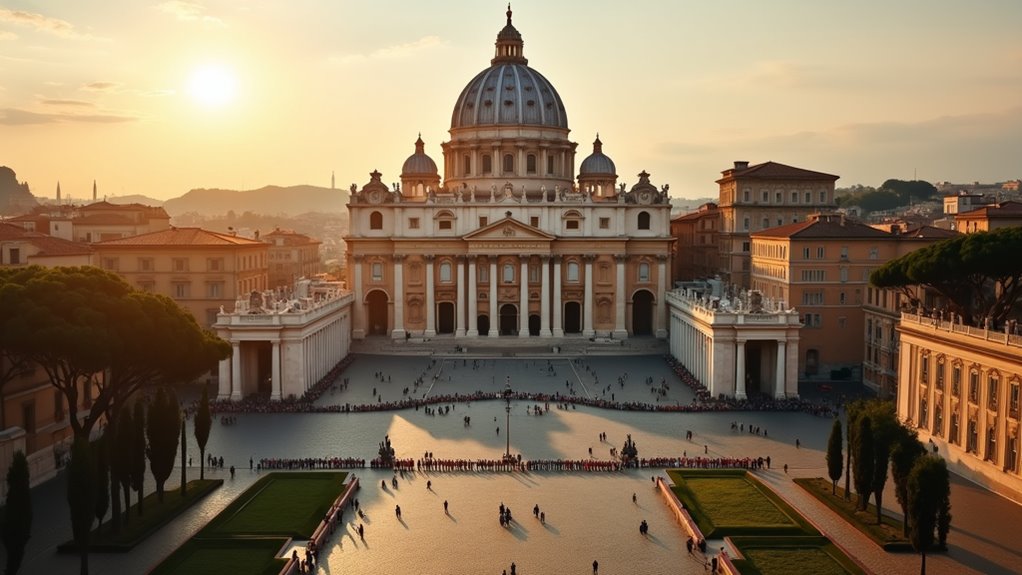
You’ve probably heard Vatican City is the world’s smallest country, but you might not realize it packs more artistic treasures per square foot than anywhere else on Earth. Whether you’re working with a tight budget or planning a splurge, there are smart ways to experience everything from Michelangelo’s masterpieces to secret papal ceremonies. The key isn’t just knowing what to see—it’s understanding when and how to see it without breaking the bank or getting lost in tourist traps.
- Climb St. Peter’s Dome for Rome’s Best Views
- Marvel at Michelangelo’s Sistine Chapel Ceiling
- Explore the Vatican Museums’ Nine Miles of Art
- Stand Before Michelangelo’s Pietà in St. Peter’s Basilica
- Experience the Grandeur of St. Peter’s Square
- Discover Ancient Treasures in the Pio-Clementino Museum
- Walk Through Raphael’s Renaissance Masterpieces
- Stroll the Vatican Gardens’ Hidden Landscapes
- Witness the Swiss Guard Ceremony
- Time Your Visit With a Papal Audience
- The Sum Up
Climb St. Peter’s Dome for Rome’s Best Views
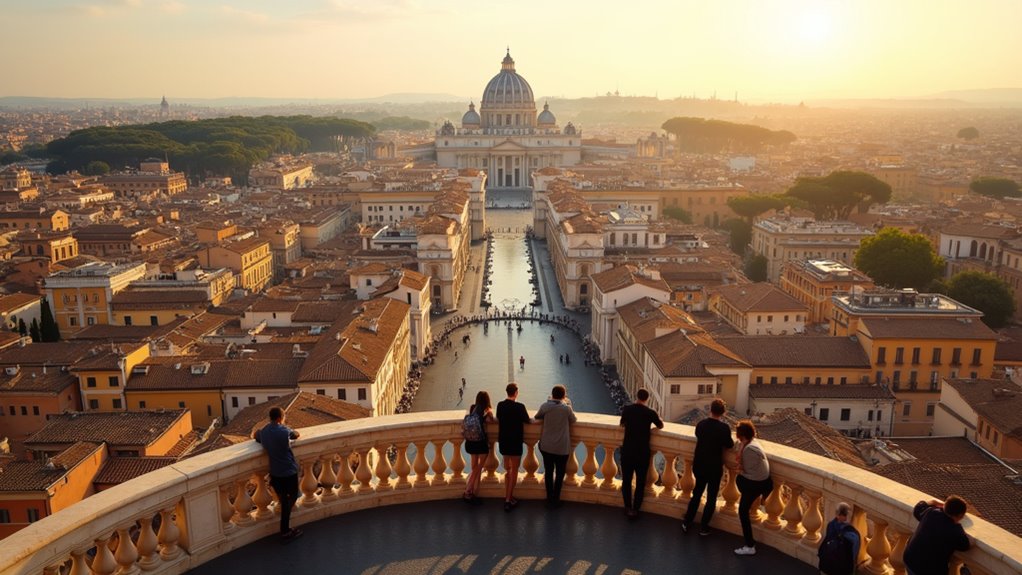
When you’re looking for the ultimate Rome vista without breaking the bank, climbing St. Peter’s Dome delivers unmatched panoramic views of Vatican City and beyond.
You’ll face two options: tackle all 551 steps for €8-€10, or take the elevator partway and climb 320 steps for €10-€15. Save money by buying tickets at on-site kiosks (cash only) rather than booking online.
The climb’s challenging but doable for most fitness levels. You’ll first reach a terrace behind the basilica’s statues, then navigate increasingly narrow spiral staircases inside Michelangelo’s 136-meter dome.
Skip this if you’re claustrophobic or fear heights.
Visit early morning to avoid crowds, especially on Wednesdays. The dome operates with summer hours from April through September (8 AM to 6 PM) and reduced winter hours from October to March.
The reward? Stunning 360-degree views of St. Peter’s Square, Rome’s cityscape, and intricate dome mosaics up close.
Marvel at Michelangelo’s Sistine Chapel Ceiling
Over 300 figures sprawl across Michelangelo’s legendary ceiling, making the Sistine Chapel’s masterpiece one of history’s most ambitious artistic undertakings. You’ll crane your neck to see nine Genesis scenes, including the famous Creation of Adam, painted between 1508-1512.
The artist worked lying on his back across 12,000 square feet, despite hating the physical demands.
Look for twelve prophets and sibyls positioned around the central panels – they’re the large figures who foretold Christ’s coming. The complex fresco technique has survived over 500 years, though a 1990s restoration removed centuries of grime to reveal vibrant original colors. Michelangelo actually painted standing with his head tilted backwards, not lying down as popular myths suggest.
Entry’s included with Vatican Museums tickets, but expect crowds. Visit early morning or late afternoon for slightly fewer visitors blocking your view of this Renaissance masterpiece.
Explore the Vatican Museums’ Nine Miles of Art
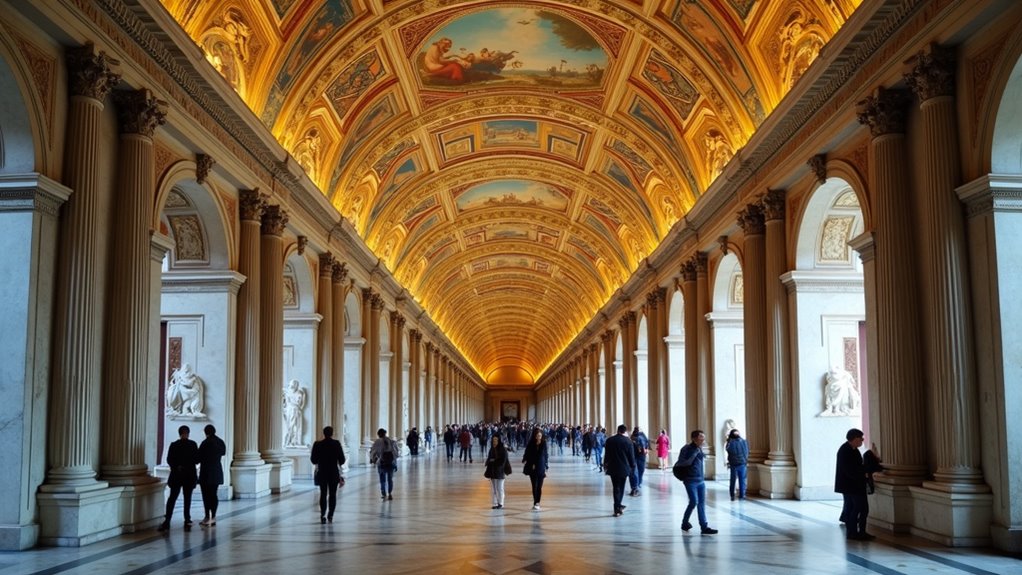
After absorbing Michelangelo’s ceiling masterpiece, you’ll find yourself amid one of the world’s largest museum complexes. The Vatican Museums stretch across 40,000+ square meters, housing 54 galleries with roughly 20,000 works on display from their 70,000-piece collection.
You’ll encounter 25 centuries of art—from ancient Egyptian mummies and Greek sculptures to Renaissance masterpieces by Leonardo da Vinci and Caravaggio. Don’t miss the Pio Clementino Museum’s 1,600 classical sculptures or the Pinacoteca’s 400 Old Master paintings.
Book tickets in advance since 6.8 million visitors explore these halls annually. Budget several hours minimum—there’s literally nine miles of galleries to navigate. The collection’s origins trace back to Pope Julius II in the 16th century, when he began acquiring Greek and Roman antiquities. The sheer scale means you can’t see everything, so prioritize collections that interest you most.
Stand Before Michelangelo’s Pietà in St. Peter’s Basilica
Few artworks command reverence like Michelangelo’s Pietà, perhaps the world’s most moving sculpture housed within St. Peter’s Basilica. You’ll find this masterpiece in the first chapel on your right after entering, protected behind bulletproof glass following a 1972 vandalism incident.
Carved from a single block of Carrara marble when Michelangelo was just 23, this sculpture depicts Mary cradling Christ’s lifeless body. What’s striking is Mary’s youthful appearance and serene expression—Michelangelo believed pure souls never age.
Unlike typical depictions of anguish, this Pietà radiates divine acceptance. The life-sized scale creates an intimate emotional connection. Look for Michelangelo’s signature across Mary’s sash—reportedly the only work he signed during his lifetime. The artist used the imperfect tense “faciebat” in his inscription, suggesting he viewed the work as continuously evolving rather than truly finished.
It’s free to view with basilica entry, making it an essential Vatican experience.
Experience the Grandeur of St. Peter’s Square
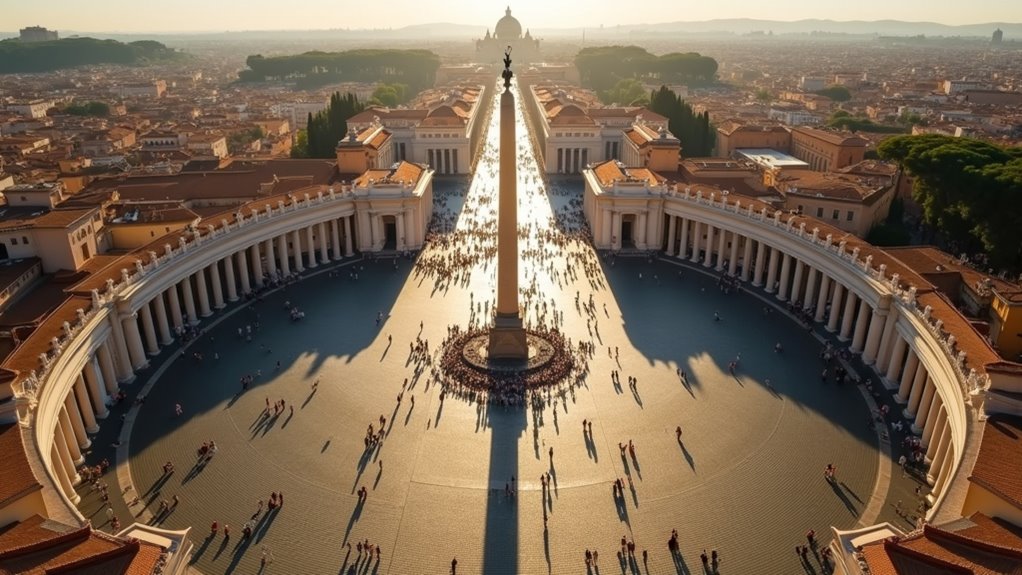
Stand at the center near the towering 25-meter Egyptian obelisk for the best perspective. From here, you’ll notice how the elliptical colonnades create an optical illusion – the four rows of columns appear as one when viewed from specific marble discs embedded in the pavement.
Don’t miss the 140 statues of saints crowning the colonnades, each over three meters tall.
The two fountains by Bernini and Maderno frame this sacred space perfectly, creating balance in this architectural triumph. The square’s design functions as a welcoming embrace, drawing pilgrims and visitors into the heart of Vatican City.
Discover Ancient Treasures in the Pio-Clementino Museum
When you step into the Pio-Clementino Museum, you’ll find yourself surrounded by some of the world’s most celebrated ancient sculptures without paying extra beyond your Vatican Museums ticket.
You’ll encounter masterpieces like the dramatic Laocoön Group, showing a Trojan priest battling sea-serpents, and the Apollo Belvedere, which epitomizes classical perfection.
Don’t miss the Round Hall’s stunning Pantheon-inspired dome or Nero’s massive red porphyry bathtub in the Sala Rotonda.
The Hall of Animals showcases restored Roman animal statues, while the Sala dei Busti displays Roman emperor portraits including Julius Caesar and Augustus.
Budget tip: Since photography’s allowed in most areas, you can capture these priceless artifacts for free.
Plan at least two hours to properly explore this treasure trove. The Belvedere Torso, a fragmentary marble sculpture, has inspired Renaissance masters like Michelangelo with its powerful anatomical form.
Walk Through Raphael’s Renaissance Masterpieces
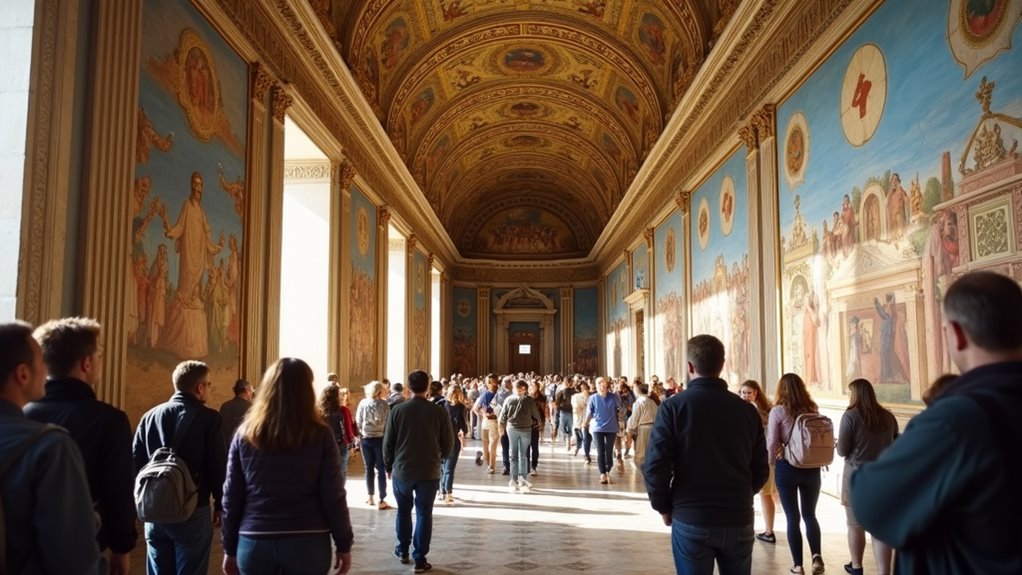
Just beyond the ancient sculptures of the Pio-Clementino Museum, you’ll discover Raphael’s four legendary rooms that showcase some of the Renaissance’s greatest artistic achievements. These reception rooms, commissioned by Pope Julius II between 1508-1524, contain breathtaking frescoes that’ll leave you speechless.
Start with the Room of the Segnatura, where you’ll find The School of Athens – possibly Raphael’s masterpiece. This former papal library features walls representing Truth, Good, and Beauty through philosophical and theological themes. The room served as the council chamber for the Apostolic Signatura, where important papal documents were officially signed and sealed.
Continue to the Room of Heliodorus, showcasing dramatic biblical scenes with vivid colors. The Room of the Fire in the Borgo depicts miraculous papal interventions, while the grand Hall of Constantine celebrates Christianity’s triumph through sweeping historical narratives completed by Raphael’s pupils after his death.
Stroll the Vatican Gardens’ Hidden Landscapes
After exploring Raphael’s artistic genius indoors, step outside to discover Vatican City’s best-kept secret – the sprawling Vatican Gardens that cover nearly half the papal state’s territory. You’ll need to book a guided tour since these 57 acres serve as the Pope’s private retreat and aren’t open for independent exploration.
During your visit, you’ll experience three distinct garden styles. The Italian Garden showcases Renaissance symmetry with geometric patterns and cypress trees. The French Garden features formal baroque layouts with topiary art and the Fountain of the Eagle. The English Garden offers romantic winding paths through rose and lavender flowerbeds.
Don’t miss unique features like the Lourdes Grotto replica, a boxwood labyrinth, and surprisingly, a fragment of the Berlin Wall displaying peace symbolism. You’ll also discover the historic Casino of Pius IV, an elegant villa that now houses the Pontifical Academy of Sciences and features beautiful frescoes from the Renaissance era.
Witness the Swiss Guard Ceremony
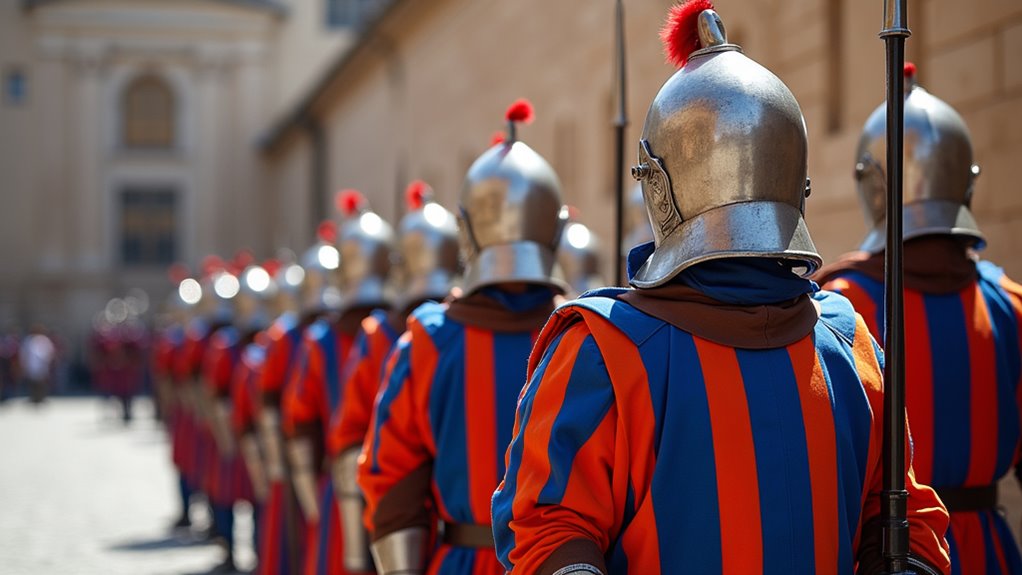
While most Vatican visitors focus on art and architecture, you can witness one of Europe’s most authentic military traditions at the annual Swiss Guard ceremony. This free event typically occurs on May 6th in San Damaso Courtyard, commemorating the 147 guards who died protecting Pope Clement VII in 1527.
You’ll watch new recruits take their historic oath, placing their left hand on the Swiss Guard flag while raising three fingers symbolizing the Holy Trinity. They pledge to serve the pope “even at risk of life” using the same formula spoken for centuries.
The ceremony includes Mass at St. Peter’s Basilica, followed by the formal oath-taking with fanfare and drumming. High-ranking Vatican officials and Swiss government representatives attend. The Swiss Guard, founded in 1506, represents the world’s oldest standing army.
Check Vatican schedules, as ceremonies can be rescheduled for papal events.
Time Your Visit With a Papal Audience
Since papal audiences offer one of the most authentic Vatican experiences without costing a penny, you’ll want to plan your Wednesday visit around the 9:00 AM gathering in Paul VI Audience Hall. Security gates open at 7:30 AM, but savvy visitors arrive three hours early to snag the best seats.
You can grab free tickets from Swiss Guards at the Bronze Door the day before or morning of the event. Don’t have tickets? You’re still welcome—Pope Francis emphasizes inclusivity, though entry depends on space availability.
The multilingual program includes papal greetings, teachings, and blessings in seven languages. You’ll witness the Pope blessing religious articles and offering apostolic blessings.
During Jubilee years like 2025, special themed audiences feature additional celebrations and unique access to Holy Door pilgrimages. The Jubilee of Youth from July 28 to August 3 is expected to draw around one million pilgrims for this remarkable spiritual gathering.
The Sum Up
You’ll find Vatican City packs incredible value into one small destination. Don’t worry about breaking the bank – many experiences like admiring St. Peter’s Square and watching the Swiss Guard won’t cost extra beyond museum admission. Book your tickets online in advance to skip lines and save time. Whether you’re climbing the dome or exploring the gardens, you’re getting world-class art, history, and spirituality all in one unforgettable visit.