
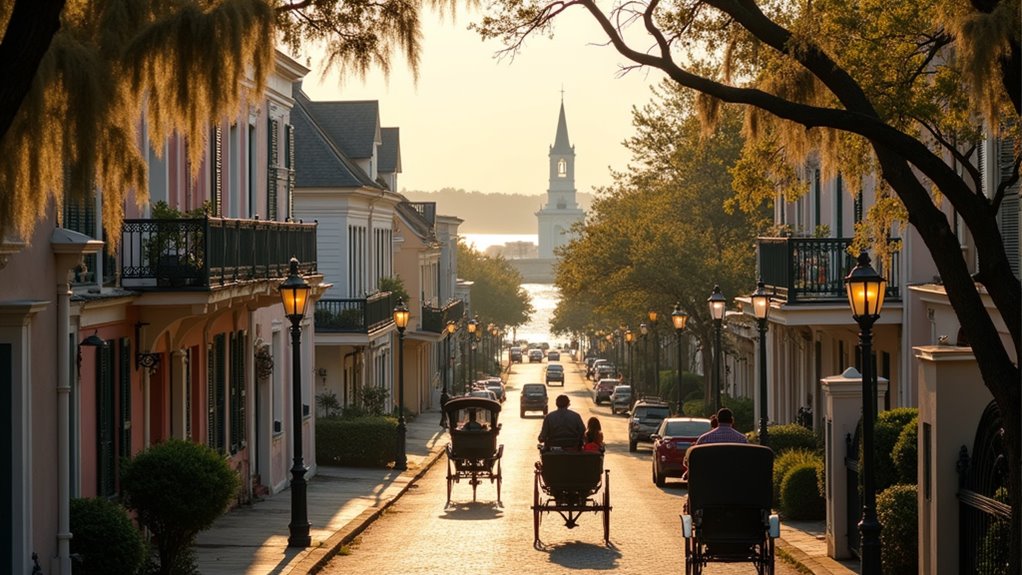
You’ll fall in love with Charleston’s Rainbow Row pastel houses, where ships once docked at colorful Georgian doorsteps. Walk cobblestone streets to The Battery’s antebellum mansions and Civil War cannons, then take harbor tours to Fort Sumter where America’s bloodiest conflict began. Kayak tidal creeks for dolphin encounters, explore Magnolia Plantation’s moss-draped gardens, and cross the Ravenel Bridge at sunrise for breathtaking views. From Gullah heritage sites to USS Yorktown’s naval history, these essential experiences reveal why Charleston captivates every visitor.
- Stroll Through Rainbow Row and the Historic District’s Cobblestone Streets
- Take a Harbor Boat Tour to Fort Sumter National Monument
- Walk or Bike Across the Arthur Ravenel Jr. Bridge at Sunrise
- Explore Magnolia Plantation’s Gardens and Swamp Tours
- Savor Lowcountry Cuisine on King Street and Beyond
- Stand Beneath the Ancient Angel Oak Tree
- Tour the USS Yorktown at Patriots Point Naval Museum
- Wander The Battery’s Antebellum Mansions and Cannons
- Experience Gullah Culture and History at the Old Slave Mart Museum
- Kayak Through Tidal Creeks for Dolphin Watching
- The Sum Up
Stroll Through Rainbow Row and the Historic District’s Cobblestone Streets
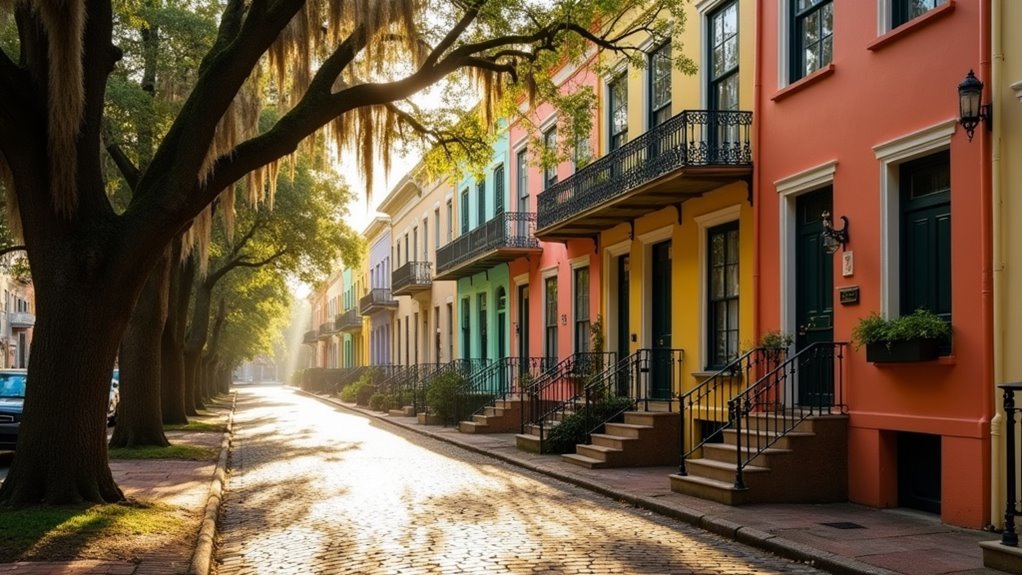
When you round the corner onto East Bay Street, Rainbow Row’s thirteen pastel Georgian houses immediately capture your attention with their candy-colored façades stretching along the historic waterfront. These merchant buildings from the 1740s-1750s once had ships docking directly at their doors before land reclamation pushed the Cooper River back.
You’ll notice each house shares party walls yet maintains distinct architectural details, creating visual rhythm as you walk. The ground-floor commercial doors and oversized windows hint at their original use as shops with residences above.
Dorothy Porcher Legge sparked the restoration movement in 1931, painting her buildings bright pink and inspiring neighbors to follow with blues, greens, and yellows. The Caribbean traditions behind these vibrant colors originally helped sailors navigate and provided cooling benefits in the coastal climate. The cobblestone streets beneath your feet complete this authentic 18th-century streetscape experience.
Take a Harbor Boat Tour to Fort Sumter National Monument
Fort Sumter’s distinction as the birthplace of America’s Civil War makes it Charleston’s most historically significant harbor destination, and you’ll need to catch one of the authorized ferry tours to reach this artificial island fortress. The 2.25-hour round-trip experience departs from Liberty Square downtown or Patriots Point in Mount Pleasant, giving you about an hour to explore the fort’s cannon positions, war-damaged brickwork, and museum exhibits.
The harbor transit itself becomes part of the attraction—you’ll cruise past Rainbow Row, The Battery, and Castle Pinckney while guides share maritime history. Keep your eyes peeled for Atlantic bottlenose dolphins during the 30-minute journey each way. Rangers often provide interpretive talks at the fort, and there’s a gift shop for Civil War memorabilia. The fort was originally constructed as a coastal defense following the War of 1812 to protect Charleston’s strategic harbor entrance.
Walk or Bike Across the Arthur Ravenel Jr. Bridge at Sunrise
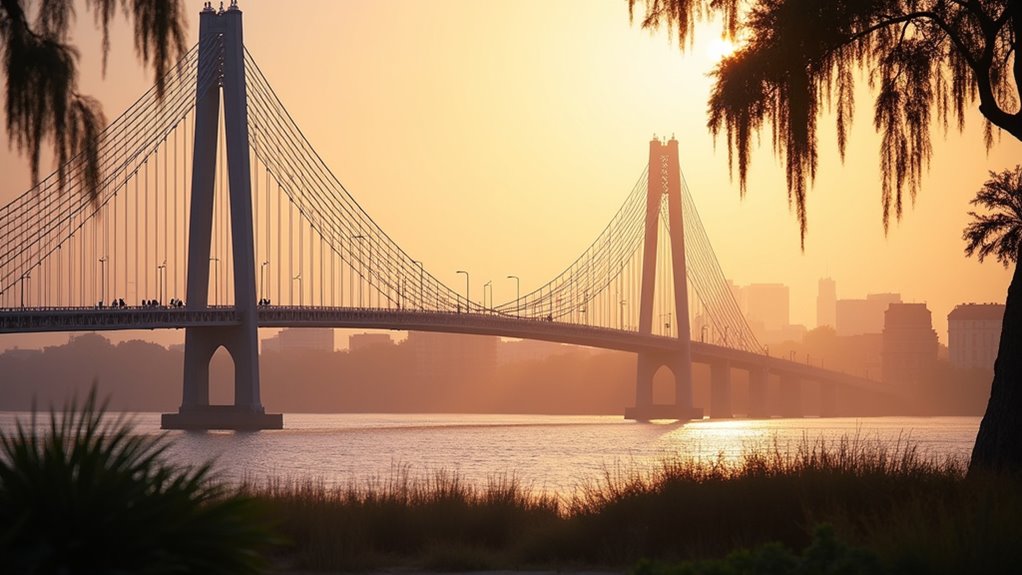
Rising 186 feet above the Cooper River, the Arthur Ravenel Jr. Bridge offers Charleston’s most spectacular sunrise experience. You’ll traverse 2.5 miles one way on the dedicated pedestrian path, safely separated from traffic by sturdy barriers.
The cable-stayed towers and sweeping harbor views create perfect photo opportunities as golden light reflects off the water below.
Plan to arrive 25-30 minutes before official sunrise (typically 6:30-7:40 a.m.) for ideal dawn colors. The sustained incline provides an excellent workout while you capture views of downtown Charleston, Mount Pleasant, and cargo ships. This modern architectural marvel opened in 2005, replacing the older spans that previously connected Charleston and Mount Pleasant.
Early morning brings lighter crowds, reduced wind, and cooler temperatures. Allow 60-90 minutes total for the walk plus photo stops to fully appreciate this iconic Charleston experience.
Explore Magnolia Plantation’s Gardens and Swamp Tours
Established in the 1840s by Reverend John Grimké Drayton, Magnolia Plantation’s romantic-style gardens offer you 25 acres of winding pathways, reflective ponds, and moss-draped oaks just 30 minutes from downtown Charleston.
You’ll discover nearly 14 miles of walking routes featuring 500 camellias and early outdoor plantings of azaleas that made this one of America’s first subtropical ornamental gardens.
Don’t miss the 150-acre Audubon Swamp Garden, where elevated boardwalks lead you through blackwater cypress swamps teeming with herons, egrets, and alligators.
The “From Slavery to Freedom” program reveals how enslaved Africans engineered the rice fields and constructed these gardens. Four restored enslaved cabins remain on the property as part of ongoing conservation efforts to honor those who worked the land.
Purchase separate tickets for swamp access and house tours to maximize your experience exploring this National Historic Landmark‘s diverse landscapes and complex history.
Savor Lowcountry Cuisine on King Street and Beyond
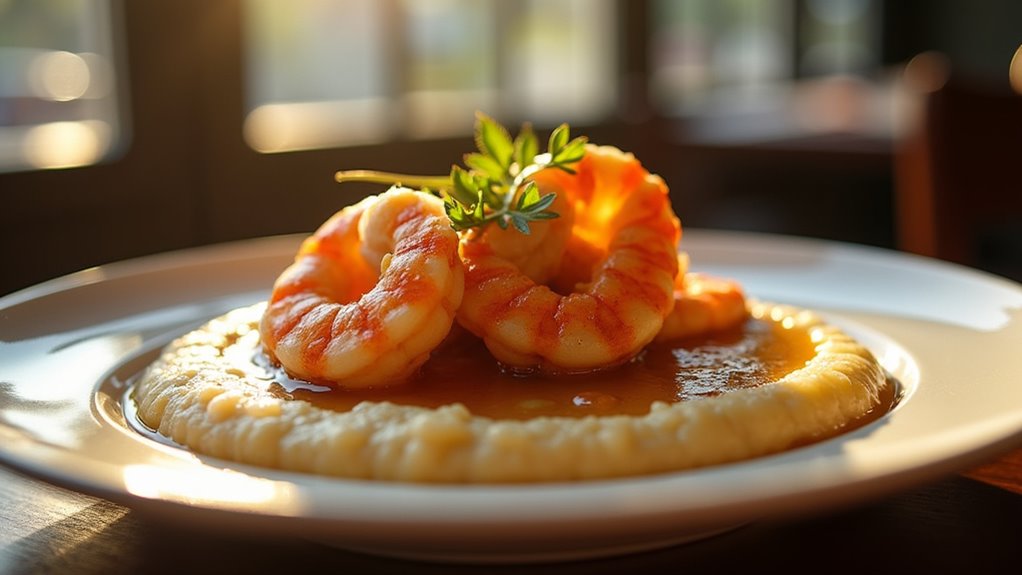
Charleston’s culinary scene transforms simple coastal ingredients into extraordinary Lowcountry masterpieces that’ll have you questioning every meal you’ve ever called “Southern food.”
You’ll find the city’s dining heart beating strongest along King Street, where centuries-old recipes meet modern innovation in restaurants like Virginia’s on King, serving sophisticated takes on shrimp and grits alongside their famous Farmer’s Plate.
Don’t miss she-crab soup at Poogan’s Porch or the Michelin-recognized Lowland Charleston for elevated comfort food.
For quick bites, grab hot biscuits at Callie’s or fried seafood at Hyman’s near City Market.
Venture beyond King Street to waterfront Tavern & Table or ingredient-driven Husk on Queen Street, where daily-changing menus showcase the region’s coastal bounty. Executive Chef Matt Dion creates a nightly dinner party atmosphere that celebrates the essence of Southern hospitality.
Stand Beneath the Ancient Angel Oak Tree
When you stand beneath the Angel Oak’s sprawling canopy, you’ll find yourself dwarfed by one of the Southeast’s most magnificent natural monuments—a 65-foot giant that’s been quietly weathering Lowcountry storms for somewhere between 300 to 1,500 years. Located just 12 miles from Charleston on Johns Island, this ancient live oak shades nearly 17,000 square feet with its 187-foot canopy spread.
The tree’s fascinating history includes Native American ceremonies, plantation life, and Civil Rights gatherings. The oak takes its name from Justis Angel, a free African American landowner who acquired the property in the 19th century, adding another layer to Charleston’s complex historical narrative.
You’ll visit for free at Angel Oak Park, though donations help preserve this natural treasure. With 400,000 annual visitors, arrive early for the best experience and fewer crowds.
The on-site gift shop offers memorable keepsakes celebrating this living record to Lowcountry resilience.
Tour the USS Yorktown at Patriots Point Naval Museum

Step aboard one of America’s most decorated aircraft carriers at Patriots Point Naval Museum, where the USS Yorktown—nicknamed “The Fighting Lady”—offers you an immersive journey through 27 years of naval history.
You’ll explore everything from the flight deck to engine rooms through self-guided routes that showcase life aboard a WWII-Cold War carrier.
Don’t miss the onboard Medal of Honor Museum, where interactive exhibits tell stories of America’s highest military honor recipients.
The ship’s historical aircraft collection spans multiple eras, while engine-room simulations let you experience a WWII technician’s role firsthand. This massive vessel stretches 888 feet in length and displaced over 30,000 tons after its 1950s modernization.
Here’s an insider tip: Download the Patriots Point Experience app for audio tours featuring oral histories.
You can even sit inside a replica Apollo command module—Yorktown recovered the Apollo 8 astronauts in 1968.
Wander The Battery’s Antebellum Mansions and Cannons
Along Charleston’s historic waterfront, The Battery stretches like an open-air museum where centuries of military history meet architectural grandeur. You’ll discover cannons and mortars displayed throughout White Point Garden—authentic Civil War relics marked with plaques detailing their wartime origins. The term “battery” actually refers to these grouped coastal defense cannons, dating back to the 1750s when dozens mounted here.
Magnificent antebellum mansions line the promenade, showcasing Greek Revival and Italianate architecture. Don’t miss the yellow Roper House, which houses a 500-pound Confederate cannon fragment embedded in its attic beam—blasted there when retreating Confederates destroyed their artillery in 1865.
The DeSaussure mansion at 1 East Battery still contains a Union shell lodged in its structure, tangible reminders of Charleston’s 18-month Civil War bombardment. This very location also witnessed the execution of pirates like Stede Bonnet, who met his end at White Point after being captured and sentenced to death for his crimes on the high seas.
Experience Gullah Culture and History at the Old Slave Mart Museum
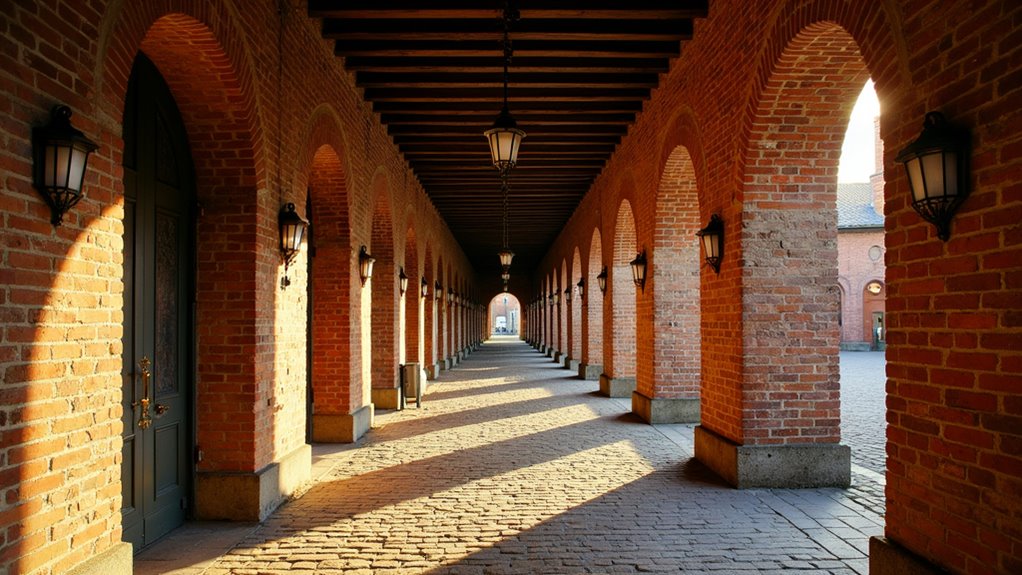
Moving beyond Charleston‘s architectural grandeur, you’ll encounter a more sobering chapter of the city’s history at the Old Slave Mart Museum on Chalmers Street. This 1859 building served as the city’s last active slave auction facility until 1863, operating after public auctions were banned from downtown areas.
Inside, you’ll find powerful exhibits featuring original bills of sale, auction advertisements, and narratives from formerly enslaved people.
The museum directly confronts Charleston’s role as a major domestic slave trading center, where an estimated 35-40% of all enslaved Africans entered the United States.
What makes this experience particularly meaningful is the museum’s connection to Gullah/Geechee heritage. Staff members, often descendants of enslaved Charlestonians, share stories linking language, foodways, and spiritual traditions to this painful past. The building you’re visiting is the last remaining structure of what was once a four-building complex that stretched from Chalmers to Queen Street.
Kayak Through Tidal Creeks for Dolphin Watching
While Charleston’s history runs deep on land, some of its most magical moments happen when you’re gliding silently through tidal creeks with dolphins surfacing just yards from your kayak. The Lowcountry’s maze of saltmarsh channels—from Shem Creek to Folly Creek—creates perfect dolphin habitat where these marine mammals hunt using shallow banks to corral fish.
Book a two-hour guided eco-tour for the best experience. Small groups of 10-12 paddlers get beginner-friendly sit-on-top kayaks, and naturalist guides time departures with favorable tides. Tours accommodate ages 4 and up, making them perfect for families exploring Charleston’s waterways together. Early morning and late afternoon tours offer calmer conditions and active wildlife behavior.
You’ll likely spot bottlenose dolphins year-round, plus herons, pelicans, and osprey steering through sweetgrass marshes and oyster beds that define Charleston’s coastal ecosystem.
The Sum Up
You’ve got Charleston’s best right at your fingertips now. Don’t try cramming everything into one trip—this city’s meant to be savored slowly. Book that harbor tour early since they fill up fast, and always pack comfortable walking shoes for those cobblestones. Trust me, you’ll want to return. Charleston hooks everyone who visits, and once you’ve experienced that Southern charm mixed with incredible history, you’ll understand why locals never leave.