
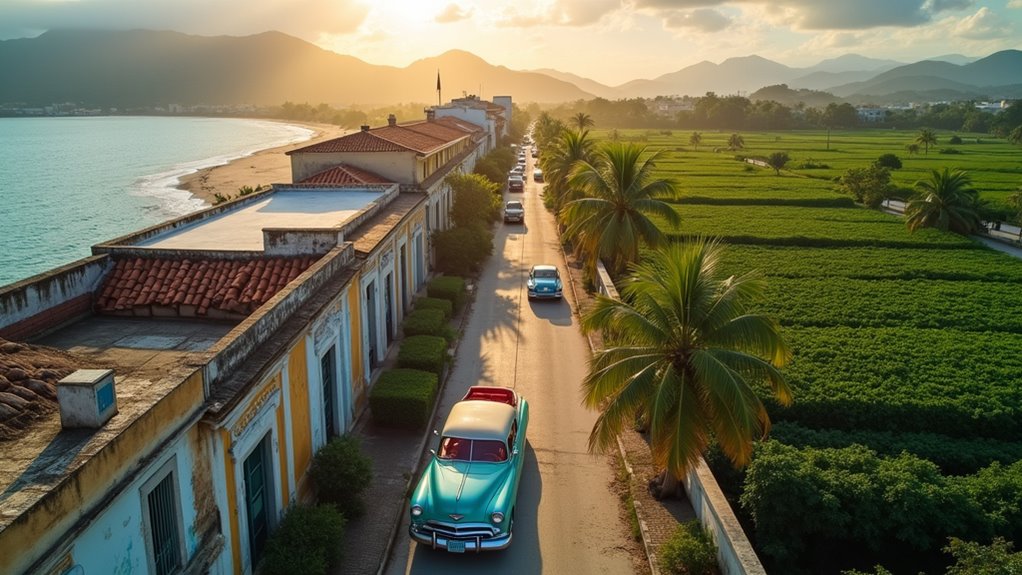
You’ll discover Cuba’s magic by wandering Old Havana’s UNESCO-protected cobblestone streets and colonial plazas, then watching sunset from El Malecón’s 5-mile seawall. Relax on Varadero’s pristine white beaches, explore Viñales Valley’s dramatic limestone mogotes, and step into Trinidad’s preserved colonial charm. Experience authentic Cuban music in Santiago’s budget-friendly casas, visit José Fuster’s vibrant mosaic village, and learn revolutionary history at the Bay of Pigs museum. These iconic experiences offer just the beginning of your Cuban adventure.
- Wander Through Old Havana’s Colonial Streets and Plazas
- Stroll Along El Malecón at Sunset
- Soak Up Sun on Varadero’s White Sand Beaches
- Explore the Dramatic Limestone Hills of Viñales Valley
- Step Back in Time in Trinidad’s Cobblestone Streets
- Discover French Colonial Elegance in Cienfuegos
- Dive or Snorkel the Pristine Reefs of Jardines De La Reina
- Hike Through Alejandro De Humboldt National Park’s Rainforests
- Visit José Fuster’s Colorful Mosaic Village in Fusterlandia
- Learn Revolutionary History at Playa Girón and the Bay of Pigs
- Experience Live Cuban Music in Santiago De Cuba’s Casas De La Música
- The Sum Up
Wander Through Old Havana’s Colonial Streets and Plazas
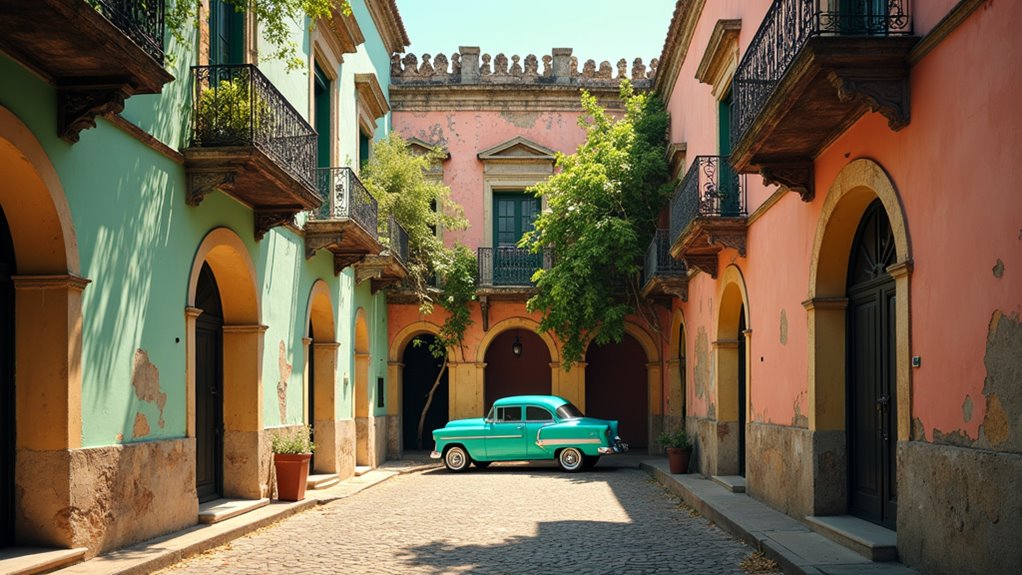
When you step into Old Havana’s cobblestone streets, you’re walking through five centuries of perfectly preserved Spanish colonial architecture that UNESCO recognized as a World Heritage Site in 1982. You’ll discover five main plazas that anchor the historic core, each offering free exploration and incredible photo opportunities.
Start at Plaza de Armas, Havana’s birthplace, where you can see the sacred Ceiba tree and browse affordable book stalls.
Move to Plaza de la Catedral for stunning Cuban Baroque architecture, then head to Plaza de San Francisco de Asís near the harbor.
The narrow streets connecting these squares showcase classic colonial features—wrought-iron balconies, internal courtyards, and shaded arcades—creating an authentic streetscape that’s completely walkable and budget-friendly to explore. Don’t miss the unique wooden-paved street in front of Palacio de los Capitanes Generales, Cuba’s only wood-block street designed to reduce the noise of horse hooves and carriage wheels.
Stroll Along El Malecón at Sunset
As the sun begins to set over Havana Bay, you’ll find yourself drawn to El Malecón—the city’s legendary 5-mile seafront promenade that locals affectionately call “the world’s longest sofa.” This iconic seawall stretches from Old Havana all the way to the Vedado district, offering completely free entertainment as waves crash against the concrete barrier while classic cars cruise the coastal highway behind you.
You’ll witness Havana’s most authentic social scene unfold here—couples sharing rum, musicians playing spontaneous concerts, and families escaping the heat. The golden hour light transforms weathered colonial facades into romantic backdrops perfect for photos. During summer evenings, you might encounter the nightly carnival featuring floats, dancing, and traditional drums that brings the entire waterfront to life.
Join locals sitting along the seawall, but watch for ocean spray during high waves. This atmospheric gathering place costs nothing and delivers Cuba’s most memorable sunset experience.
Soak Up Sun on Varadero’s White Sand Beaches
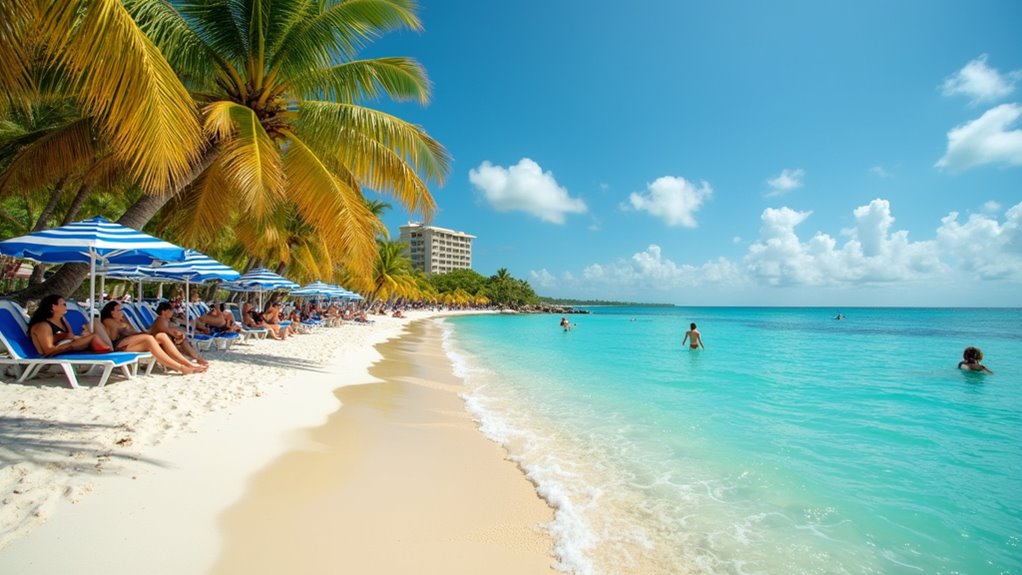
While Havana’s urban coastline offers culture, you’ll find Cuba’s ultimate beach paradise just two hours east in Varadero. This 13-mile stretch of powdery white sand ranks among the world’s top beaches, earning its nickname “Playa Azul” for its stunning turquoise waters.
You’ll enjoy the shallow, calm seas with warm temperatures perfect for swimming year-round. The soft sand creates brilliantly bright conditions, so pack sunglasses and sunscreen. Since natural shade is limited along many stretches, you’ll want to secure an umbrella.
Visit during the dry season (December-April) for the best weather, though expect larger crowds. Over 50 resorts line the peninsula, making beach access easy. The area welcomes over 1.5 million visitors annually, cementing Varadero’s status as Cuba’s premier sun-and-sand destination. The beach is surrounded by lush vegetation that creates a striking natural contrast against the brilliant white sand and azure waters.
Explore the Dramatic Limestone Hills of Viñales Valley
Just two hours west of Havana, you’ll discover one of Cuba’s most striking natural wonders in Viñales Valley. These dramatic limestone hills called mogotes rise up to 300 meters from the valley floor, creating an otherworldly landscape that’s perfect for budget-friendly exploration.
You can hike trails around the mogotes’ bases for stunning close-up views, or try horseback riding through tobacco fields between the towering formations. Rock climbing has exploded here recently, attracting international climbers to the limestone walls.
Don’t miss exploring the extensive cave systems like Cueva del Indio, where you’ll boat through underground rivers surrounded by stalactites. The valley’s UNESCO World Heritage status protects this unique blend of dramatic karst geology and traditional Cuban agriculture.
While exploring, you’ll encounter the fascinating Mural of Prehistory, a massive contemporary artwork painted on a 120-meter-high mogote that depicts Cuba’s evolutionary history from ancient Indians to giant prehistoric animals.
Step Back in Time in Trinidad’s Cobblestone Streets
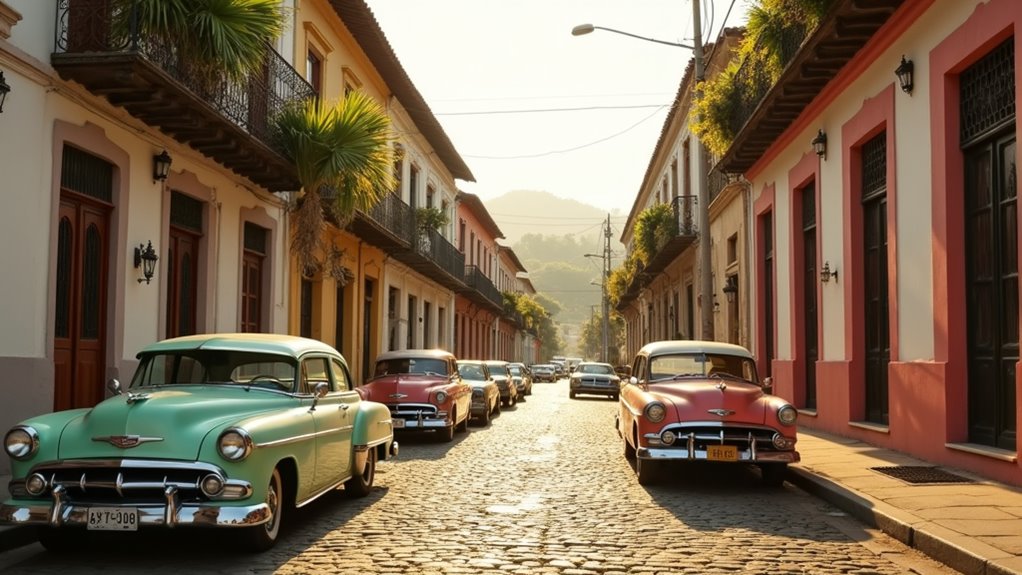
When you walk Trinidad’s uneven cobblestone streets, you’ll feel like you’ve stepped into a perfectly preserved Spanish colonial town from the 1800s. This UNESCO World Heritage Site froze in time after its sugar economy collapsed, leaving pastel-colored houses and colonial mansions untouched for decades.
You’ll find the best architecture around Plaza Mayor, where cobblestones connect museums like Palacio Brunet and the striking Iglesia Parroquial. The narrow stones naturally slow down foot traffic, horse-drawn carts, and vintage cars, enhancing that old-world atmosphere. As you wander through the colonial streets, you’ll notice children playing in the quieter areas, adding life to the historic setting.
Wear sturdy shoes since the irregular cobblestones get slippery when wet. Focus your exploration within the UNESCO zone where original streets remain – paved roads mark where the protected area ends and modern Trinidad begins.
Discover French Colonial Elegance in Cienfuegos
From Trinidad’s Spanish colonial charm, you’ll find a completely different architectural story in Cienfuegos, where French settlers created Cuba’s most elegantly planned city. Founded in 1819 by French immigrants from Louisiana, this UNESCO World Heritage site showcases perfectly ordered grid streets and stunning neoclassical architecture.
Start at Parque José Martí, surrounded by the twin-towered cathedral and ornate Tomás Terry Theatre. Don’t miss Cuba’s only triumphal arch, erected in 1902. The baby-blue Ferrer Palace offers panoramic city views, while the eclectic Palacio de Valle combines multiple architectural styles with its imported marble and Venetian glass.
Known as “La Perla del Sur” (Pearl of the South), Cienfuegos maintains its French elegance through pastel façades, iron balconies, and harmonious symmetry that distinguishes it from any other Cuban city. End your exploration at the scenic Punta Gorda neighborhood, where the bayside Malecon promenade offers stunning views and upscale dining options.
Dive or Snorkel the Pristine Reefs of Jardines De La Reina
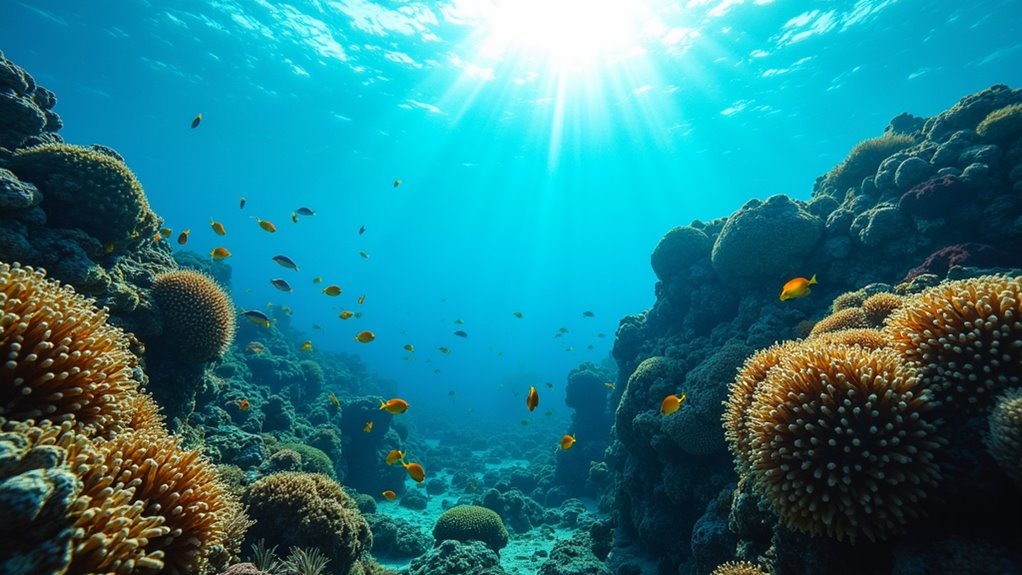
Sixty miles off Cuba’s southern coast lies Jardines de la Reina, one of the Caribbean’s last pristine marine sanctuaries where you’ll encounter shark populations and coral health that disappeared from most other diving destinations decades ago. This marine protected area hosts ten times more sharks and groupers than unprotected Caribbean reefs, with silky sharks and Caribbean reef sharks appearing on most dives without baiting.
You’ll explore underwater canyons, walls, and pinnacles with visibility often exceeding 100 feet. The reefs feature brain corals, ancient black corals over 4,000 years old, and massive barrel sponges. Depths typically range 15-30 meters, perfect for extended bottom times.
Low diver traffic creates an authentic pre-tourism experience. Night dives reveal hunting sharks and bioluminescence across this strictly regulated national park. Named by Christopher Columbus in honor of Queen Isabella of Spain, this archipelago became a protected sanctuary in 1996 to preserve its exceptional marine ecosystems.
Hike Through Alejandro De Humboldt National Park’s Rainforests
While Cuba’s marine sanctuaries showcase underwater wonders, the island’s terrestrial treasures prove equally spectacular at Alejandro de Humboldt National Park. This UNESCO World Heritage Site protects Cuba’s most biodiverse rainforests, home to endemic species like the tiny Monte Iberia eleuth frog and rare Cuban solenodon.
You’ll navigate four official trails with mandatory guides, ranging from short interpretive walks to the challenging 7-9km Balcón de Iberia trek. Expect muddy red clay paths, river crossings, and 4-6 hour hiking durations through dense tropical forests. The park spans across multiple provinces including Baracoa, Holguín, and Guantánamo. The reward? Swimming holes, endemic bird sightings, and orchid-filled landscapes.
Access requires a bumpy 1.5-hour drive from Baracoa over deteriorated roads. Book through Baracoa agencies since visitor numbers stay restricted to protect this pristine ecosystem.
Visit José Fuster’s Colorful Mosaic Village in Fusterlandia
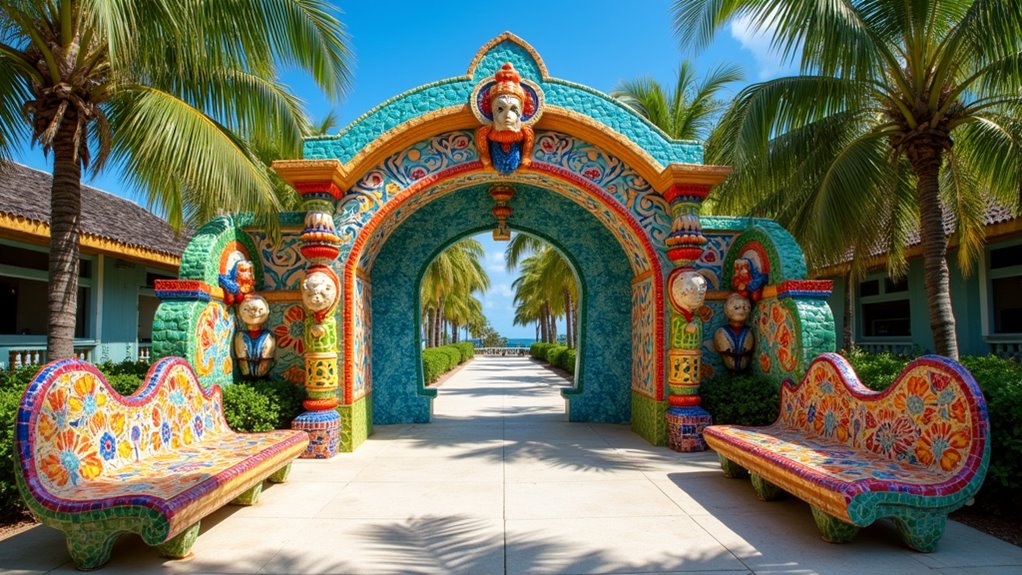
Twenty kilometers west of Havana’s bustling center, you’ll discover one of Cuba’s most extraordinary art projects where local fisherman-turned-artist José Fuster has spent nearly five decades transforming his humble Jaimanitas neighborhood into a whimsical mosaic wonderland.
Starting in 1975, Fuster covered over 80 homes with vibrant tiles depicting Cuban life, Santería symbols, and revolutionary history. You’ll wander through narrow lanes lined with Gaudí-inspired curves and organic forms, earning this “Picasso of the Caribbean” comparisons to Barcelona’s Park Güell.
Visit Fuster’s main studio (small admission fee) from 9:30 a.m. to 4:00 p.m., Wednesday through Sunday, though exploring the colorful streets costs nothing. Fuster envisions his work creating the world’s largest mural as he continues adding new mosaics daily. Plan 30-45 minutes for this Instagram-worthy neighborhood that perfectly captures Cuba’s creative spirit.
Learn Revolutionary History at Playa Girón and the Bay of Pigs
About 150 kilometers southeast of Havana, you’ll find Playa Girón, where one of the Cold War’s most pivotal moments unfolded in April 1961. The small Playa Girón Museum tells the story of the Bay of Pigs invasion through weapons, uniforms, and photographs from the 72-hour conflict.
You’ll see exhibits detailing how 1,400 CIA-trained Cuban exiles attempted to overthrow Castro’s government, only to be defeated by revolutionary forces.
The museum frames this victory as Cuba’s “first defeat of imperialism in America.” Entry fees are minimal, making it budget-friendly. Outside the museum, you can view the remains of an American aircraft and military vehicles that serve as lasting reminders of the failed invasion.
Around town, you’ll spot billboards and monuments commemorating the battle. This former pirate coastline—named after French pirate Girón—offers you authentic insight into revolutionary Cuba’s defining moment without tourist crowds.
Experience Live Cuban Music in Santiago De Cuba’s Casas De La Música
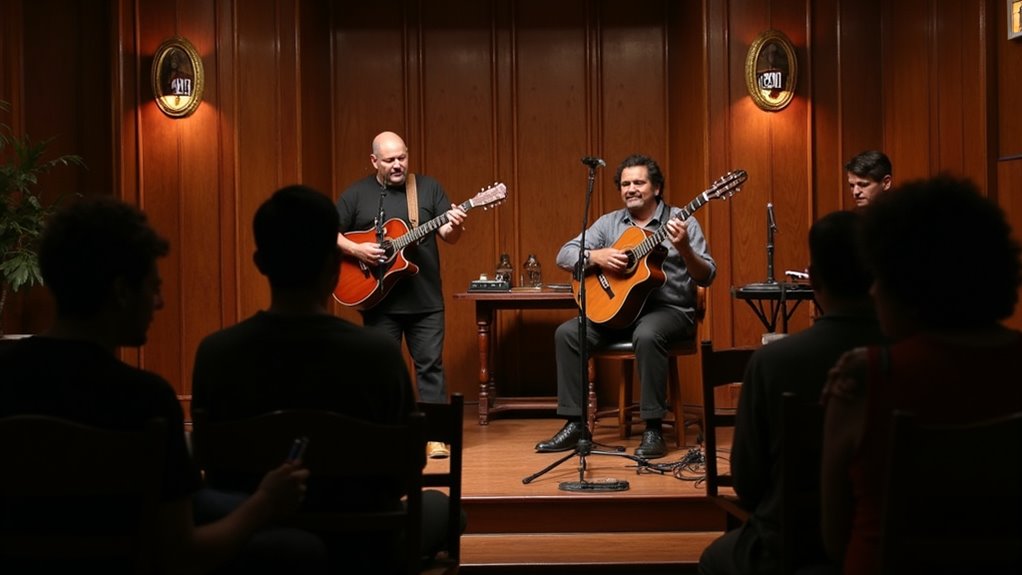
If you’re serious about experiencing authentic Cuban music, Santiago de Cuba’s legendary Casas de la Música offer you an unmatched culture that no other Cuban city can match.
Head straight to Casa de la Trova “Pepe Sánchez” on Calle Heredia, where trova and son cubano fill colonial patios daily. You’ll find locals and visitors dancing together while seasoned musicians perform with tres guitars and trumpets.
Don’t miss Casa de la Música EGREM Santiago for live salsa and boleros, or Casa de las Tradiciones in Tivolí neighborhood for intimate Buena Vista Social Club-style sessions. These venues function as living museums where artists like Eliades Ochoa have performed. Arrive early to secure the best seats and enjoy complete performances before crowds gather.
Entry fees are minimal, making this authentic cultural experience incredibly budget-friendly compared to tourist shows elsewhere.
The Sum Up
You’ll find Cuba offers incredible experiences without breaking the bank. Street food, casa particulares, and local buses keep costs down while you’re exploring colonial cities, pristine beaches, and lush valleys. Don’t forget to bring cash since credit cards aren’t widely accepted. Pack comfortable walking shoes for those cobblestone streets, and you’re set for an unforgettable Caribbean adventure that’ll give you stories to tell for years.