
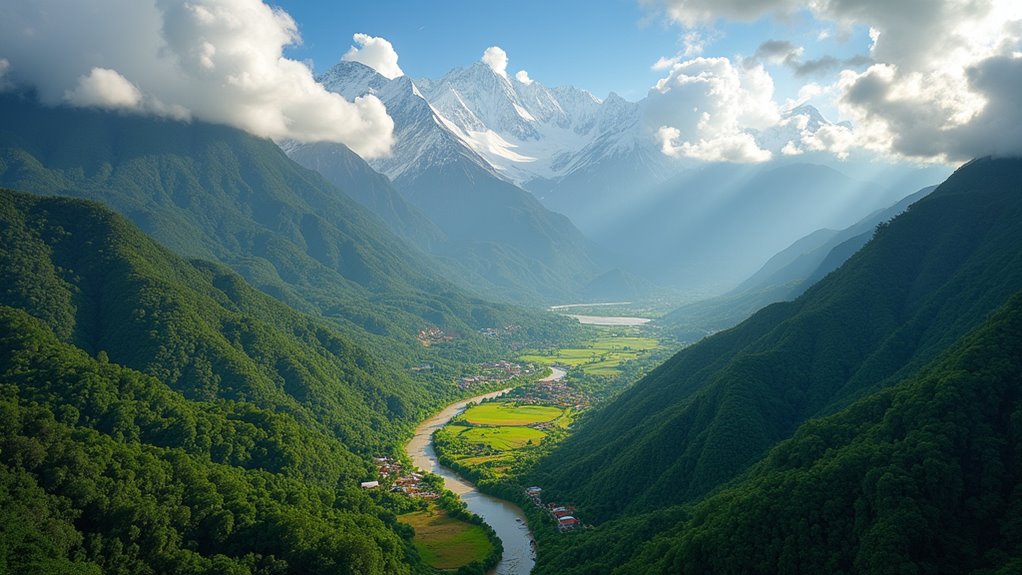
You’ll discover Ecuador’s incredible diversity across four distinct regions: explore the Galápagos Islands‘ unique wildlife including giant tortoises and blue-footed boobies, wander through Quito’s UNESCO-listed colonial center with its 32 museums and cobblestone streets, hike the volcanic Quilotoa crater lake at 3,900 meters, experience the Amazon’s rich biodiversity in Yasuni National Park, shop at Otavalo’s renowned indigenous market, and watch migrating humpback whales from Puerto López. Each destination offers unforgettable adventures that showcase this compact nation’s remarkable natural and cultural treasures.
- Explore the Galápagos Islands’ Unique Wildlife
- Wander Through Quito’s Colonial Historic Center
- Hike Around Quilotoa Crater Lake
- Experience the Amazon Rainforest in Yasuni National Park
- Discover Cloud Forest Magic in Mindo
- Chase Waterfalls and Adventure in Baños
- Soak in Termas De Papallacta Hot Springs
- Shop at Otavalo’s Indigenous Market
- Explore Cuenca’s Cobblestone Streets and Panama Hat Heritage
- Visit Ingapirca Inca Ruins
- Watch Humpback Whales From Puerto López
- The Sum Up
Explore the Galápagos Islands’ Unique Wildlife
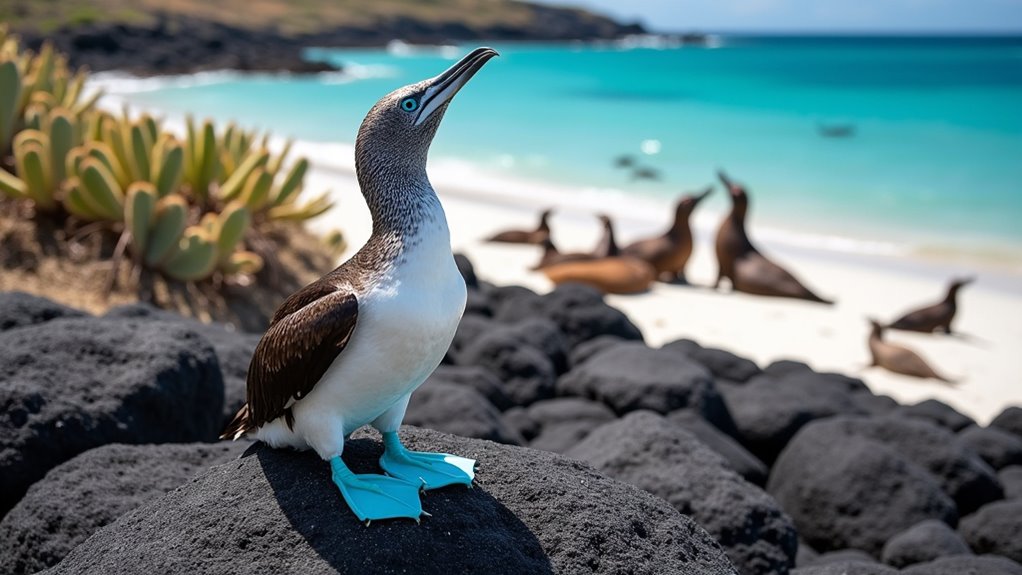
Where else on Earth can you witness evolution in action while swimming alongside penguins in tropical waters? The Galápagos Islands offer unparalleled wildlife encounters that you’ll find nowhere else.
You’ll observe giant tortoises—one of only two remaining giant tortoise groups worldwide—and marine iguanas, Earth’s only sea-going lizards with specialized salt-expelling glands.
Watch seventeen species of Darwin’s finches, each displaying distinctive beak adaptations for different ecological niches.
You’ll spot flightless cormorants with reduced wings but powerful swimming abilities, and if you’re exceptionally fortunate, glimpse the critically endangered pink land iguanas on Wolf Volcano.
Endemic Galápagos sea lions, fur seals, and hawks complete this evolutionary showcase where species adapted in isolation for millions of years. The blue-footed boobies captivate visitors with their vibrant blue feet that serve as indicators of reproductive fitness during elaborate courtship displays.
Wander Through Quito’s Colonial Historic Center
After experiencing Ecuador’s natural wonders, you’ll discover that Quito’s Colonial Historic Center offers equally compelling treasures through centuries of preserved architecture and culture. This UNESCO World Heritage Site spans 304 hectares with 32 museums, 24 churches, and 13 plazas showcasing Spanish Baroque and indigenous artistic traditions.
Start at Plaza Grande, Ecuador’s political heart, where the Presidential Palace and Metropolitan Cathedral frame the independence monument. Don’t miss La Compañía de Jesús, the gold-leaf covered “Church of Gold,” and San Francisco Convent with its 3,500 Quito School artworks.
Walk the cobblestone streets to Calle La Ronda for artisan workshops and traditional eateries. For breathtaking city views, climb the towers of the Neo-Gothic Basilica del Voto Nacional, which features unique gargoyles shaped like Ecuadorian fauna. At 2,850 meters elevation, pace yourself and stay hydrated while exploring this highly walkable colonial masterpiece.
Hike Around Quilotoa Crater Lake
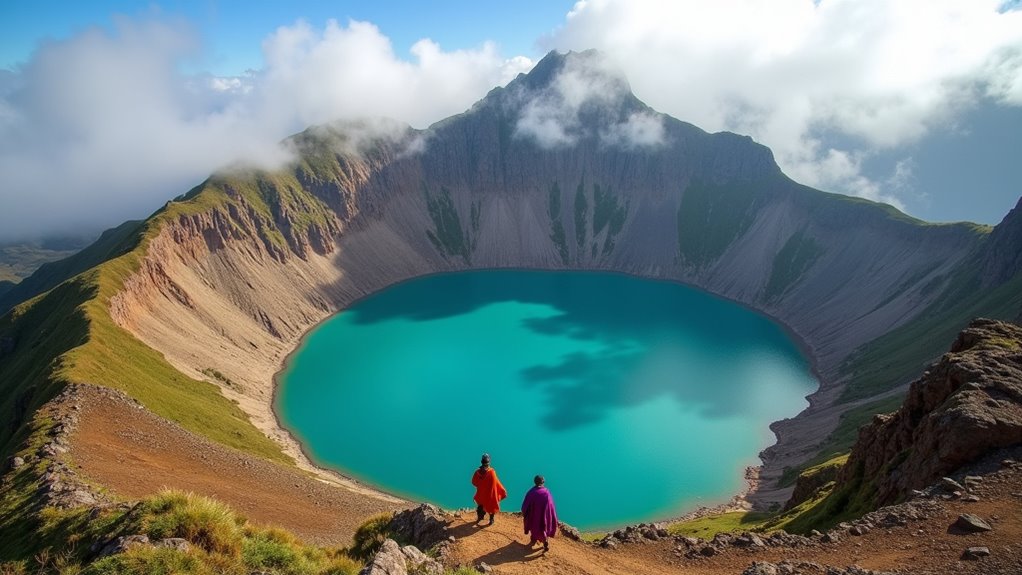
One of Ecuador’s most spectacular high-altitude adventures awaits at Quilotoa Crater Lake, where you’ll hike around the rim of a volcanic crater formed 800 years ago. The 11-14 kilometer loop sits at 3,900 meters elevation, taking 3-5 hours to complete while offering panoramic views of the striking blue-green lake below.
You’ll need proper preparation for this moderately challenging trek. Pack layered clothing, water, and sun protection—altitude amplifies UV exposure and weather changes rapidly. Start early morning for clearest views before clouds roll in, and go counterclockwise for best trail flow.
The well-marked dirt and rocky trail includes steep sections near the crater edge. A down-and-back hike to the lake takes about 30-50 minutes from the rim if you want to get closer to the water.
Visit during dry season (June-September, December-February) and allow time for altitude acclimatization before attempting this rewarding Andean adventure.
Experience the Amazon Rainforest in Yasuni National Park
Deep within Ecuador’s eastern Amazon basin lies Yasuni National Park, where you’ll encounter one of Earth’s most biodiverse ecosystems across 10,000 square kilometers of pristine rainforest. You’ll witness extraordinary wildlife diversity, including 13 primate species, jaguars, giant armadillos, and over 595 bird species.
The park harbors an estimated 100,000+ insect species—rivaling all of North America’s diversity. The park is home to critically endangered giant otters, with fewer than 250 remaining in Ecuador.
Access the park through Coca via flight or road, then travel by motorized canoe to jungle lodges. Plan multi-day stays (3-5 nights) for ideal wildlife viewing in remote primary forest zones. Join guided canoe safaris, night walks, and canopy tower excursions.
You’ll also experience Waorani indigenous culture through authorized community tourism projects, learning traditional forest practices and ancestral cosmology.
Discover Cloud Forest Magic in Mindo
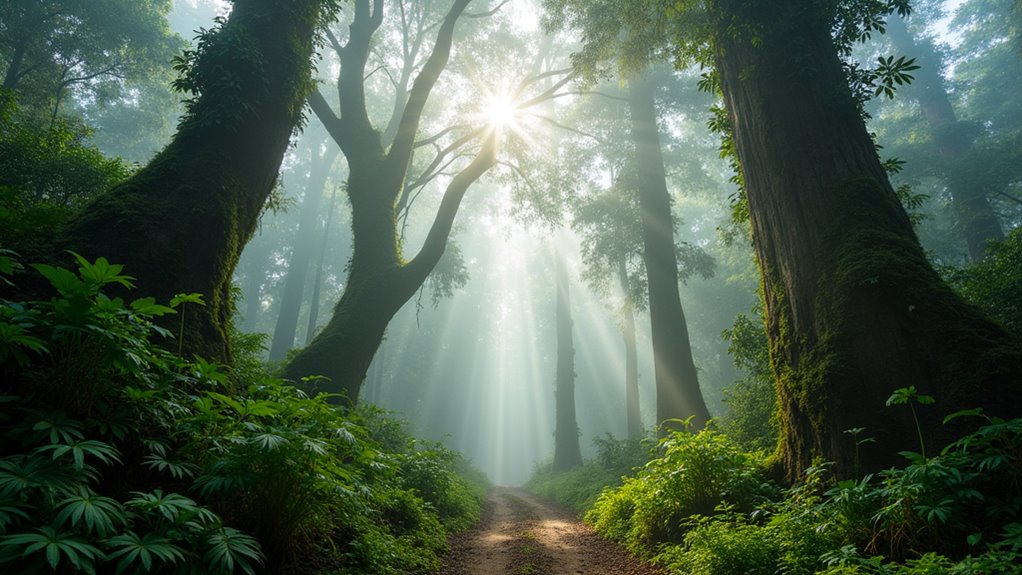
From the steamy lowlands of the Amazon, Ecuador’s cloud forests present an entirely different yet equally enchanting ecosystem. In Mindo-Nambillo Protected Forest, you’ll discover persistent mist creating perfect conditions for orchids, bromeliads, and mosses at 1,200–1,400 meters elevation.
You can spot over 500 bird species here, including Andean cock-of-the-rock, toucans, and numerous hummingbirds. Private guided tours cost around $75, while bird sanctuaries charge $5–10 for self-guided visits. The cloud forest transforms dramatically after sunset, when night walks reveal nocturnal wildlife like frogs, owls, and kinkajous using flashlights.
Take the tarabita cable car ($5) to access seven waterfalls along Ruta de las Cascadas, where you’ll hike through dense cloud forest to swimming holes.
Visit Mariposas de Mindo butterfly farm ($8) to see 1,000 native butterflies, or join chocolate tours exploring local cacao cultivation and artisanal production methods.
Chase Waterfalls and Adventure in Baños
Twenty-five kilometers of Ecuador’s most spectacular waterfall corridor await along Baños’ famous Ruta de las Cascadas, where you’ll descend 1,000 meters through a narrow Andean canyon carved by the Pastaza River.
You’ll encounter dozens of waterfalls, with twelve major cascades developed for tourism access.
El Pailón del Diablo stands as the route’s crown jewel—an 80-meter thundering cascade requiring a 2-kilometer hike with suspension bridges and viewpoints. Expect heavy spray, so bring rain gear. The site offers two separate entrances providing different perspectives and experiences of the waterfall.
Explore via bike rental for the mostly downhill 17-25 kilometer ride, then catch return transport uphill.
Alternatively, join chiva bus tours stopping at major falls and adventure installations.
Most waterfalls require short 5-20 minute walks from roadside, with small entrance fees around one dollar.
Soak in Termas De Papallacta Hot Springs
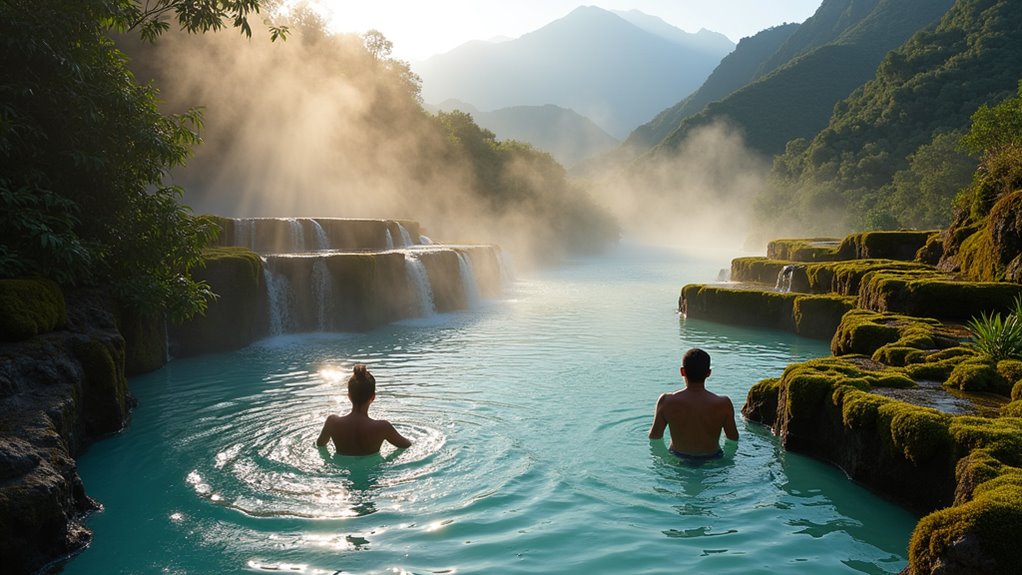
At 10,500 feet above sea level, Ecuador’s premier thermal springs beckon from the eastern Andean slopes just ninety minutes from Quito. Termas de Papallacta‘s volcanic-heated waters emerge naturally at temperatures reaching 158°F, then get tempered for comfortable soaking in multiple outdoor pools.
You’ll find mineral-rich waters containing calcium, sulfates, and chloride that locals believe help with muscle tension and inflammation.
The resort offers both day passes ($9 for public pools, $22 for spa access) and overnight accommodations with private pool access. Open daily from 6 a.m. to 9 p.m., the complex sits along the historic Cinnamon Trail at kilometer 65 of the Quito-Baeza road.
Beyond the therapeutic pools, you can enjoy spa treatments, hydro-massage, and on-site dining while surrounded by pristine Andean landscapes. The location serves as a gateway to the Ecuadorian Amazon, making it an ideal stop for travelers exploring multiple ecosystems.
Shop at Otavalo’s Indigenous Market
Two hours north of Quito lies Otavalo’s legendary Plaza de Ponchos, South America’s largest indigenous market and Ecuador’s most vibrant showcase of Andean craftsmanship. You’ll discover exceptional alpaca textiles, intricate woodcarvings, leather goods, and handmade jewelry among the maze of colorful stalls.
Saturday’s the main market day when vendors spill into surrounding streets, though you can shop daily from early morning until evening.
Arrive early around 6:30-9:00 AM for the best selection and fewer crowds. Bargaining’s expected, so bring small bills and negotiate respectfully.
The Otavaleño vendors, many wearing traditional dress, represent 4,000 years of trading heritage. The market’s evolution from a local farmers’ trading hub reflects Ecuador’s rich indigenous culture.
Plan 2-3 hours to fully explore this cultural hub where you’ll support indigenous artisans while experiencing authentic Andean atmosphere.
Explore Cuenca’s Cobblestone Streets and Panama Hat Heritage
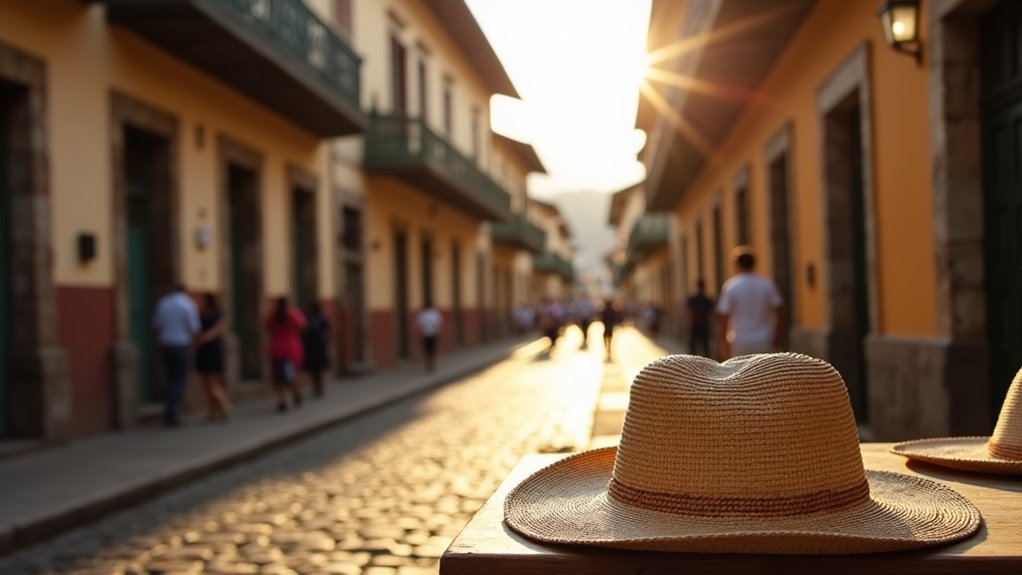
From the indigenous markets of the northern highlands, Ecuador’s cultural treasures continue in the south where Cuenca’s UNESCO World Heritage historic center beckons with 250 blocks of meticulously preserved cobblestone streets.
You’ll walk through a strict Renaissance grid layout ordered by Charles V, where hand-maintained stone pathways connect 18th-19th century colonial buildings, French-influenced facades, and internal courtyards.
Start at Parque Calderón, then explore Calle Simón Bolívar‘s dense historic architecture and Calle Larga’s riverside colonial streetscape.
The New Cathedral’s blue domes and converted mansion hotels showcase preserved interiors along your route. Despite housing approximately 660,000 residents, Cuenca maintains an intimate, non-urban atmosphere that feels more like a collection of interconnected small towns.
Don’t miss Cuenca’s Panama hat heritage—these traditional Ecuadorian toquilla straw hats were actually crafted here, not Panama, with Cuenca serving as a major 19th-century production center.
Visit Ingapirca Inca Ruins
Ecuador’s most significant pre-Columbian archaeological site awaits you at Ingapirca, where the country’s largest known Inca ruins crown a strategic hilltop 80 kilometers north of Cuenca at 3,200 meters elevation.
You’ll discover the remarkable elliptical Temple of the Sun, built with precision ashlar masonry using volcanic stones fitted without mortar—a technique unique in the Inca Empire.
The site represents a fascinating cultural fusion, where Cañari moon-worship traditions merged with Inca sun-worship after 15th-century conquest.
Local Cañari guides will explain the temple’s astronomical functions for tracking solstices and setting agricultural calendars.
You’ll explore terraces, plazas, and storage areas while enjoying panoramic valley views. The site also features an ingenious aqueduct system that demonstrates the advanced engineering capabilities of both cultures.
Don’t miss the nearby Cara del Inca rock formation, considered sacred by both cultures.
Watch Humpback Whales From Puerto López
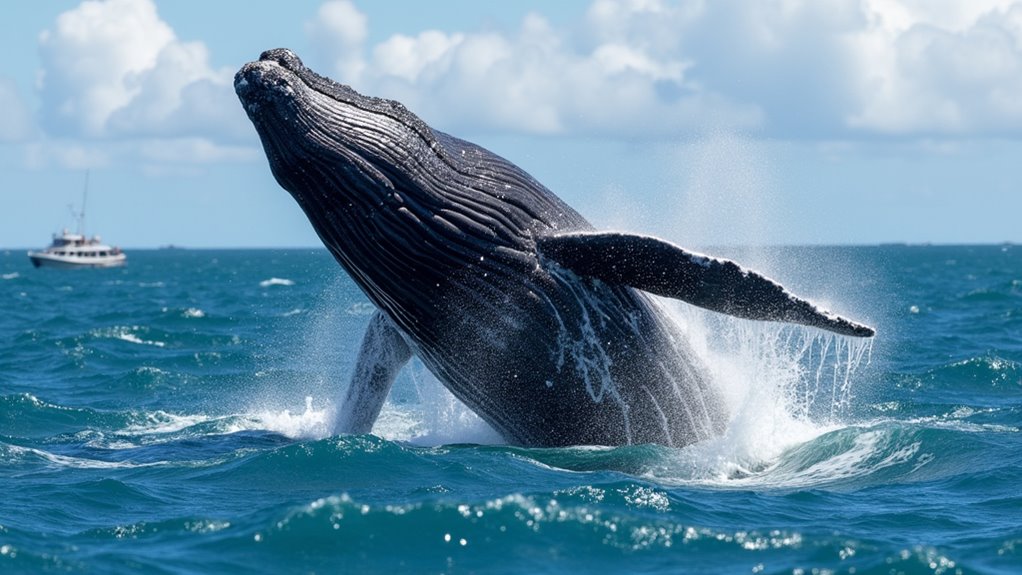
Between June and September, more than 7,000 humpback whales complete their remarkable 7,000-mile journey from Antarctic feeding grounds to Ecuador’s warm coastal waters, creating one of South America’s most spectacular marine wildlife experiences.
You’ll find Puerto López, a small fishing town in Manabí Province, serves as Ecuador’s premier whale-watching hub within Machalilla National Park’s protected waters.
Book 2-3 hour tours with licensed operators who navigate the Puerto López-Isla de la Plata-Manta triangle, where whales concentrate for breeding. These tours typically last around three hours and often include additional activities beyond whale observation.
You’ll witness breaching, tail-slapping, and spyhopping behaviors during peak season.
Many tours combine whale watching with snorkeling and visits to Isla de la Plata.
The town celebrates with an annual whale festival, and tourism has transformed the local economy from fishing to marine conservation.
The Sum Up
You’ve discovered Ecuador’s incredible diversity, from volcanic craters to ancient ruins. Don’t try cramming everything into one trip—you’ll miss the magic. Pick three or four destinations that speak to you and explore them properly. Whether you’re tracking wildlife in the Galápagos or haggling at Otavalo’s market, Ecuador rewards travelers who take time to connect with its people and places. Pack layers, bring patience, and prepare for unforgettable experiences.