
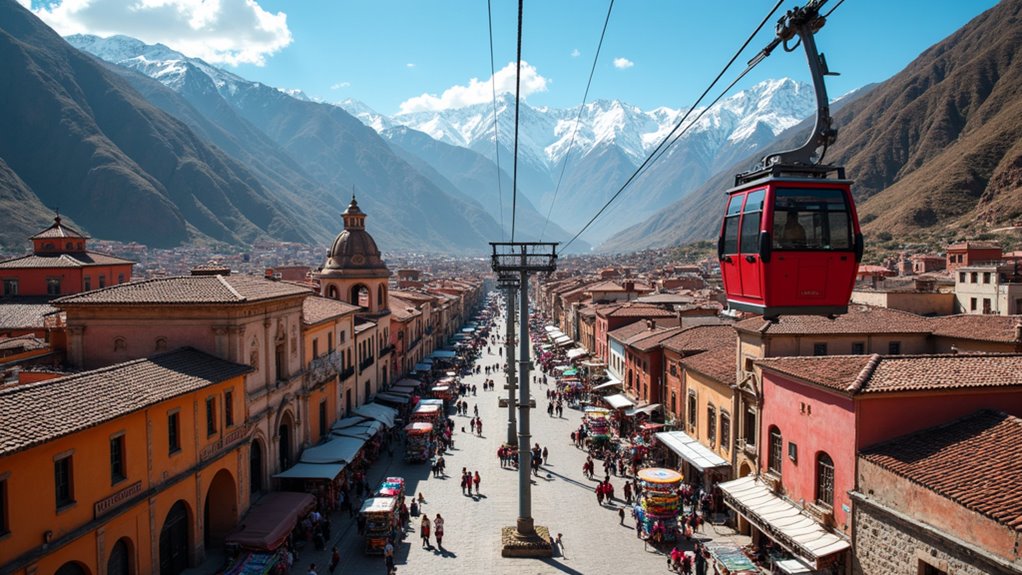
You’ll experience La Paz’s unique blend of indigenous culture and high-altitude adventure through its world’s longest cable car network, offering stunning views across the Altiplano. Visit the mystical Witches’ Market for coca-leaf readings, explore colonial Calle Jaén’s cobblestone streets, and witness the political heart at Plaza Murillo. Don’t miss hiking Valle de la Luna‘s lunar landscapes, biking the infamous Death Road, browsing El Alto’s massive Thursday market, or catching theatrical cholita wrestling matches. These experiences showcase Bolivia’s vibrant capital in ways you’ll discover ahead.
- Soar Above the City on Mi Teleférico Cable Cars
- Wander Through the Witches’ Market and Central La Paz
- Explore Colonial Charm on Calle Jaén
- Take in the Political Heart at Plaza Murillo
- Hike the Otherworldly Valle De La Luna
- Experience Lake Titicaca on a Day Trip
- Discover Ancient Tiwanaku Ruins
- Bike the Infamous Death Road
- Dive Into El Alto’s Massive Thursday Market
- Catch Cholita Wrestling in El Alto
- The Sum Up
Soar Above the City on Mi Teleférico Cable Cars
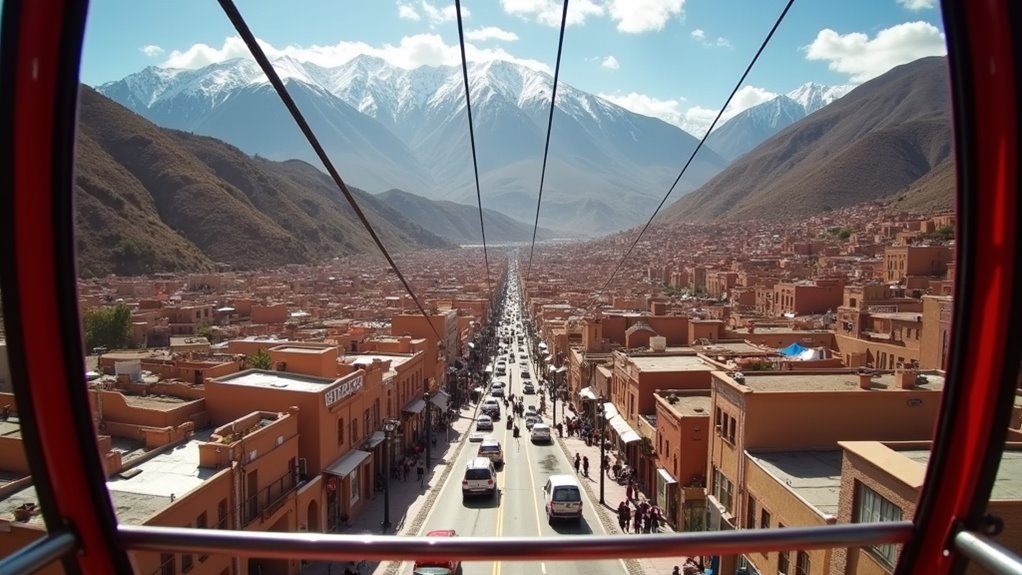
Why settle for street-level views when you can experience La Paz from 13,000 feet above sea level? Mi Teleférico’s cable cars offer the world’s longest aerial transit network, spanning 20.3 miles across 10 lines. You’ll traverse an 828-meter elevation difference between El Alto and La Paz’s canyon in just 10-15 minutes—cutting typical road travel time by 75%.
Board the Silver Line for the most dramatic route, where cabins glide above the Altiplano ridge before descending into the canyon. With departures every 12 seconds and 17-hour daily operation, you won’t wait long. The system’s impressive ridership includes the Red and Yellow lines alone carrying about 70,000 passengers daily between La Paz and El Alto.
At 3 bolivianos per ride (half-price for students and seniors), it’s cheaper than buses while delivering unmatched Andean panoramas through floor-to-ceiling windows in 10-passenger cabins.
Wander Through the Witches’ Market and Central La Paz
Although modern pharmacies line La Paz’s main streets, you’ll discover the city’s spiritual heart at Mercado de las Brujas—the Witches’ Market—where Aymara healers have sold ritual remedies and mystical offerings since colonial times.
Walk five minutes uphill from Plaza San Francisco to Calles Jiménez and Linares, where dried llama fetuses dangle alongside medicinal herbs and protective amulets. Yatiri shamans offer coca-leaf readings and spiritual consultations, while vendors sell bottled potions for love, prosperity, and protection.
These aren’t tourist trinkets—locals purchase ingredients for ch’alla ceremonies honoring Pachamama. Browse respectfully; photography isn’t always welcome.
The market operates as living cultural heritage, connecting modern La Paz with ancestral Andean spirituality through traditional medicine and ritual practice. Recognized in 2019 as an Intangible Cultural Heritage of La Paz, this mystical corner showcases authentic Bolivian traditions to the world.
Explore Colonial Charm on Calle Jaén
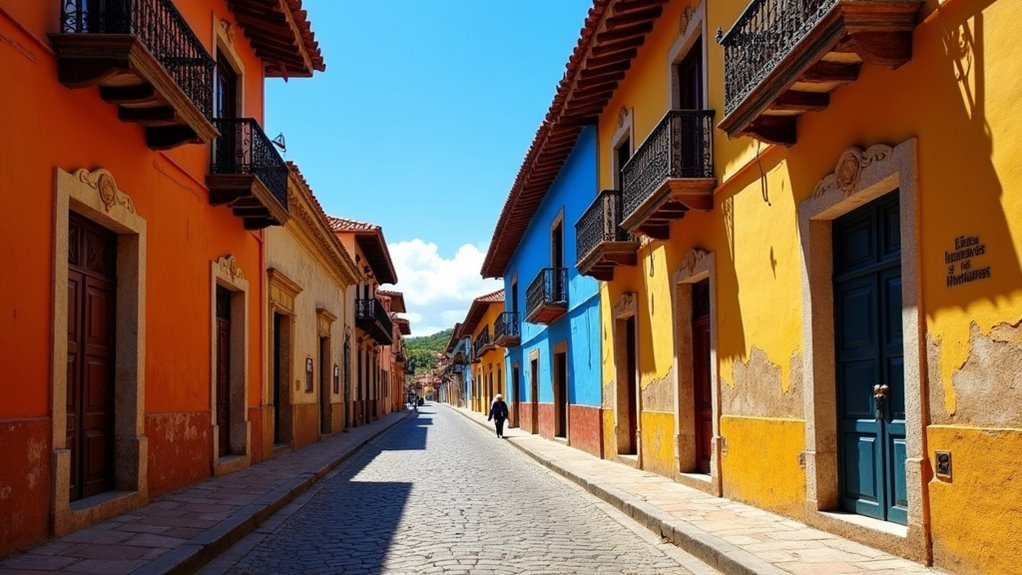
From the spiritual energy of the Witches’ Market, walk just a few blocks to discover Calle Jaén, La Paz’s best-preserved colonial street and most photogenic historical corridor. This 100-meter cobblestone pedestrian street showcases brightly colored facades, wrought-iron balconies, and authentic mestizo baroque architecture dating to the 18th century.
Purchase a single ticket for around $3 to access four excellent museums clustered here. Don’t miss the Museo Costumbrista’s detailed dioramas of La Paz life, the Gold Museum’s pre-Columbian artifacts from Tiwanaku culture, and Casa de Murillo, former home of independence leader Pedro Domingo Murillo.
The elevated position offers stunning views of La Paz’s colorful hillside neighborhoods. The steep incline to reach Calle Jaén adds a physical challenge but rewards visitors with breathtaking perspectives of the city’s unique topography.
Visit during golden hour for the best photography, when the colonial colors pop against the mountain backdrop.
Take in the Political Heart at Plaza Murillo
Just three blocks from Calle Jaén lies Plaza Murillo, Bolivia’s most powerful square and the beating heart of the nation’s political drama. Here you’ll stand where presidents have ruled and fallen—literally. The imposing Government Palace dominates one side, while the neoclassical Cathedral rises dramatically above street level due to La Paz’s steep terrain.
The central monument honors Pedro Domingo Murillo, the independence hero executed here by Spanish forces in 1810. This square has witnessed coups, protests, and even the 1946 lynching of President Villarroel. Today it remains Bolivia’s political epicenter, hosting rallies and ceremonies.
Walk the perimeter to appreciate the colonial architecture and visit the nearby National Museum of Art. Look for the guards in red uniforms standing outside the Government Palace, whose distinctive dress symbolizes Bolivia’s territorial claims. Come during weekdays to catch the political energy firsthand.
Hike the Otherworldly Valle De La Luna
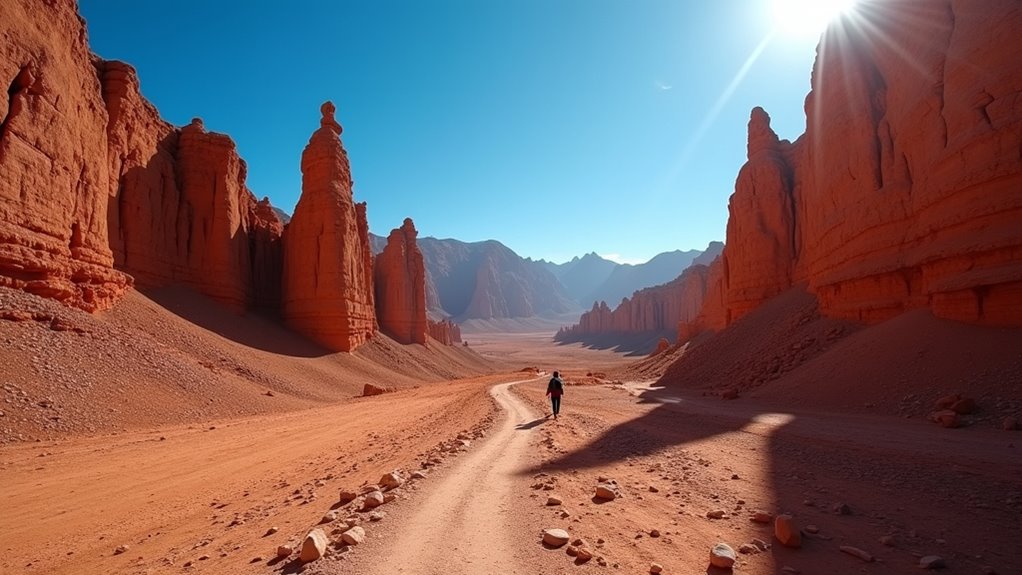
When you need a break from La Paz’s urban intensity, Valle de la Luna offers an otherworldly escape that’ll make you question whether you’ve left Earth entirely. Just 10 kilometers southwest of central La Paz, this eroded clay and sandstone maze resembles a lunar surface with its towering spires and bizarre hoodoos.
You’ll find two walking circuits—a 15-minute loop and a longer 45-minute trail. Both are manageable, though watch your footing near steep drop-offs. Bring cash for the $2 entrance fee and arrive in late afternoon when changing light transforms the pale rock formations into photography gold.
Pack water, sunscreen, and snacks since on-site services are minimal. The high altitude demands respect, so pace yourself and stay hydrated throughout your extraterrestrial adventure. This remarkable landscape was sculpted by millions of years of wind and rain erosion, transforming what was once a mountain into today’s maze of canyons and pointed formations.
Experience Lake Titicaca on a Day Trip
Why settle for postcards when you can stand on the shores of the world’s highest navigable lake? Lake Titicaca sits at 12,500 feet, offering stunning Cordillera Real views and sacred Inca sites just four hours from La Paz.
Book a day tour ($90-250) or go DIY via public transport to Copacabana—the gateway town where you’ll catch boats to Isla del Sol. Don’t miss the Basilica’s revered “Dark Virgin” statue while waiting for departures.
On Sun Island, hike steep stone paths to the ancient Temple of the Sun and terraced slopes where Aymara communities still farm traditional crops. According to Andean mythology, Lake Titicaca is revered as the birthplace of the Sun itself.
The 12-14 hour expedition includes the unique Tiquina Strait crossing, where your vehicle ferries separately while you boat across. Pack layers—altitude and lake winds create dramatic temperature swings.
Discover Ancient Tiwanaku Ruins
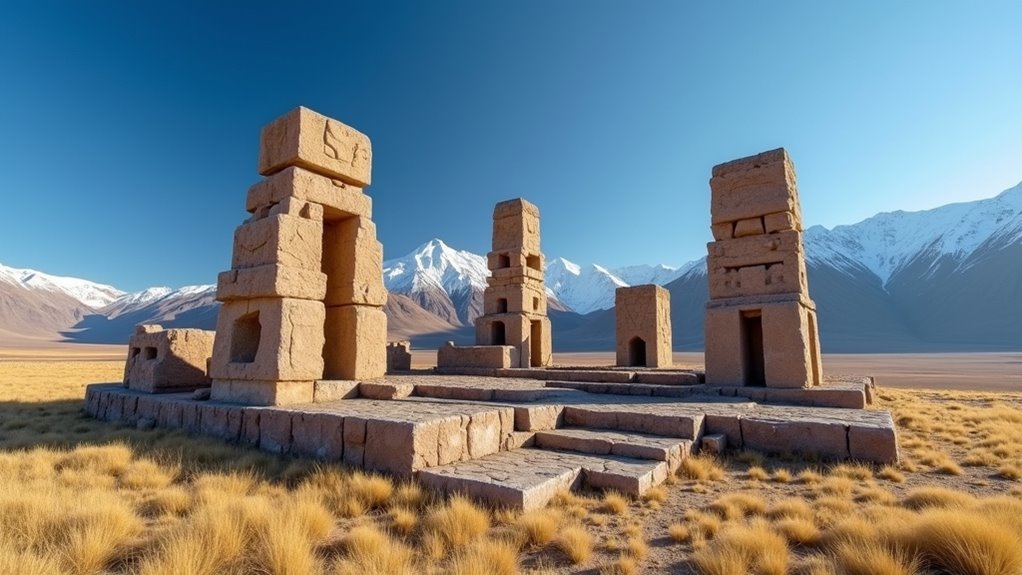
Thirty miles west of La Paz lies Tiwanaku, Bolivia’s most significant archaeological site and the remnants of a civilization that dominated the southern Andes for nearly a millennium. This UNESCO World Heritage Site showcases the architectural prowess of a culture that peaked between 500-900 CE, once housing up to 70,000 residents.
You’ll explore the seven-tiered Akapana Pyramid, the Semi-Subterranean Temple with its mysterious stone heads, and the imposing Kalasasaya Temple. Don’t miss the iconic Gateway of the Sun with its intricate carvings depicting celestial deities.
The on-site museums house remarkable monoliths and artifacts that illuminate this pre-Inca civilization’s sophisticated engineering and astronomical knowledge. The Museo Litico displays the impressive Bennett Monolith, standing 7.3 meters tall and covered in intricate carvings that represent one of the site’s most significant discoveries.
Book a half-day tour from La Paz, or take public transport for a more budget-friendly option.
Bike the Infamous Death Road
Though the North Yungas Road has shed its deadly reputation since a new bypass opened in 2009, biking this notorious 64-kilometer descent from La Cumbre Pass to the Yungas valley remains one of Bolivia’s most thrilling adventures. You’ll start at 4,650 meters above sea level and plummet nearly 3,500 meters through cloud forest to subtropical jungle.
Most tours begin with early morning pickup around 6:30 a.m., followed by safety briefings and equipment checks. The first section’s paved highway lets you adjust to your bike before shifting to the infamous gravel stretch.
Here, you’ll navigate narrow 3-meter-wide sections with 600-meter drop-offs, waterfalls, and loose rocks. Be prepared for the activity to continue in rain or shine conditions, as weather can be unpredictable with misty or rainy conditions common in the dense jungle areas.
While traffic has dramatically decreased, respect the road’s hazards. Experienced cyclists can reach 60 km/h on upper sections, but controlled descent matters more than speed.
Dive Into El Alto’s Massive Thursday Market
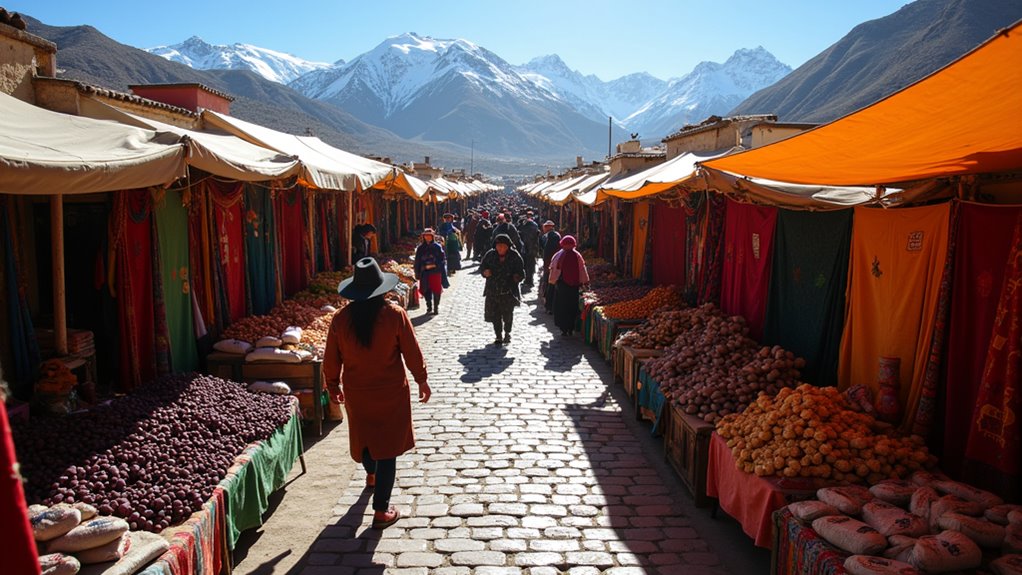
When Thursday morning arrives in El Alto, the sprawling 16 de Julio Market transforms into one of Latin America’s most chaotic and authentic trading spectacles. You’ll navigate over five square kilometers of street stalls selling everything from llama fetuses to branded sneakers, where cholitas in traditional dress haggle alongside modern vendors.
Take the Red or Silver teleférico lines to reach this non-touristic maze. Prepare for hours of walking across uneven cobblestones through galpones and open-air sections.
You’ll find incredible bargains: used coats for 30 Bs, suits for 100 Bs, and electronics at rock-bottom prices. The market’s sensory overload hits immediately with street musicians performing between vendors, the aroma of grilled choripán wafting through the aisles, and the constant buzz of haggling voices.
Arrive Thursday or Sunday morning for peak activity. This isn’t polished retail—it’s Bolivia’s informal economy in action, offering an unfiltered glimpse into Aymara culture and working-class commerce.
Catch Cholita Wrestling in El Alto
Since cholita wrestling burst onto El Alto’s entertainment scene in the early 2000s, it’s become one of Bolivia’s most enthralling cultural spectacles. You’ll witness Indigenous Aymara and Quechua women performing lucha libre-style matches in full traditional dress—multilayered pollera skirts, embroidered shawls, and bowler hats.
These scripted bouts blend comedy, melodrama, and acrobatics while challenging Bolivia’s patriarchal norms.
Catch matches on Tuesdays, Thursdays, and Sundays at colorful cholet venues or El Alto’s Multifunctional Center. The remarkable performances take place at roughly 4,000 meters above sea level, showcasing the wrestlers’ incredible athleticism in the thin mountain air. Expect carnival-like atmosphere with Andean music, vocal crowds, and dramatic entrances.
Tourist packages typically include transport from La Paz, soft drinks, and snacks. The theatrical storylines pit heroes against villains, creating an unforgettable experience that celebrates Indigenous women’s empowerment and cultural pride.
The Sum Up
You’ve got enough adventures here to fill weeks, not days. Don’t try cramming everything into a rushed itinerary—La Paz’s altitude will slow you down anyway. Pick three or four activities that genuinely excite you, and save the rest for your inevitable return trip. Book cable car rides for sunset, carry cash everywhere, and remember that coca tea isn’t just touristy advice—it’ll actually help with the altitude adjustment.