
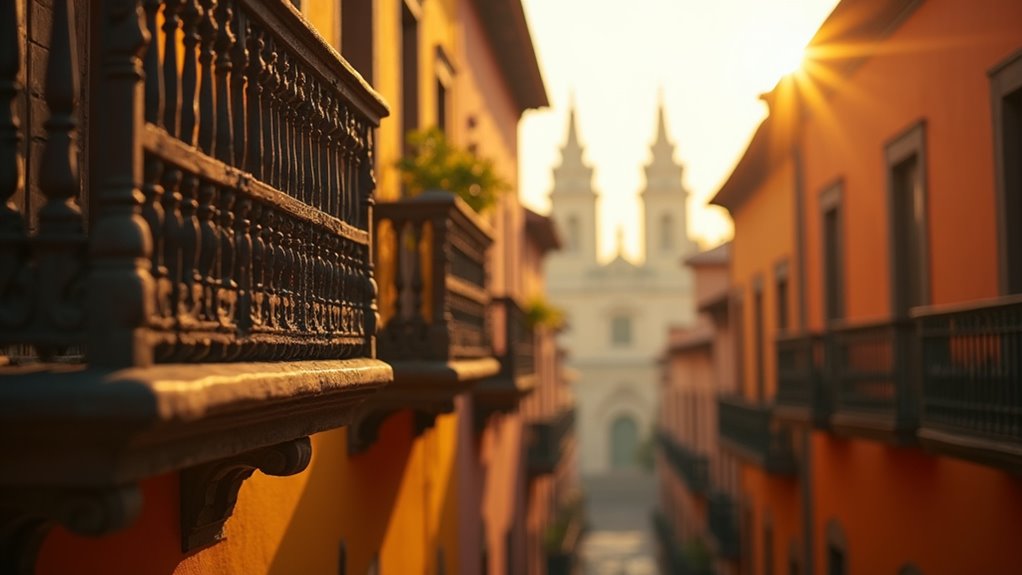
You’ll discover Lima’s soul in its UNESCO-listed historic center, where Pizarro’s actual tomb lies in the cathedral and 70,000 bodies rest in San Francisco’s bone-lined catacombs. Watch the noon changing of the guard at Government Palace, then explore pre-Columbian treasures at Museo Larco and contemporary art at MALI. Catch sunset at Parque del Amor, wander Barranco’s bohemian streets, and experience the Magic Water Circuit’s synchronized fountains after dark—these highlights barely scratch Peru’s enthralling capital.
- Wander Around Plaza Mayor and the Historic Center
- Step Inside the Cathedral of Lima and See Pizarro’s Tomb
- Watch the Changing of the Guard at Government Palace
- Descend Into the Bone-Lined Catacombs at San Francisco Monastery
- Browse Pre-Columbian Treasures at Museo Larco
- Climb the Ancient Pyramid at Huaca Pucllana
- Stroll the Clifftop Malecón in Miraflores
- Kiss at Parque Del Amor During Sunset
- Explore the Bohemian Streets of Barranco
- Marvel at Peru’s Art History at MALI
- Experience the Magic Water Circuit After Dark
- Take a Day Trip to Pachacámac Archaeological Site
- The Sum Up
Wander Around Plaza Mayor and the Historic Center
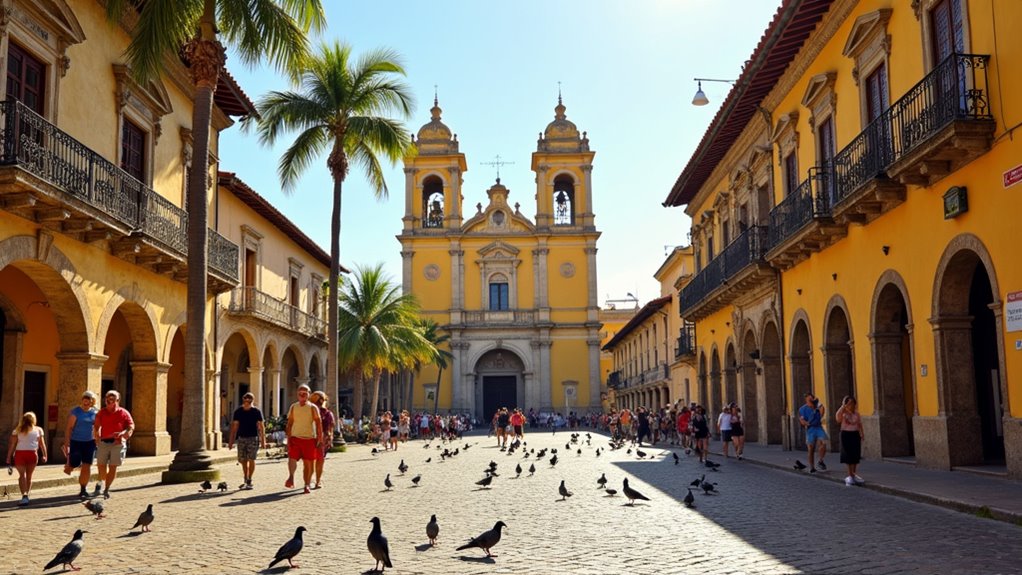
When Francisco Pizarro founded Lima in 1535, he chose this exact spot for Plaza Mayor, and you’ll immediately understand why as you step into the rectangular square that’s served as the city’s beating heart for nearly five centuries.
The Government Palace dominates the north side where Peru’s president works, while the Archbishop’s Palace showcases ornate wooden balconies that define Lima’s colonial architecture. Don’t miss the 1650 bronze fountain at the center—it’s one of the city’s most photographed landmarks.
Time your visit for the Changing of the Guard at Government Palace around midday. The plaza transforms dramatically after dark with stunning night illumination that creates a magical ambiance perfect for photography.
From here, walk down pedestrian-only Jirón de la Unión for shopping, then explore nearby San Francisco Church’s catacombs and Torre Tagle Palace’s exquisite 18th-century balconies.
Step Inside the Cathedral of Lima and See Pizarro’s Tomb
Directly across from the Government Palace stands the Cathedral of Lima, where you’ll find one of South America’s most intriguing historical mysteries—Francisco Pizarro’s actual tomb. For nearly a century, visitors viewed the wrong mummy displayed in an ornate glass coffin.
Then in 1977, workers discovered a lead box in the cathedral’s crypt containing Pizarro’s skull and sword hilt, complete with an inscription identifying the conquistador’s head.
You can visit both the elaborate chapel where the misidentified remains were displayed and learn about the forensic investigation that solved this historical puzzle. Modern DNA analysis reveals a 90% chance the remains are authentic, meeting Peru’s legal standards for verification.
The cathedral itself showcases stunning colonial architecture with baroque altarpieces and vaulted ceilings. Don’t miss exploring the crypts beneath, where viceroys and notable figures rest alongside Lima’s controversial founder.
Watch the Changing of the Guard at Government Palace
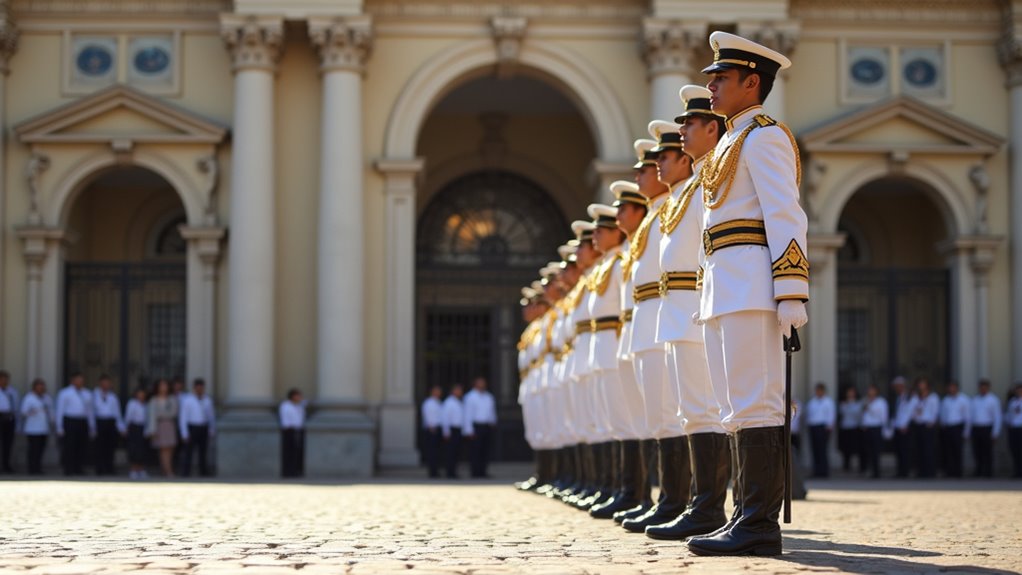
Every day at noon, the Cavalry Regiment “Mariscal Domingo Nieto” performs one of Lima’s most mesmerizing military traditions right in the Honor Courtyard of Government Palace. You’ll hear the trumpet call around 11:45 a.m., signaling the start of synchronized marching and formal military drills accompanied by a live band playing patriotic pieces.
Arrive 15-30 minutes early to claim your spot directly in front of the palace railings on Plaza de Armas—crowds gather quickly. The 30-40 minute ceremony is completely free and runs daily from around 11:45 a.m. to 12:15 p.m.
Bring a telephoto lens to capture the intricate uniform details and choreographed movements from behind the barriers. On special occasions, you’ll witness mounted guards and horses adding extra pageantry to this colonial-era tradition. This tradition traces back to colonial times when the Royal Spanish Infantry protected the Viceroy at the “House of Pizarro.”
Descend Into the Bone-Lined Catacombs at San Francisco Monastery
Beneath the colonial Basilica of San Francisco lies one of Latin America’s most haunting archaeological sites—a labyrinthine network of catacombs where an estimated 25,000 to 70,000 bodies rest in geometric bone arrangements. You’ll descend through narrow stone corridors and chambers that served as Lima’s primary cemetery from 1546 to 1810.
Skulls and femurs create striking visual patterns in deep circular wells.
The earthquake-resistant tunnels extend beyond the monastery, possibly reaching toward the Government Palace. Guided tours reveal how Franciscan monks conducted masses for the dead while managing burials for nobles, guild members, and common citizens who couldn’t afford traditional cemetery plots. The site gained UNESCO recognition in 1991, acknowledging its significance as a remarkable window into colonial funeral practices and underground architecture.
The dim lighting and claustrophobic passages create an unforgettable atmosphere in this remarkably preserved colonial necropolis.
Browse Pre-Columbian Treasures at Museo Larco
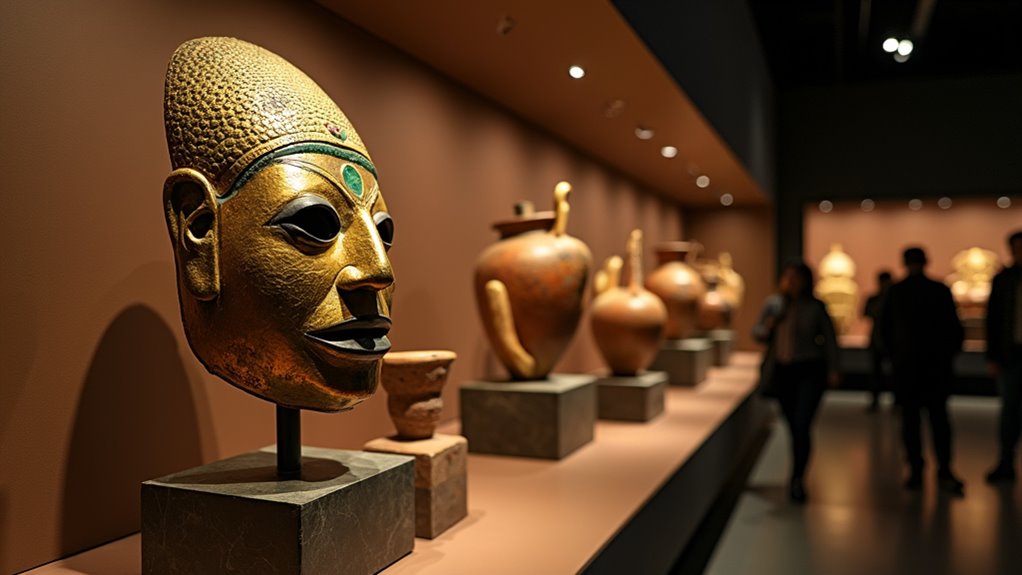
While Lima’s underground reveals its colonial burial practices, the city’s most extensive collection of ancient Peruvian artifacts awaits above ground at Museo Larco in Pueblo Libre. You’ll explore 5,000 years of pre-Columbian history through 45,000 meticulously catalogued objects housed in an 18th-century mansion built atop a 7th-century pyramid.
Don’t miss the Gold and Silver Gallery‘s stunning Mochica portrait vessels and complete Chimú ceremonial attire. The museum’s world-renowned erotic ceramics collection offers fascinating insights into ancient Andean cosmology and fertility beliefs.
What sets Museo Larco apart is its accessible storage rooms—you can view thousands of additional artifacts beyond the main galleries. The museum also lends collections to museums worldwide, promoting Peruvian cultural heritage through international exhibitions.
Plan two hours to fully appreciate the chronological narrative that makes Peru’s complex ancient cultures accessible to any visitor.
Climb the Ancient Pyramid at Huaca Pucllana
Where else can you climb a 1,500-year-old pyramid surrounded by gleaming skyscrapers? Huaca Pucllana offers this surreal experience in Lima’s Miraflores district. This massive adobe complex, built by the Lima Culture around 500 AD, stretches 500 meters long with seven stepped platforms reaching 25 meters high.
You’ll join guided tours that follow marked circuits up earthen ramps to viewing areas near the summit. The climb’s moderate, but the payoff’s spectacular—panoramic views of Miraflores’ skyline contrasting with ancient plazas and excavation sites below.
At ground level, you’ll see recovered ceramics, funerary bundles, and reconstructions showcasing pre-Columbian life. The site also features a native flora park where visitors can observe traditional plants and animals like corn, guava, and Peruvian hairless dogs.
Book evening tours when the pyramid’s dramatically lit. The site’s earthquake-resistant “bookcase” brick technique demonstrates sophisticated engineering that predates Inca construction by centuries.
Stroll the Clifftop Malecón in Miraflores
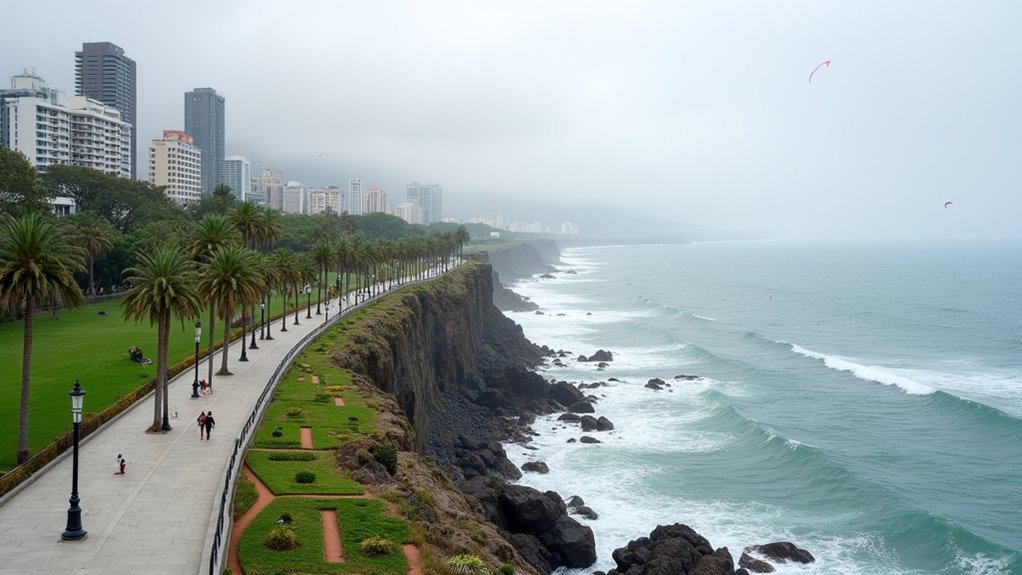
After exploring Lima’s ancient past, you’ll want to experience the city’s most stunning modern attraction—the clifftop Malecón in Miraflores. This elevated esplanade stretches 6-10 kilometers along the Pacific coast, offering uninterrupted ocean views from atop Costa Verde cliffs.
Walk the dedicated paths connecting three main sectors: Malecón de la Marina, Malecón Cisneros, and Malecón de la Reserva. Don’t miss the blue-and-white striped lighthouse and Puente Villena Rey bridge for dramatic coastal photos.
The route links multiple oceanfront parks and connects to Larcomar shopping complex built into the cliff face. Along the way, you’ll discover notable sculptures including The Kiss at Parque del Amour by Victor Delfín.
Visit during morning or late afternoon for ideal lighting and clearer views. You’ll find paragliders launching overhead, street performers near popular spots, and plenty of benches positioned for Pacific sunset viewing.
Kiss at Parque Del Amor During Sunset
Five blocks south of central Miraflores, Parque del Amor delivers Lima’s most romantic sunset experience from its clifftop perch above the Pacific. The park’s centerpiece, “El Beso” statue by Víctor Delfín, has become Lima’s iconic kissing landmark since its 1993 Valentine’s Day inauguration.
Arrive before golden hour to claim prime viewing spots among the Gaudí-inspired mosaic benches adorned with Spanish love poems.
The west-facing terraces provide unobstructed ocean views where you’ll watch surfers below and paragliders drift across the setting sun. Couples flock here during peak sunset hours, creating an infectiously romantic atmosphere.
The colorful ceramic walls form intimate nooks perfect for photos and stolen moments. The park draws inspiration from Barcelona’s Park Güell, showcasing similar artistic elements that create an immersive environment celebrating love and creativity. Plan 30-60 minutes for this free attraction, easily accessible along Malecón Cisneros.
Explore the Bohemian Streets of Barranco
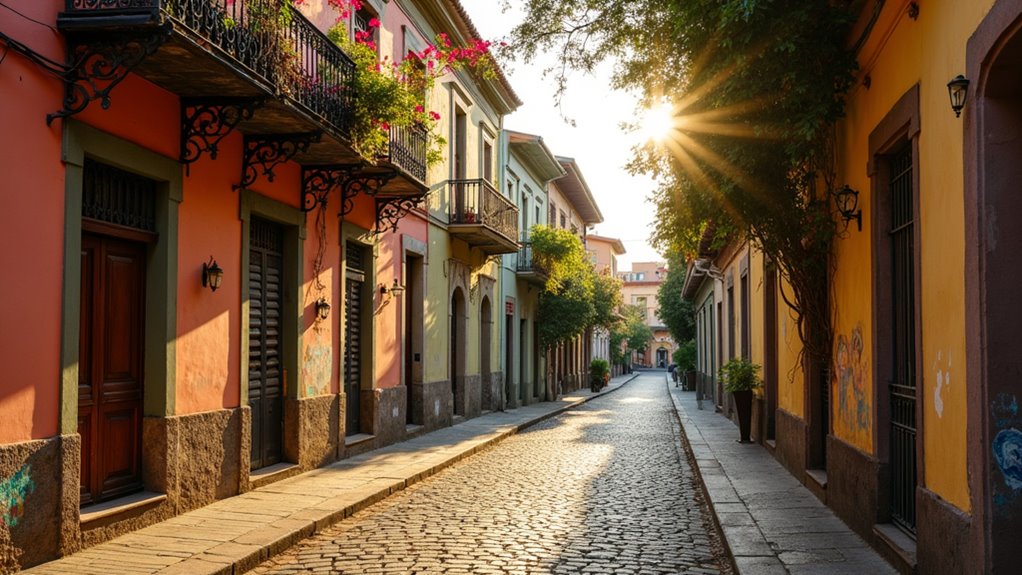
Just ten minutes south of Miraflores’ romantic clifftops, Barranco unfolds as Lima’s creative soul where colonial mansions house contemporary galleries and street murals transform every corner into an outdoor exhibition.
Start at Parque Municipal, photographing the yellow neoclassical Municipal Library before wandering toward the iconic Bridge of Sighs. Descend Bajada de los Baños—the former fishermen’s path now lined with vibrant murals and artisan cafés leading to Playa Barranco’s oceanfront.
Don’t miss MAC (Museo de Arte Contemporáneo), Lima’s only dedicated contemporary art museum, and Museo Pedro de Osma for colonial treasures.
Browse Dédalo’s design concept store for Peruvian handicrafts. The district became a haven for artists and musicians following the devastating War of the Pacific in the 1880s.
As evening approaches, the district transforms into Lima’s premier nightlife destination with rooftop bars and traditional criollo restaurants serving exceptional ceviche.
Marvel at Peru’s Art History at MALI
Since Lima’s Palacio de la Exposición opened as MALI in 1961, Peru’s premier art museum has housed an extraordinary 3,000-year timeline spanning pre-Columbian textiles to contemporary masterpieces. You’ll discover over 1,200 carefully curated works from a collection exceeding 17,000 pieces, all within Antonio Leonardi’s stunning neo-Renaissance palace.
Start with the pre-Columbian galleries showcasing exquisite Nazca, Moche, and Inca textiles and ceramics.
The colonial sections reveal Spanish viceregal influence through religious art and intricate silverware. Don’t miss the republican galleries featuring 19th-century portraits that capture Peru’s nation-building era.
The recently renovated second-floor galleries, reopened in 2015, offer enhanced viewing experiences.
MALI’s rotating temporary exhibitions complement the permanent collection, making each visit unique. The museum also participates in the Google Art Project, providing digital access to thousands of artworks online.
The museum’s research library doubles as Peru’s most exhaustive art history documentation center.
Experience the Magic Water Circuit After Dark
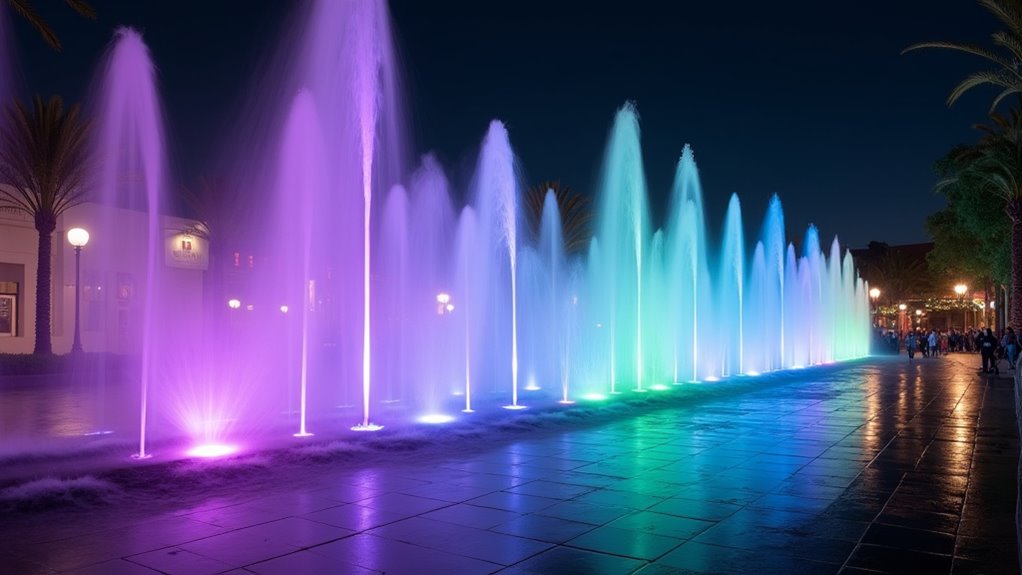
When the sun sets over Lima, the world’s largest fountain complex transforms into a mesmerizing spectacle of synchronized water, light, and sound that’ll leave you breathless. The Magic Water Circuit features 13 cybernetic fountains showcasing Peruvian history through projected imagery on water screens.
Arrive by 19:00 for ideal lighting and cooler temperatures. The main shows run at 19:15, 20:15, and 21:15, lasting 15 minutes each.
Position yourself on the left-hand side or central front of the Fantasy Fountain for the best projection views. This spectacular centerpiece spans 120 meters long and showcases the circuit’s most impressive hydraulic choreography.
Entry costs just 5 PEN, making this an incredible value for a 2-4 hour experience. Don’t miss the interactive Tunnel of Surprises, where you can walk through the fountains themselves.
Book evening tours for hassle-free transport from Miraflores.
Take a Day Trip to Pachacámac Archaeological Site
While most visitors stick to Lima’s colonial center, you’ll discover Peru’s most significant pre-Columbian sanctuary just 30 kilometers south at Pachacámac—a sprawling archaeological complex that served as the Pacific coast’s primary oracle for over 1,500 years.
You’ll explore temples from multiple civilizations, including the impressive Inca Temple of the Sun and the well-preserved Ajllawasi compound where priestesses once lived. The site’s 80+ hectares contain over 50 structures, from stepped adobe pyramids to reconstructed Ychsma streets.
Start at the on-site museum to understand the layered history, then follow marked circuits connecting major temples. Ancient pilgrims from both the coast and Andes once made sacred journeys to this revered site to seek guidance from the powerful oracle. Wear comfortable shoes for extensive walking on sandy terrain, and bring sun protection—the elevated viewpoints offer stunning panoramas of the Pacific coastline.
The Sum Up
You’ve just scratched Lima’s surface with these highlights. Don’t miss the weekend anticucho stands in Barranco—locals queue for hours. Book Larco Museum tickets online to skip lines, and time your Circuito Mágico visit for 7:30 PM when crowds thin. For Pachacámac, hire a guide who speaks Quechua—they’ll share stories tourist groups never hear. Keep your camera ready in the catacombs; flash photography’s actually permitted despite what most guides claim.