
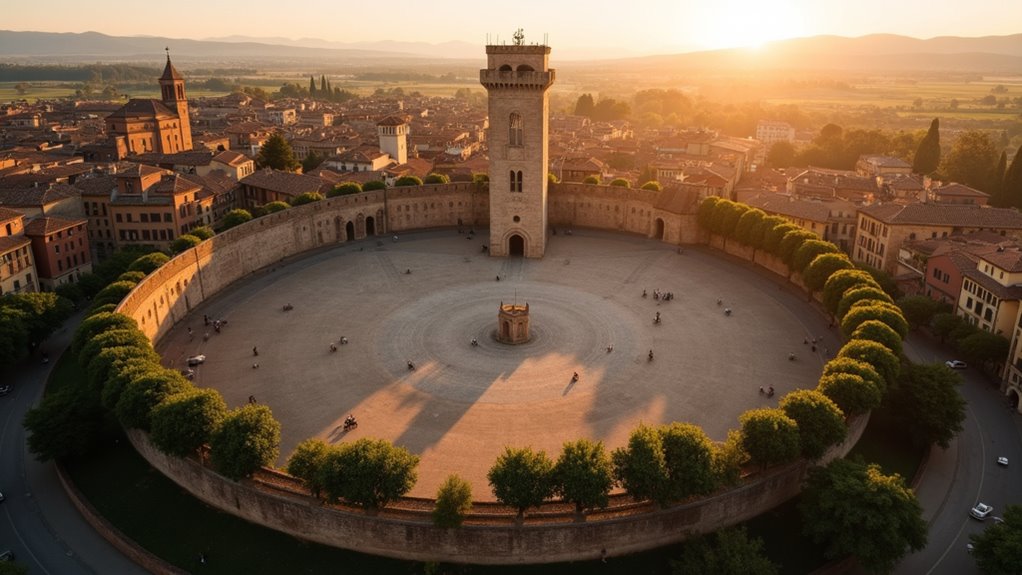
You’ll find Lucca tucked away in Tuscany, where Renaissance walls still embrace a city that hasn’t sold its soul to mass tourism. Unlike Florence or Rome, you won’t need deep pockets or advance reservations to enjoy most attractions here. This compact medieval gem offers authentic Italian experiences without the overwhelming crowds—from cycling atop ancient fortifications to discovering hidden gardens that most travelers walk right past. Here’s how to make the most of your time in this underrated destination.
- Walk or Bike the Renaissance City Walls
- Climb Torre Guinigi for Rooftop Garden Views
- Scale the Torre Delle Ore Clock Tower
- Wander the Oval Piazza Dell’anfiteatro
- Explore Piazza Napoleone and People-Watch
- Visit the Duomo and See the Volto Santo
- Tour San Michele in Foro and San Frediano Churches
- Stroll Through Palazzo Pfanner’s Baroque Gardens
- Browse the Wednesday and Saturday Farmers’ Markets
- The Sum Up
Walk or Bike the Renaissance City Walls
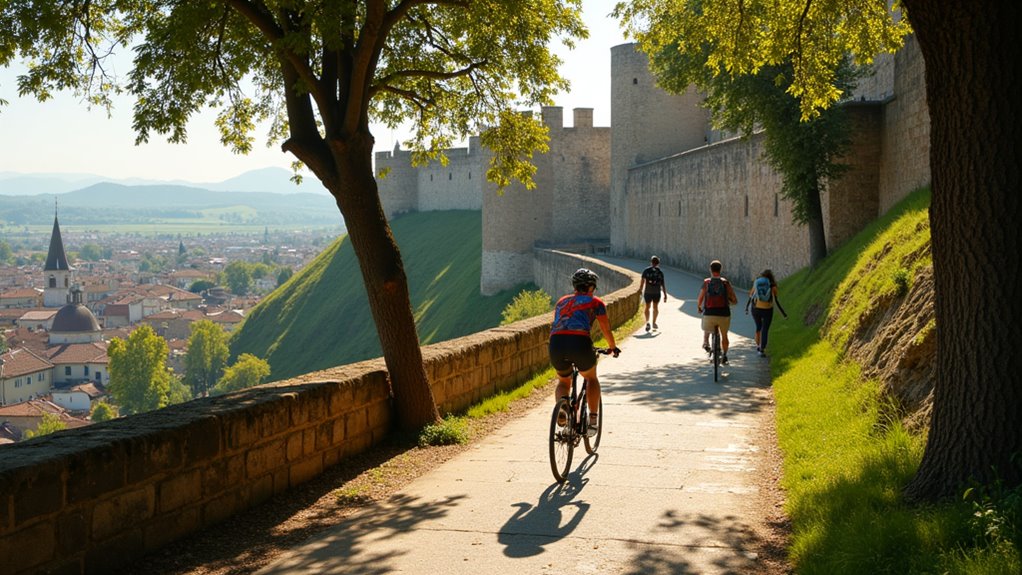
Walking or cycling along Lucca’s Renaissance walls gives you one of Italy’s most unique urban experiences—a complete 2.5-mile loop around the historic city center on top of 16th-century fortifications.
You’ll find this tree-lined path perfect for morning jogs, leisurely strolls, or bike rides with stunning views over terracotta rooftops and surrounding countryside.
The walls stretch 12 meters high and feature eleven bastions where you can pause for photos or picnics.
You’ll discover playgrounds, benches, and six access gates making entry convenient from anywhere in the city.
Rent a bike locally for about €15 per day, or simply walk the entire circuit in roughly an hour.
It’s completely free and offers safe, traffic-free recreation that locals and travelers alike cherish daily. The walls were designed by notable architects including Jacopo Seghizzi and Francesco Paciotto during their construction from 1545 to 1650.
Climb Torre Guinigi for Rooftop Garden Views
Rising 125 feet above Lucca’s medieval streets, Torre Guinigi offers something you won’t find anywhere else in Italy—a rooftop garden crowned with seven ancient holm oak trees atop a 14th-century tower.
Built by the wealthy Guinigi family as a symbol of power and prestige, this unique landmark requires climbing 230 steps up narrow spiral staircases.
The effort pays off with breathtaking 360-degree views of Lucca’s terracotta rooftops and the surrounding Tuscan countryside.
The ancient holm oaks provide welcome shade while you catch your breath and snap photos of this surreal green oasis floating above the medieval city. The garden’s trees symbolize rebirth and renewal for the original owners, adding deeper meaning to this architectural marvel.
The tower represents one of Lucca’s few surviving medieval towers, making it an essential stop for history buffs and Instagram enthusiasts alike.
Scale the Torre Delle Ore Clock Tower
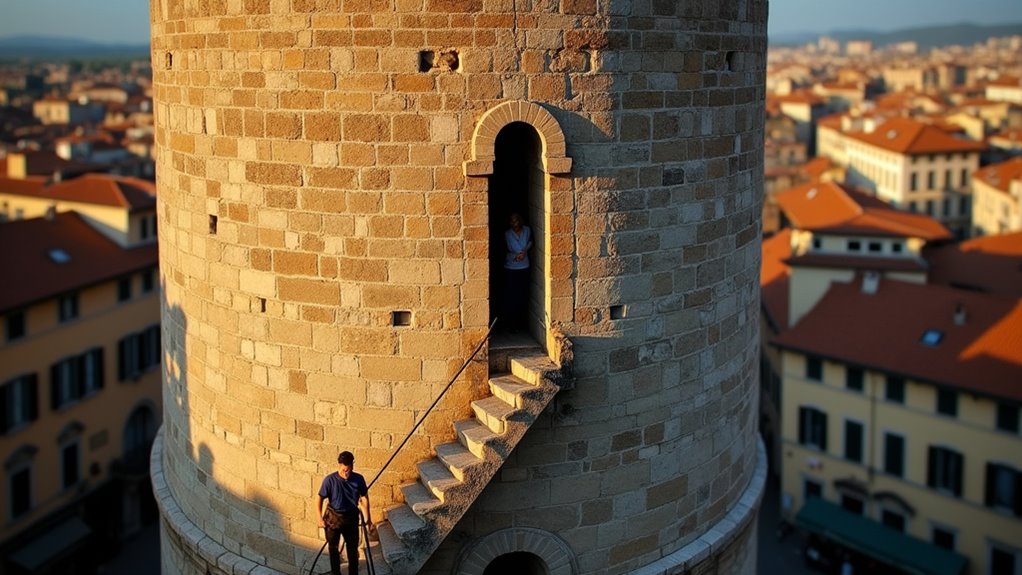
At 164 feet tall, Torre Delle Ore stands as Lucca’s highest tower and home to one of Europe’s best-functioning historical clock mechanisms. You’ll climb 207 wooden steps to reach panoramic views of Lucca’s rooftops and Tuscan hills beyond.
The tower’s unique Roman-style clock strikes hours one through six, repeating four times daily using three different-sized bells.
Inside, you’ll see the original 18th-century manually wound clockworks, still operational since 1754. The climb costs around €4, or you can grab combined tickets with Torre Guinigi for better value.
Located on Via Fillungo, Lucca’s main shopping street, it’s easily accessible. The narrow wooden staircase provides a workout, but the stunning vistas and fascinating clock machinery make it worthwhile. Legend connects the tower to Lucida Mansi, a 17th-century noblewoman who allegedly made a pact with the Devil to preserve her eternal youth.
Wander the Oval Piazza Dell’anfiteatro
After taking in Lucca’s skyline from above, you’ll want to explore one of Italy’s most unusual squares at street level. Piazza dell’Anfiteatro sits atop a 2,000-year-old Roman amphitheater, and you’ll immediately notice its distinctive oval shape surrounded by colorful medieval buildings.
Walk through one of the four archway entrances and you’re standing where 10,000 Romans once watched gladiator battles. The cobblestone piazza preserves the amphitheater’s original elliptical outline, while the surrounding buildings rest directly on ancient Roman foundations. During medieval times, the ruined amphitheater was known as “grotte” due to its deteriorated state.
You can grab an affordable espresso at one of the cafes built into the former arena walls, browse local shops, or simply admire this remarkable example of adaptive reuse. The cross-shaped tiles in the center mark the amphitheater’s historical axis points.
Explore Piazza Napoleone and People-Watch
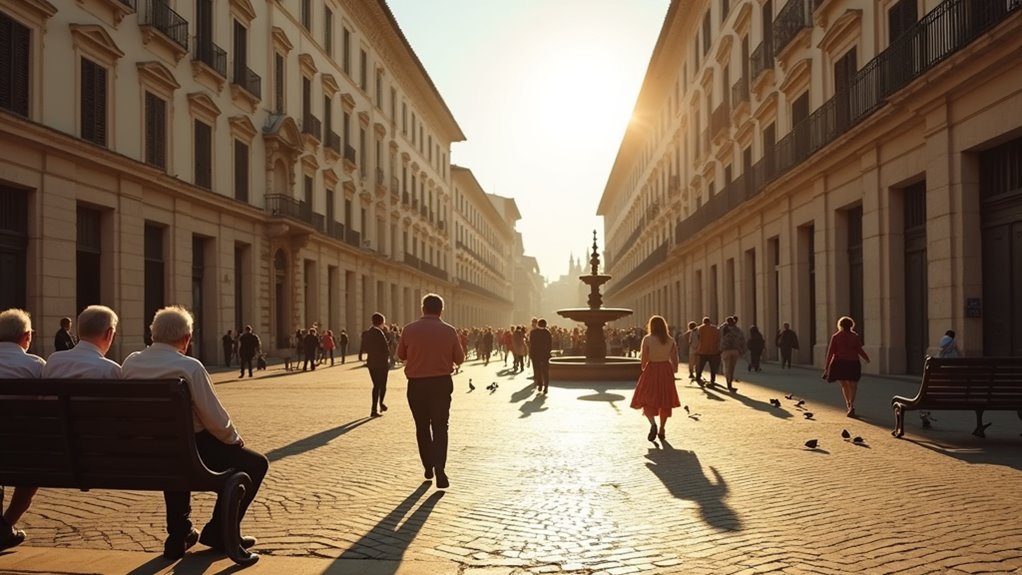
From the charming oval piazza, head to Lucca’s largest public square, Piazza Napoleone, where centuries of dramatic history unfold beneath your feet. This expansive space, named after Napoleon by his sister Elisa, replaced a 14th-century fortress that citizens demolished in revolt against centralized power.
Grab a coffee from one of the budget-friendly cafés lining the square and settle under the elegant sycamore trees for prime people-watching. You’ll observe a fascinating mix of locals and travelers against the backdrop of the impressive Renaissance Palazzo Ducale. The palace itself served as a rulers’ residence for centuries before becoming today’s civic and cultural venue.
Look for glass blocks revealing archaeological remains from the 1998 excavations. The statue of Maria Luisa di Borbone anchors the center, while Teatro del Giglio nearby adds cultural flair.
During summer, you might catch the renowned Lucca Summer Festival‘s world-class performances.
Visit the Duomo and See the Volto Santo
Six centuries of devotion and architectural mastery converge at the Duomo di San Martino, where you’ll discover one of Tuscany’s most treasured religious artifacts without paying a single euro to admire the exterior. The cathedral’s polychrome marble facade draws inspiration from Pisa’s cathedral, featuring intricate bas-reliefs depicting St. Martin’s stories across three stunning tiers of open galleries.
Step inside to witness the famous Volto Santo, a wooden crucifix legendarily carved by Nicodemus himself. This sacred relic sits within Matteo Civitali’s octagonal chapel, built specifically in 1484 to house this pilgrimage destination. The Holy Cross celebrations take place every September 14th with a spectacular street luminara honoring the Holy Face.
Don’t miss Nicola Pisano’s 1260 Deposition sculpture near the entrance. The Gothic interior showcases centuries of artistic devotion, making this free cultural experience essential for understanding Lucca’s spiritual heritage.
Tour San Michele in Foro and San Frediano Churches
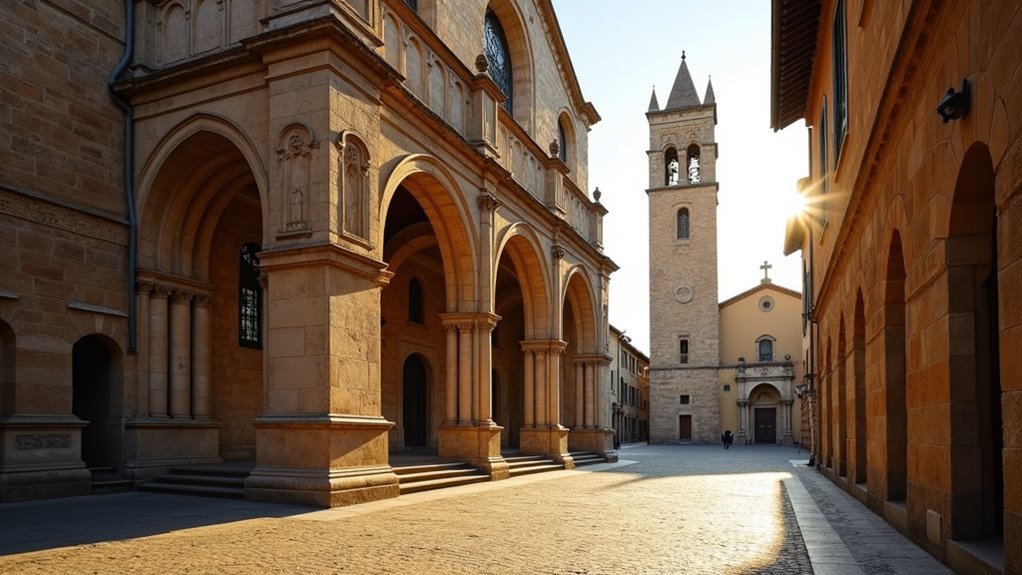
Two magnificent churches showcase Lucca’s religious heritage without charging admission, making them perfect stops for budget-conscious travelers. San Michele in Foro stands where ancient Romans built their forum, offering stunning Tuscan Romanesque architecture. You’ll spot the four-tier facade with its blind arcades and the impressive 4-meter marble statue of Archangel Michael crowning the top. Local legend claims an emerald sparkles in the angel’s finger when sunlight hits it just right.
Inside, you can admire works by Luca della Robbia and Filippino Lippi without paying extra fees. The church’s historical significance runs deep—it served as Lucca’s civic center until 1370. The current structure emerged from 11th-century renovations commissioned by Pope Alexander II, transforming the ancient site into the architectural masterpiece you see today.
Fun fact: Giacomo Puccini’s family played the organ here for generations, connecting you to Italy’s musical heritage.
Stroll Through Palazzo Pfanner’s Baroque Gardens
While most visitors rush between Lucca’s famous towers and piazzas, you’ll discover one of Tuscany’s finest 18th-century gardens tucked away at Palazzo Pfanner. This Baroque gem features geometric pathways lined with classical statues depicting Greek gods and the Four Seasons, all centered around a dramatic octagonal fountain.
You’ll find the garden at Via degli Asili, 33, where admission costs just €4.50. The lemon house displays terracotta pots filled with citrus trees, while QR codes throughout help you identify various plants.
The peaceful setting offers perfect relief from Lucca’s bustling streets, and you might recognize the scenery from films like “Portrait of a Lady.” The garden was created in the early 18th century and is attributed to renowned architect Filippo Juvarra.
Visit during afternoon hours when the garden’s tranquil atmosphere is most pronounced and ideal for leisurely exploration.
Browse the Wednesday and Saturday Farmers’ Markets
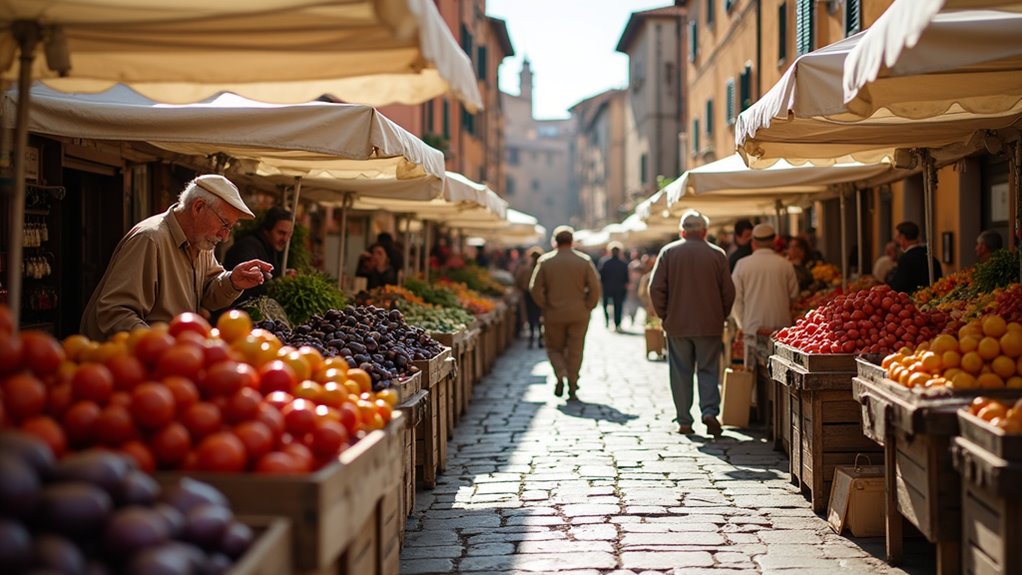
When Wednesday and Saturday roll around, you’ll find Lucca’s streets come alive with vibrant farmers’ markets that showcase the region’s finest local produce. Wednesday’s MercoledìBio at Piazza San Francesco (4-7 pm) focuses on organic goods, while Saturday’s Foro Boario market caters to early risers from 7 am to 1 pm.
You’ll discover seasonal treasures like canestrino tomatoes, Garfagnana cheeses, and olive oil from Compitese hills. Don’t miss the atmospheric Mercato in Piazza del Carmine, housed inside an old church, where fresh bread aromas mix with colorful vegetable displays.
These markets offer budget-friendly ways to taste authentic local flavors while supporting small farmers. Lucca also hosts Campagna Amica on Thursday, providing another opportunity to shop for high-quality regional products throughout the week. Grab some regional specialties like Cinta Senese pork or ancient grain flour, then enjoy coffee at nearby trattorias.
The Sum Up
You’ll find Lucca’s compact size perfect for budget travelers—most attractions are free or low-cost, and you can easily walk everywhere. Pack comfortable shoes and bring a water bottle to save money. Don’t miss the free Wednesday and Saturday markets for affordable local treats. If you’re staying overnight, book accommodations outside the walls for better rates, then walk in each morning. Lucca’s charm won’t break your budget.