
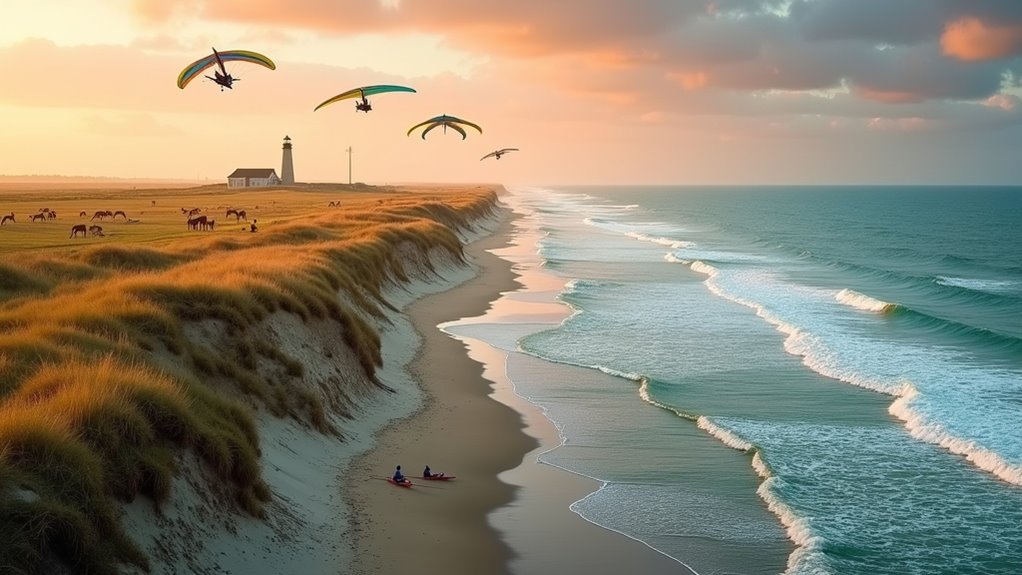
You’ll find incredible adventures across the Outer Banks’ barrier islands, from climbing Jockey’s Ridge’s 100-foot sand dunes to spotting wild Colonial Spanish horses on Corolla’s back roads. Scale Currituck Beach Lighthouse’s 220 steps for panoramic views, explore where the Wright Brothers first flew, and watch dolphins in protected waters. Kayak through Alligator River’s wetlands, hunt ghost crabs at dusk, and visit the aquarium’s interactive exhibits. These experiences offer something for every budget and adventure level.
- Climb Jockey’s Ridge State Park’s Towering Sand Dunes
- Take a Wild Horse Safari Through Corolla’s Back Roads
- Scale the 220 Steps of Currituck Beach Lighthouse
- Explore the Wright Brothers National Memorial
- Go Dolphin Watching on Protected Waters
- Discover Wildlife at Pea Island National Wildlife Refuge
- Experience Maritime History in Historic Corolla Village
- Kayak Through Alligator River’s Marshlands
- Visit North Carolina Aquarium on Roanoke Island
- Hunt Ghost Crabs on Evening Beach Walks
- The Sum Up
Climb Jockey’s Ridge State Park’s Towering Sand Dunes

When you’re looking for an unforgettable adventure that won’t cost you a dime, Jockey’s Ridge State Park delivers one of the East Coast’s most unique experiences. You’ll climb the tallest active sand dune system on the Atlantic coast, towering 60-100+ feet above sea level.
The challenging ascent through shifting quartz sand rewards you with panoramic views spanning from the Atlantic Ocean to Roanoke Sound.
This “Living Dune” constantly reshapes itself, so each visit offers something new. You can try sandboarding, fly kites in the consistent coastal winds, or tackle hang gliding lessons.
The visitor center‘s free boardwalk provides easy dune access and educational displays about the ecosystem. Beyond the bare dunes themselves, you’ll discover three distinct ecosystems that support diverse wildlife from foxes and deer in the maritime thicket to blue crabs in the Roanoke Sound estuary.
Pack water and sun protection—the exposed sand creates desert-like conditions that’ll test your endurance.
Take a Wild Horse Safari Through Corolla’s Back Roads
If you’re seeking an authentic wildlife encounter that rivals any African safari, Corolla’s wild horse tours deliver an extraordinary adventure through terrain that’s impossible to explore on your own.
You’ll venture into 4×4-only zones where Colonial Spanish mustangs have roamed for 400-500 years, spotting these magnificent Banker horses grazing under beach houses and wandering sandy back roads.
These 2-2.5 hour guided tours cover 20-30 miles of dunes, maritime forests, and residential areas using open-air safari trucks with stadium seating for ideal viewing.
Multiple daily departures operate seven days weekly during peak season, though you’ll want to book ahead due to high demand. Expert guides provide educational commentary about the local ecology while highlighting natural features that visitors typically overlook.
Remember: you must maintain 50 feet distance from horses—feeding or approaching them’s illegal.
Many operators contribute tour revenue to habitat preservation efforts.
Scale the 220 Steps of Currituck Beach Lighthouse
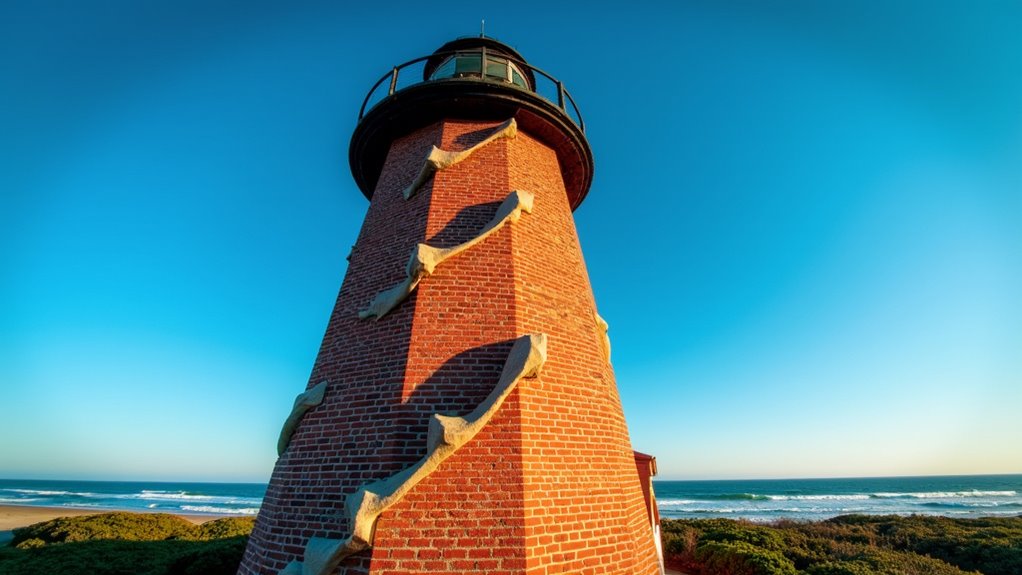
After experiencing Corolla’s wild horses from ground level, you can gain a completely different perspective of the area’s natural beauty by climbing the 220 cast-iron steps inside Currituck Beach Lighthouse.
This 162-foot brick tower offers panoramic views from 158 feet above sea level after a moderate 5-10 minute climb.
Built in 1875, the lighthouse’s distinctive unpainted red-brick exterior makes it instantly recognizable among the Outer Banks’ black-and-white striped towers.
You’ll need a ticket to climb, and the lighthouse operates seasonally from spring through late fall with varying daily hours. The lighthouse features a First Order Fresnel lens that rotates every 20 seconds and remains visible up to 18 nautical miles on clear nights.
Expect crowds during summer months, which can mean wait times due to safety capacity limits.
The interior gets warm and humid, so dress appropriately and bring water for this 12-story equivalent workout.
Explore the Wright Brothers National Memorial
Where else can you stand on the exact spot where human flight began? At Wright Brothers National Memorial in Kill Devil Hills, you’ll walk the actual flight line where Orville and Wilbur made aviation history on December 17, 1903. Stone markers show where each of their four flights started and landed—from that first 120-foot hop to the final 852-foot journey.
You’ll climb the 60-foot granite monument atop Big Kill Devil Hill for panoramic Outer Banks views. Then explore reconstructed wooden sheds that served as the world’s first airplane hangar and the brothers’ living quarters. The visitor center features full-scale reproductions of the 1902 glider and the 1903 Flyer, plus interactive exhibits explaining their problem-solving process. The memorial spans 430 acres of protected land, making it one of the largest historical aviation sites in the country. Entry costs under $15 per vehicle.
Go Dolphin Watching on Protected Waters
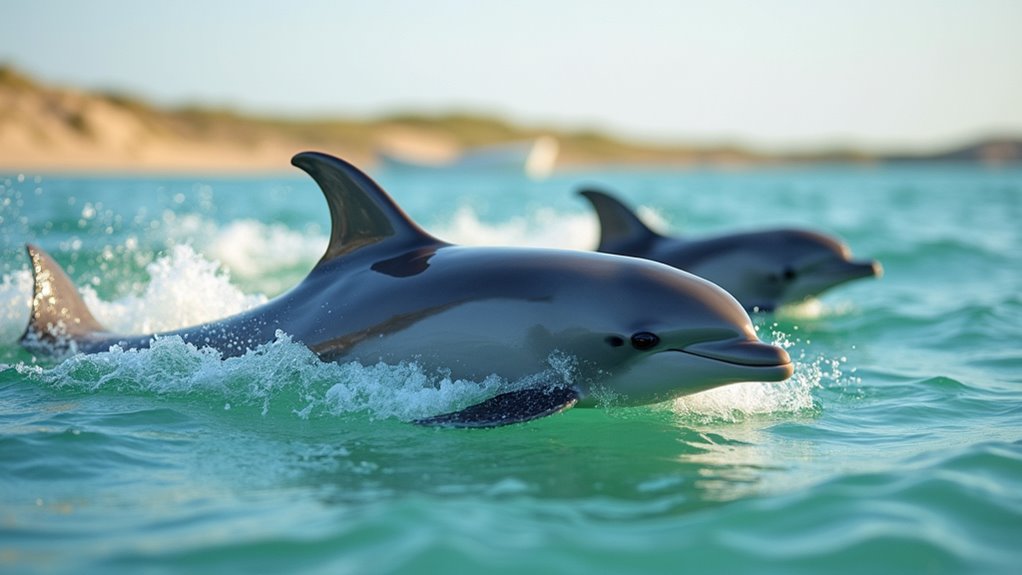
From the historic heights of aviation history, you’ll discover the Outer Banks offers equally spectacular experiences on the water. Dolphin watching tours guarantee sightings from May through October in protected waters like Roanoke and Pamlico Sounds.
You’ll cruise calm soundside conditions perfect for spotting bottlenose dolphins during their feeding and cruising activities.
Choose from experienced operators like Captain Johnny’s Dolphin Tours (30th season) or Nags Head Dolphin Watch, which partners with dolphin researchers. Standard two-hour tours operate multiple times daily, with sunset options available.
You’ll enjoy educational narration about dolphin behavior while relaxing on vessels designed for maximum viewing. Research programs have identified over 800 dolphins by their unique dorsal fin shapes since 2008.
Book early since tours fill quickly during peak season.
Departure locations offer convenient dining options, making dolphin watching an affordable, family-friendly adventure.
Discover Wildlife at Pea Island National Wildlife Refuge
Why settle for glimpsing wildlife from a distance when you can learn about one of the East Coast’s most biodiverse refuges? Pea Island National Wildlife Refuge offers incredible bang for your buck—it’s completely free and hosts over 400 bird species plus dozens of mammals, reptiles, and amphibians.
You’ll find excellent wildlife viewing year-round, but visit during winter for massive waterfowl concentrations or spring and fall for spectacular migrations. The refuge’s managed impoundments concentrate ducks, geese, and swans for easy spotting, while soundside trails provide close-range photography opportunities.
Start at the Visitor Center for maps and current wildlife reports, then explore the nature trails. The center is conveniently located just 4 miles south of the Basnight Bridge over Oregon Inlet, making it easily accessible as you travel NC Highway 12. Don’t miss the observation deck—it’s perfect for scanning the managed ponds where hundreds of species gather daily.
Experience Maritime History in Historic Corolla Village
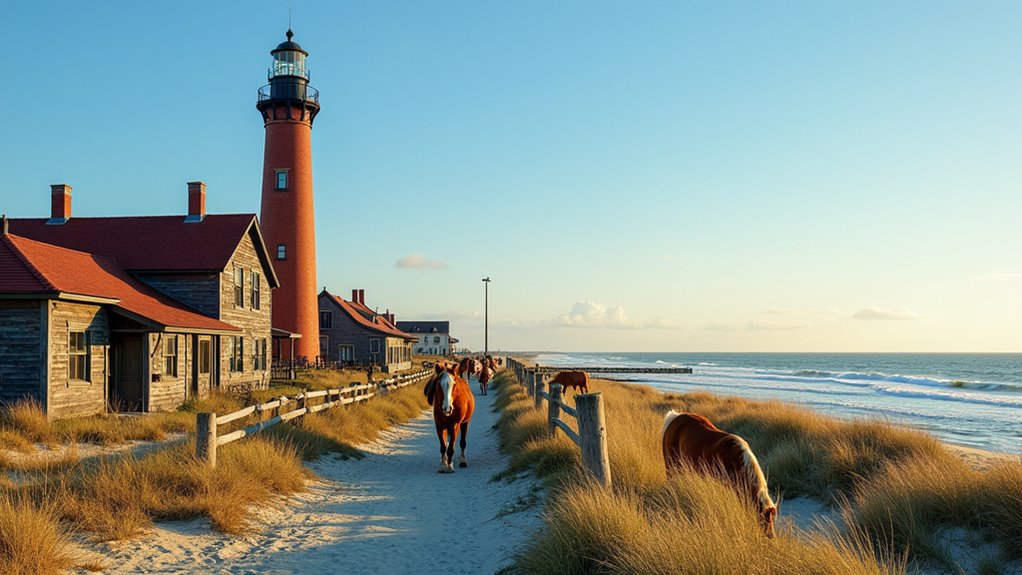
After soaking in nature’s wonders at Pea Island, step back in time at Historic Corolla Village, where centuries of maritime heritage come alive in one spectacular 39-acre waterfront park.
You’ll find four major attractions within walking distance of each other, making it easy to explore without driving between sites.
Climb the 214 steps inside the red-brick Currituck Beach Lighthouse for stunning panoramic views – it’s worth the seasonal admission fee.
Tour the elaborate Whalehead mansion, a 1920s hunting lodge with fascinating ghost stories and original furnishings.
The Outer Banks Center for Wildlife Education offers free interactive exhibits about local maritime culture.
The park itself costs nothing to explore, with free picnic areas, walking paths, and sound access for kayaking. During summer evenings, the grounds come alive with weekly events including concerts, wine tastings, and live music performances.
Kayak Through Alligator River’s Marshlands
While Historic Corolla Village showcases the Outer Banks’ maritime past, Alligator River National Wildlife Refuge lets you paddle through 152,000 acres of living wetland ecosystem on the mainland.
You’ll glide through calm blackwater canals lined with cypress trees, exploring one of the Atlantic Coast’s largest remaining pocosin wetland complexes.
Two-hour guided tours start around $50-$65 per person from Buffalo City Road, about 10 miles west of Roanoke Island.
Operators provide kayaks, paddles, and life jackets plus basic instruction.
You might spot alligators basking on banks, black bears along forest edges, or endangered red wolves at dawn.
The refuge supports over 250 bird species, making spring and fall ideal for wildlife viewing. These guided kayak tours are suitable for all ages and skill levels with expert guides providing safe wildlife viewing opportunities.
Pack bug spray—mosquitoes are intense in warmer months.
Visit North Carolina Aquarium on Roanoke Island

From mainland wetlands, you can head back to Roanoke Island for an up-close look at the marine life that defines the Outer Banks. The North Carolina Aquarium houses the state’s largest shark collection in a massive 285,000-gallon “Graveyard of the Atlantic” habitat.
You’ll walk through a shipwreck hall, touch stingrays in interactive tanks, and watch river otters during “Happy Otter Hour” talks.
Don’t miss the Sea Turtle Assistance and Rehabilitation Center, where you can observe real turtle rescues. Daily programs like “Dialogue with a Diver” sessions are free, while adventurous visitors can dive with sharks for $195.
Plan 2-3 hours for your visit, and book timed-entry tickets in advance. Family admission typically runs under $42. The aquarium also offers outdoor activities like guided kayak tours that let you explore the surrounding waters.
Hunt Ghost Crabs on Evening Beach Walks
As the sun sets over the Outer Banks, you’ll discover one of the area’s most entertaining free activities: ghost crab hunting along the shoreline. Pack a flashlight, bucket, and net for this summer adventure that’s perfect from May through October.
Head to quiet beaches away from traffic and bonfires for the best results. You’ll find these pale crabs scurrying between the tide lines, darting in and out of nickel-to-half-dollar-sized burrows in the sand. These crabs emerge at dusk to wet their gills by heading to the ocean after spending the day hidden underground.
Use stealth tactics: approach with your flashlight off, then flash it intermittently to freeze crabs momentarily. Work in pairs for better success rates, with one person handling the light while the other pursues. Remember to handle gently and release quickly—this is about observation and fun, not harvesting.
The Sum Up
You’ve got endless adventure waiting in the Outer Banks without breaking the bank. Pack your hiking boots for those sand dunes, bring binoculars for dolphin spotting, and don’t forget a flashlight for ghost crab hunting after dark. Many of these experiences cost little to nothing—just gas money and parking fees. Whether you’re scaling lighthouses or kayaking through marshlands, you’ll create memories that’ll last a lifetime on North Carolina’s stunning coast.