
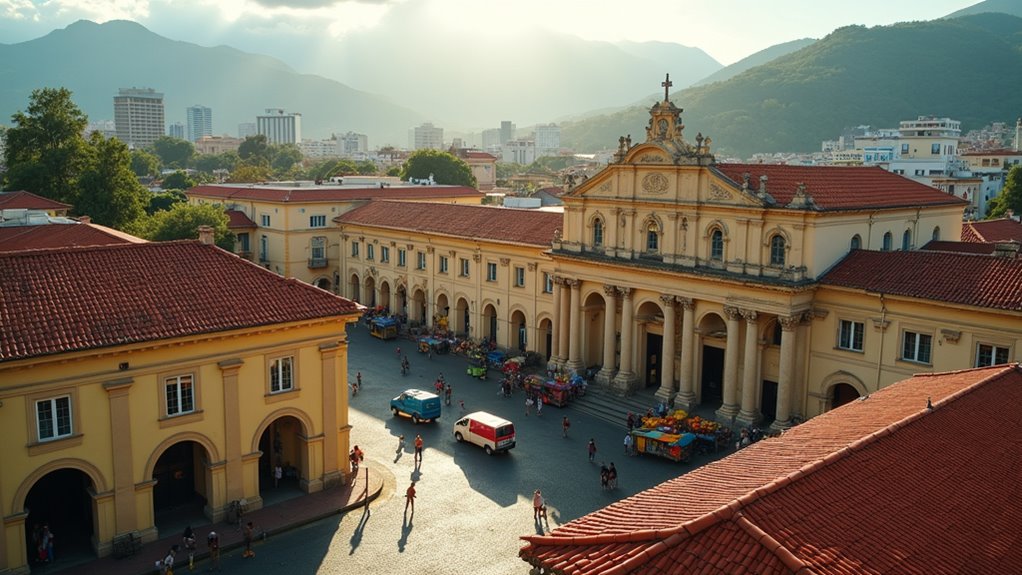
You’ll discover San José’s hidden gems beyond the typical tourist path, from the opulent Teatro Nacional with its 22.5-carat gold details to the chaotic Mercado Central where $3 casados beat expensive restaurant meals. Explore underground pre-Columbian gold treasures, take day trips to Poás Volcano’s active crater, and wander through vibrant street art in colonial neighborhoods. Don’t miss the former Bellavista Fortress turned museum or La Paz Waterfall Gardens‘ rescued wildlife sanctuary. These authentic experiences reveal Costa Rica’s true cultural heart.
- Step Inside the Opulent Teatro Nacional for a Glimpse of 1890s Grandeur
- Navigate the Chaotic Aisles of Mercado Central for Authentic Local Flavors
- Marvel at Pre-Columbian Gold Treasures Beneath Plaza De La Cultura
- Take a Day Trip to Poás Volcano’s Active Crater and Cloud Forest
- Explore Costa Rica’s History at the Former Bellavista Fortress
- Join a Coffee Farm Tour at Nearby Plantations in the Central Valley
- Wander Through Parque La Sabana, the City’s Green Heart
- Experience Wildlife Up Close at La Paz Waterfall Gardens
- Discover Street Art and Colonial Architecture on Foot Through Downtown
- Venture Into Monteverde’s Mystical Cloud Forest for Quetzal Spotting
- The Sum Up
Step Inside the Opulent Teatro Nacional for a Glimpse of 1890s Grandeur

When you step through the sandstone entrance of Teatro Nacional de Costa Rica, you’re entering what Costa Rica’s coffee barons built as their crowning cultural achievement in 1897.
You’ll immediately notice the Carrara marble floors and 22.5-carat gold leaf detailing that showcase the coffee elite’s wealth during San José’s cultural boom—when the city had just 20,000 residents.
Don’t miss Aleardo Villa’s ceiling mural “Allegory of Coffee and Bananas,” famously reproduced on Costa Rica’s five colón banknote.
The neoclassical façade features statues of Beethoven and Calderón de la Barca, while Pietro Bulgarelli’s allegorical figures of Dance, Music, and Fame adorn the entrance.
Guided tours cost around $10 and reveal how coffee export taxes funded this $4.5 million architectural masterpiece modeled after European opera houses. The opulent interior regularly hosts orchestras, operas, and ballets beneath velvet curtains and bronze lamp lighting.
Navigate the Chaotic Aisles of Mercado Central for Authentic Local Flavors
Since 1880, Mercado Central has served as San José’s beating commercial heart, where you’ll navigate a maze of 200+ stalls crammed into narrow aisles that assault your senses with shouting vendors, pungent spice aromas, and visual chaos.
Head straight to the traditional sodas for authentic casados and gallo pinto at rock-bottom prices—you’ll eat better here than at touristy restaurants for half the cost.
Don’t miss La Sorbetera de Lolo Mora, dishing out handmade ice cream since 1901. Sample exotic tropical fruits you’ve never seen, browse medicinal herbs reflecting Costa Rica’s folk medicine traditions, and hunt for genuine leather goods like snakeskin boots.
You’ll find this vibrant market located in central San José at coordinates 9°56′05″N 84°04′55″W, making it easily accessible from anywhere in the city.
Visit Monday through Saturday (closed Sundays) and embrace the overwhelming sensory experience—it’s chaotic but authentically Costa Rican.
Marvel at Pre-Columbian Gold Treasures Beneath Plaza De La Cultura
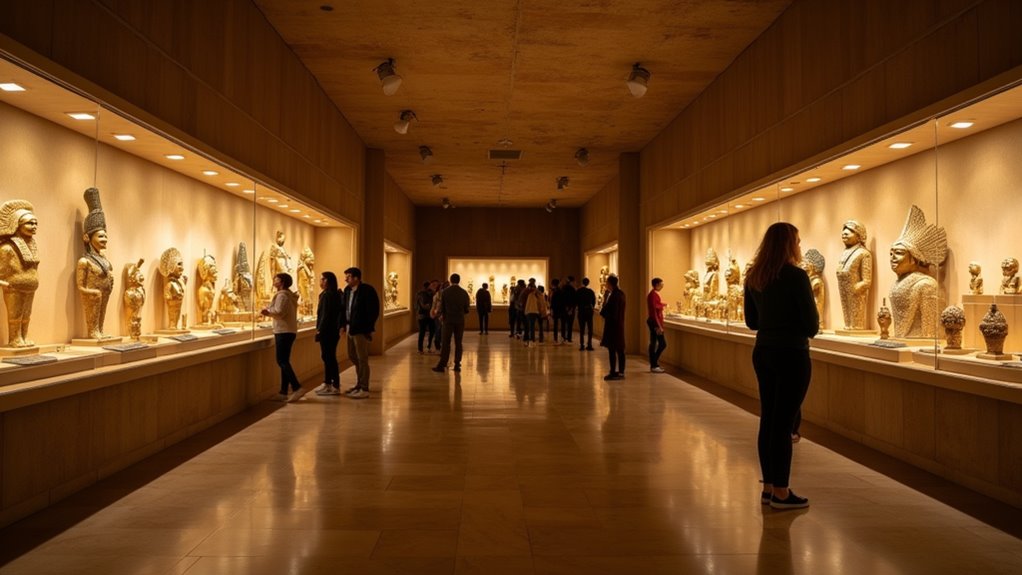
Descending beneath San José’s bustling Plaza de la Cultura, you’ll discover Costa Rica’s most extraordinary archaeological treasure—the Museo del Oro Precolombino, housed in the country’s only fully underground public building. This modernist concrete complex holds over 1,600 pre-Columbian gold pieces spanning 300 BC to 1550 AD, making it one of Latin America’s most important collections.
You’ll marvel at intricate animal figurines, ceremonial pendants, and jaguar-shaped ornaments that showcase sophisticated lost-wax casting techniques. The exhibits reveal how indigenous societies valued gold for spiritual power rather than currency, connecting you to Costa Rica’s rich cultural heritage.
Budget-friendly admission includes access to three underground levels, where displays trace technological evolution and ancient cosmology through stunning craftsmanship. The museum houses a total of 3,567 pre-Columbian artifacts, including ceramic objects, stone items, jade pieces, and glass beads alongside the impressive gold collection.
Take a Day Trip to Poás Volcano’s Active Crater and Cloud Forest
Just over an hour’s drive from San José, Poás Volcano National Park offers one of Central America’s most accessible encounters with an active volcanic crater. Here, you’ll peer into a mile-wide caldera containing one of Earth’s most acidic lakes. The aquamarine Laguna Caliente is more acidic than battery acid, while dramatic steam plumes shoot 820 feet skyward.
You’ll need advance online reservations since daily visitors are strictly limited. The park’s 5,600 hectares protect stunning cloud forest where you can spot resplendent quetzals and endemic Poás squirrels. Unlike many volcanic destinations worldwide, you can drive within 300 ft of the crater rim, making this an extraordinarily accessible natural wonder.
Don’t miss the peaceful Lake Botos trail through twisted, moss-covered trees. Pack warm layers and sun protection—temperatures drop markedly at 8,800 feet elevation, but UV exposure remains intense when clouds clear.
Explore Costa Rica’s History at the Former Bellavista Fortress
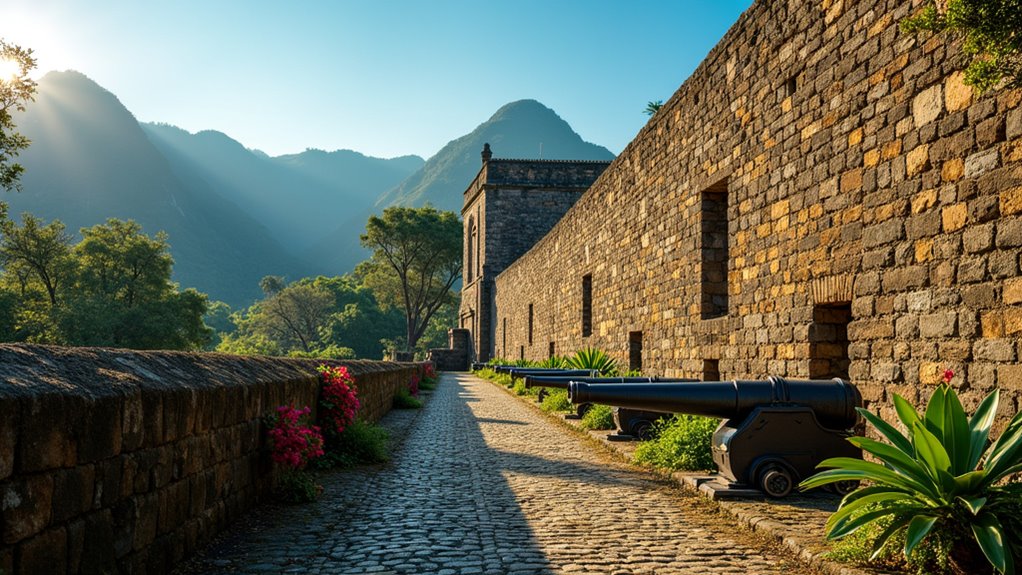
While most travelers focus on Costa Rica’s natural wonders, you’ll discover the nation’s most pivotal historical moment at the former Bellavista Fortress, now home to the National Museum. This hilltop military barracks witnessed José Figueres Ferrer’s symbolic abolition of Costa Rica’s army on December 1, 1948, when he struck a battlement with a sledgehammer, transforming the site into a symbol of peace.
You’ll explore pre-Columbian pottery dating to 500 BCE, jade artifacts, and colonial-era exhibits for an affordable entrance fee. Don’t miss the preserved bullet holes on exterior walls—visible reminders of the 1948 Civil War and earlier conflicts like the 1932 “Bellavistazo.” Step outside to the museum’s Butterfly Garden, where over 20 species flutter among native plants, offering a peaceful contrast to the fortress’s military past.
The museum’s strategic location offers panoramic views of San José while housing Costa Rica’s most extensive collection of archaeological and historical treasures.
Join a Coffee Farm Tour at Nearby Plantations in the Central Valley
Beyond San José’s urban bustle, you’ll find Costa Rica’s coffee heritage thriving in the Central Valley’s volcanic highlands, where family-run plantations offer immersive tours just 30–60 minutes from your hotel. These 1.5–3 hour experiences cover everything from seedling cultivation to cupping techniques, with many estates providing convenient hotel pickup from San José, Escazú, and Alajuela.
Consider Doka Estate’s award-winning plantation walks or Café Britt’s theatrical storytelling approach. For sustainability-focused travelers, Finca Rosa Blanca’s organic, shade-grown operation offers excellent value. Central Valley coffees are known for their well-balanced cups featuring citrus and chocolate notes that make them ideal for first-time coffee travelers.
Visit during harvest season (November–February) for dynamic demonstrations of cherry picking and active mills. Many operators combine coffee tours with Poás Volcano visits for efficient full-day Central Valley circuits.
Wander Through Parque La Sabana, the City’s Green Heart
After exploring Costa Rica’s agricultural heritage in the mountains, head to Parque La Sabana for a completely different but equally authentic Costa Rican experience.
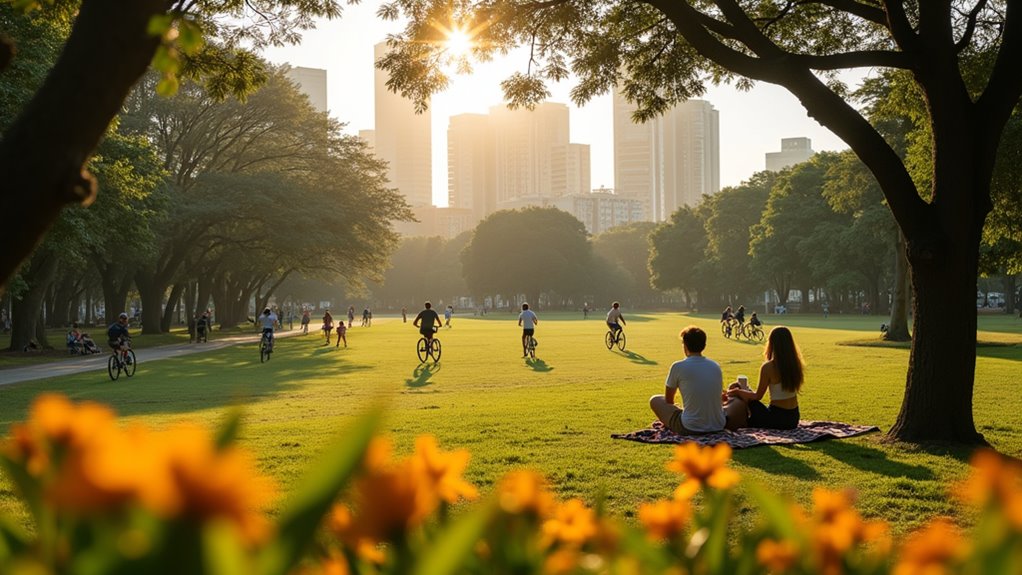
This 177-acre park serves as San José’s green heart, where locals gather daily for morning runs, family picnics, and weekend soccer games.
You’ll find the best atmosphere arriving by 6 AM when the park buzzes with joggers and dog walkers.
Entry’s completely free, making it perfect for budget travelers.
Don’t miss the Costa Rican Art Museum housed in the preserved former airport terminal—yes, this was actually the country’s first international airport until 1958. The park also features a large outdoor sculpture garden that showcases impressive artistic displays.
Pack water and comfortable shoes since you’ll want to explore the tree-lined trails, sports fields, and cultural facilities that make this Costa Rica’s most visited park.
Experience Wildlife Up Close at La Paz Waterfall Gardens
Just 90 minutes from San José, La Paz Waterfall Gardens offers Costa Rica’s most accessible wildlife encounter, combining the country’s largest animal sanctuary with spectacular cloud forest scenery. You’ll walk 2+ miles of paved trails past 100+ rescued species that can’t survive in the wild, including jaguars, sloths, and poison dart frogs.
The butterfly observatory houses 4,000 specimens and ranks among the world’s best. Twenty-six hummingbird species feed within arm’s reach at the garden’s feeders. The serpentarium displays 30 snake species with detailed educational information.
Budget tip: Visit early morning for cooler temperatures and more active wildlife. The $44 entrance fee includes access to five waterfalls along La Paz River, making this excellent value for families seeking guaranteed wildlife sightings without jungle trekking. The park encompasses 70 acres of diverse rainforest and cloud forest ecosystems that support rich flora and fauna.
Discover Street Art and Colonial Architecture on Foot Through Downtown
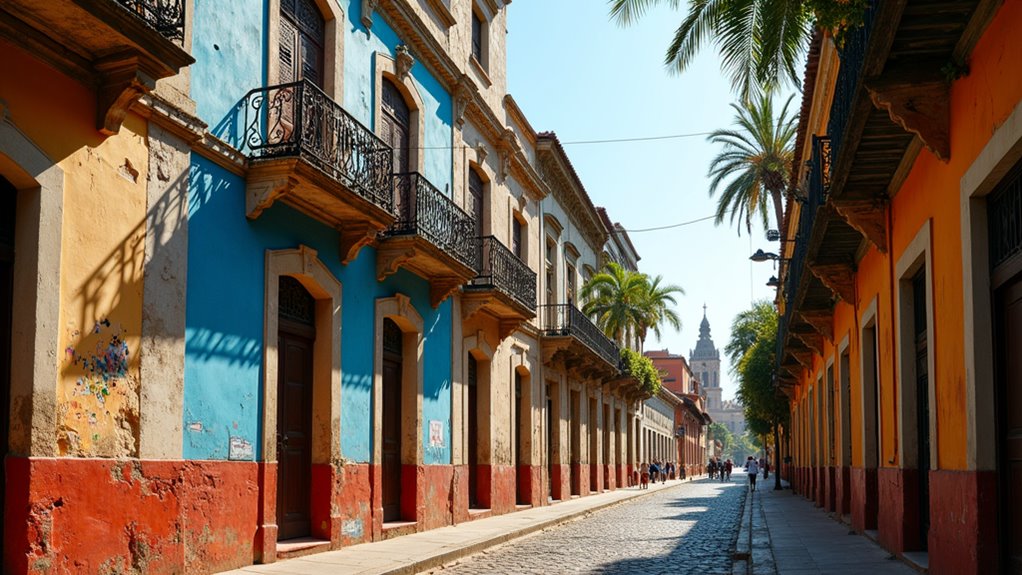
While La Paz Waterfall Gardens showcases Costa Rica’s natural heritage, San José’s downtown reveals the country’s rich cultural story through centuries-old colonial buildings and vibrant street art that transforms ordinary walls into open-air galleries.
Start your walking tour in Barrio Amón, where coffee-baron mansions display neoclassical facades now housing affordable cafes and galleries. Visit the National Theater’s marble interiors (admission required) and the free-to-view Metal Building near Morazán Park.
For street art, explore Bella Vista’s City of Color Murals and Calle 17 behind the National Museum, where San José’s urban art movement began. You’ll find environmental motifs celebrating Costa Rica’s biodiversity alongside political commentary and vibrant portraiture reflecting local identity. Look for Fralem’s ‘Monkey Politician’ mural in the business district, which uses satirical imagery to comment on corruption.
The downtown bohemian neighborhoods offer budget-friendly exploration combining historic architecture with contemporary artistic expression.
Venture Into Monteverde’s Mystical Cloud Forest for Quetzal Spotting
Though San José’s urban art scene captures Costa Rica’s cultural pulse, Monteverde’s mystical cloud forest offers an entirely different treasure: the chance to spot the legendary resplendent quetzal in its natural habitat.
You’ll find ideal viewing during breeding season (February-June) when these emerald-tailed birds frequent fruiting trees and nest sites.
The 26,000-acre Monteverde Cloud Forest Reserve protects 400 bird species within nearly 100% humidity conditions that create the mystical fog quetzals love.
Visit early morning to avoid crowds—peak season brings 450 daily visitors.
Try Sendero El Rio trail (1.9km) for mature forest habitat.
Budget-conscious travelers can join guided quetzal walks or explore independently using the reserve’s signed trail network. The reserve contains over 2,500 plant species, making it one of the most biodiverse destinations in Costa Rica.
This birthplace of Costa Rican ecotourism combines conservation with authentic wildlife encounters you’ll never forget.
The Sum Up
You’ve now got nine incredible experiences waiting in San José, from budget-friendly market adventures to splurge-worthy volcano excursions. Mix free activities like downtown walks with affordable cultural sites—the Gold Museum’s only $10. Don’t skip the local sodas for cheap, authentic meals between attractions. Whether you’re catching a show at Teatro Nacional or hunting quetzals in Monteverde, you’ll discover San José’s perfect blend of urban culture and natural wonders without breaking your travel budget.