

You’ll discover St. John’s offers an incredible mix of dramatic clifftop views, colorful historic neighborhoods, and authentic Newfoundland culture that makes it one of Atlantic Canada’s most rewarding destinations. Climb Signal Hill for panoramic harbor views, explore Cape Spear’s lighthouse and easternmost point, wander the vibrant Jellybean Row houses, and take affordable boat tours to see puffins at Witless Bay. Don’t miss the historic Water Street shopping district, George Street’s lively pub scene, and joining a traditional Screech-In ceremony to become an honorary Newfoundlander—each experience reveals deeper layers of this enchanting maritime city.
- Climb Signal Hill and Cabot Tower for Harbor Views and Marconi History
- Drive to Cape Spear Lighthouse, Canada’s Easternmost Point
- Explore The Rooms for Newfoundland Culture and Art
- Wander Jellybean Row and The Battery’s Colorful Streets
- Take a Day Trip to Witless Bay for Puffins and Whales
- Walk Water Street and Duckworth Street’s Historic Shopping District
- Experience George Street’s Pub Scene and Traditional Music
- Tour the Underground WWII Bunkers at Cape Spear
- Join a Screech-In Ceremony at a Local Pub
- The Sum Up
Climb Signal Hill and Cabot Tower for Harbor Views and Marconi History

When you’re looking for the best free activity in St. John’s, Signal Hill delivers unbeatable harbor views and fascinating history. You’ll climb this strategic headland where British forces fought the final Seven Years’ War battle in 1762, then explore Cabot Tower‘s Gothic Revival architecture from the 1890s.
Inside the tower, you’ll discover how Guglielmo Marconi received the first transatlantic wireless signal here in 1901 – just three dots spelling “S” in Morse code that changed global communication forever. The exhibits trace Signal Hill’s evolution from military lookout to wireless pioneer.
Take the paved access road or challenge yourself on steeper hiking trails. Either way, you’ll reach 360-degree views spanning St. John’s Harbor, the dramatic Narrows, and rugged Avalon Peninsula coastline without spending a dime. During summer visits, catch the Signal Hill Tattoo featuring military reenactments with period uniforms and cannon displays at 11 a.m. and 3 p.m. on select days.
Drive to Cape Spear Lighthouse, Canada’s Easternmost Point
Just 15 minutes southeast of Signal Hill, Cape Spear Lighthouse marks the easternmost point of North America and offers you a completely different perspective on Newfoundland’s maritime heritage. You’ll drive along Route 11 to reach this National Historic Site, where the oldest surviving lighthouse in Newfoundland has operated since 1836.
The restored lighthouse’s interior showcases 19th-century keeper life, while the clifftop location provides spectacular Atlantic views. You might spot whales feeding offshore or catch spring icebergs drifting past.
Since you’re at the continent’s easternmost point, sunrise viewing here gives you some of North America’s first daylight.
The site connects to East Coast Trail hiking paths, making it perfect for a half-day adventure combining history with coastal exploration. You’ll also discover WWII gun batteries with preserved artillery that defended convoy routes during the war.
Explore The Rooms for Newfoundland Culture and Art

While Cape Spear connects you to Newfoundland’s maritime past, The Rooms at 9 Bonaventure Avenue offers the province’s most extensive cultural experience under one striking roof. This iconic complex houses the Provincial Museum, Art Gallery, and Archives in a building inspired by traditional fishing rooms.
You’ll discover over 7,000 artworks featuring renowned local artists like Christopher Pratt and Mary Pratt, plus natural history exhibits with regional wildlife dioramas. The museum’s social history sections display fascinating artifacts, including Titanic-related objects and military memorabilia.
The hilltop location provides stunning panoramic views of St. John’s Harbour and Signal Hill – perfect for photos. The site sits atop the ruins of Fort Townshend, an 18th-century British star-shaped citadel that once defended the area’s fishing interests. With roughly 15 exhibitions annually and educational programming, you’ll gain deep insights into Newfoundland culture without breaking the bank.
Wander Jellybean Row and The Battery’s Colorful Streets
After soaking up Newfoundland’s history at The Rooms, you’ll find St. John’s most Instagram-worthy attraction just minutes away. Jellybean Row’s vibrant Victorian houses, painted in candy-bright colors, create stunning photo opportunities throughout downtown’s compact core.
Head to Duckworth and Gower Streets for the best concentrations of colorful row houses. These narrow wooden homes, rebuilt after the 1892 Great Fire, gained their rainbow hues during a 1970s revitalization project. You’ll spot bright reds, yellows, blues, and purples with contrasting window trim creating eye-catching street scenes.
Don’t miss The Battery, a historic hillside neighborhood clinging to cliffsides near Signal Hill. Its colorful houses on stilts offer dramatic harbor views and winding boardwalks. These beloved structures have become symbols of resilience for the local community throughout the decades. You can easily explore both areas on foot in 1-2 hours.
Take a Day Trip to Witless Bay for Puffins and Whales

When you’re ready to witness one of North America’s most spectacular wildlife shows, head south from St. John’s to Witless Bay Ecological Reserve. This protected area hosts over 260,000 breeding pairs of Atlantic puffins—the continent’s largest colony—along with millions of other seabirds.
You’ll find several tour operators in Bay Bulls and nearby communities, less than an hour’s drive from downtown. Most offer 60-90 minute cruises visiting the reserve’s four main islands during puffin season (mid-May to mid-September).
Peak whale watching runs mid-June through mid-August when humpbacks follow capelin runs. The waters also attract other whale species including fin whales, blue whales, and minke whales throughout the season.
Dress warmly despite summer weather—North Atlantic winds and ocean spray make conditions chilly. While wildlife sightings aren’t guaranteed, you’ll likely see puffins flying, floating, and nesting on dramatic clifftop colonies.
Walk Water Street and Duckworth Street’s Historic Shopping District
Since the 16th century, Water Street has served as St. John’s main commercial thoroughfare, making it one of North America’s oldest shopping districts. You’ll discover twenty contiguous mid-19th-century mercantile buildings between Beck’s Cove and Mahon’s Lane, designated as a National Historic Site for their commercial heritage value.
Start at the Murray Premises, then explore the stone and brick warehouse-office blocks that exemplify Victorian mercantile architecture. These buildings were mostly rebuilt after the Great Fire of 1846, creating the cohesive streetscape you see today. The buildings reflect the influence of merchants involved in Newfoundland fisheries and Atlantic trade, serving both residential and commercial purposes for traders and fishermen.
Don’t miss 271-275 Duckworth Street, a Classical Revival building constructed in reinforced concrete for the Newfoundland Clothing Company in 1911. The narrow frontages and continuous street walls reflect clever adaptation to steep topography and historic port functions.
Experience George Street’s Pub Scene and Traditional Music
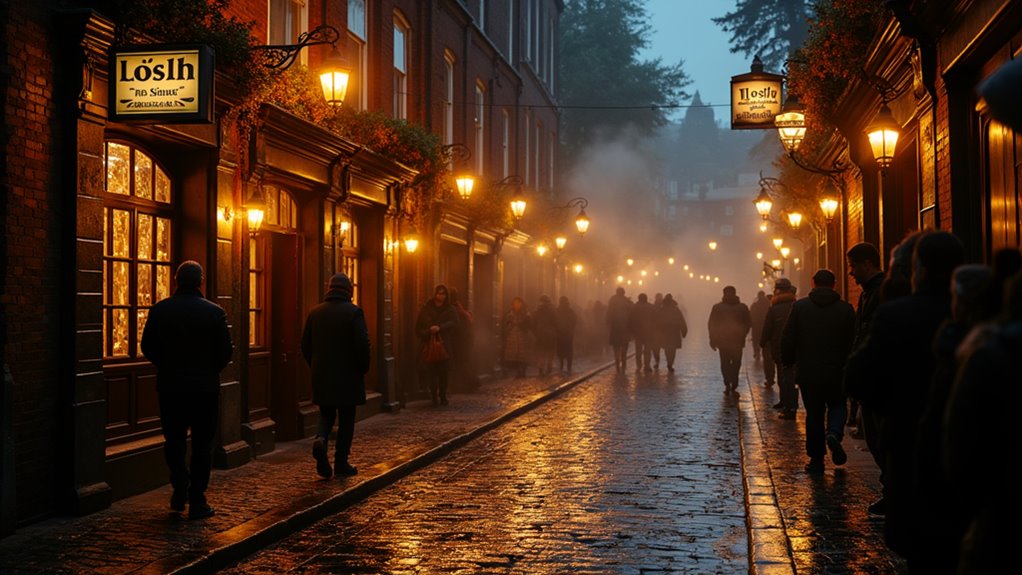
You’ll find everything from traditional Irish pubs like Bridie Molloy’s to dance clubs, making pub-hopping effortless. O’Reilly’s Irish Newfoundland Pub offers live music every night, while venues throughout the street feature authentic Newfoundland and Irish folk music alongside rock, jazz, and blues. Many bars stay open until 3 a.m., with last calls sometimes at 3 a.m. and doors locked by 3:30 a.m.
Visit during August’s six-day George Street Festival for outdoor concerts leading to Regatta Day, when the street transforms into a gated concert zone with main stage performances.
Tour the Underground WWII Bunkers at Cape Spear
Just 11 kilometers southeast of downtown St. John’s, you’ll discover Cape Spear National Historic Site, where fascinating WWII coastal defenses await exploration. The underground bunker complex features concrete gun emplacements, ammunition magazines, connecting tunnels, and two massive 10-inch guns that once protected Atlantic convoy routes during the Battle of the Atlantic.
You can explore the preserved fortifications through accessible sections of the tunnel network, though some areas remain sealed for safety. The site includes ready rooms, storage areas, and gun pits built into the hillside between 1940-1941. The fortifications were manned by members of the 103rd Coastal Artillery of the Royal Canadian Artillery who lived in barracks and facilities on site.
A boardwalk and walking trail lead directly from the parking area to the coastline fortifications.
Parks Canada manages this free historic site, making it an affordable way to experience authentic WWII military history while enjoying Newfoundland’s dramatic coastal scenery.
Join a Screech-In Ceremony at a Local Pub

When you’re ready to embrace Newfoundland’s quirkiest tradition, head to one of St. John’s legendary pubs for a Screech-In ceremony. This initiation ritual transforms you into an “Honorary Newfoundlander” through reciting an oath, kissing a cod (or puffin), and downing a shot of Screech rum.
Christian’s Pub on George Street offers the most authentic experience—a 30-minute theatrical performance complete with local history, dialect coaching, and storytelling.
For families, The Screech Room provides kid-friendly ceremonies daily at 3 p.m. during summer for around $25.
Trapper John’s Museum & Pub runs long-standing ceremonies with toy puffins.
You’ll learn Newfoundland sayings, participate in call-and-response segments, and receive a certificate proving your honorary status. The ceremony is specifically designed to welcome Come From Aways (CFAs), as locals call visitors to their island.
Only native Newfoundlanders can officiate proper ceremonies.
The Sum Up
You’ve got plenty to keep you busy in St. John’s without breaking the bank. Most of these activities won’t cost you much—walking the colorful streets is free, Signal Hill’s just a small parking fee, and you can explore historic areas without spending a dime. Pack snacks for day trips to save money, and don’t miss the free traditional music sessions in many pubs. You’ll discover this charming city offers incredible value for budget travelers.