
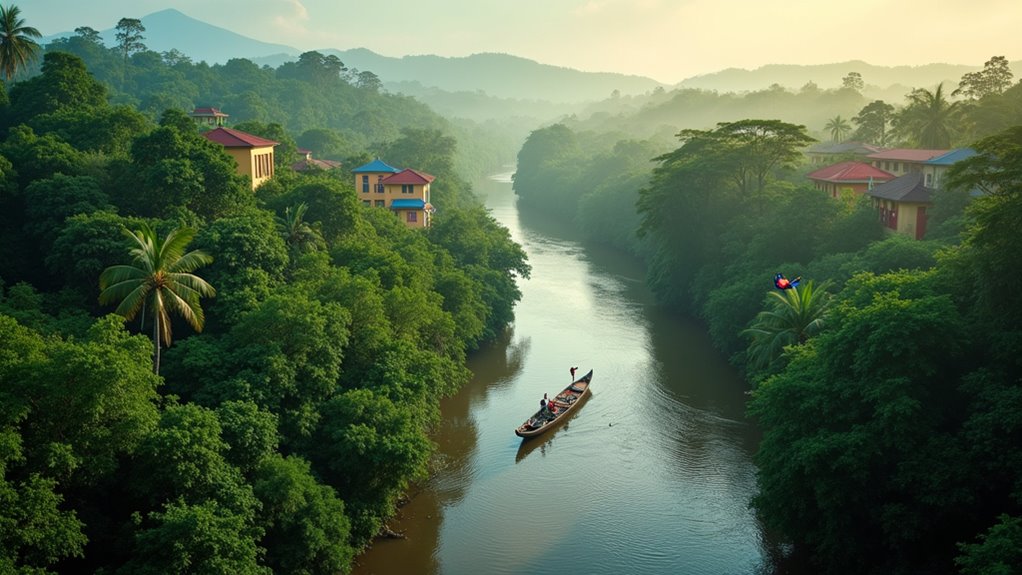
You can explore Paramaribo’s UNESCO-protected colonial district with its 17th-century wooden architecture, then venture into pristine Amazon rainforest at Brownsberg Nature Park for panoramic views and waterfalls. Trek to Voltzberg’s granite summit through primary jungle, watch Scarlet Ibis flocks at Bigi Pan wetlands, and spot nesting sea turtles at Braamspunt beaches. Navigate rivers to remote Maroon villages, kayak through coastal mangroves, and take sunset dolphin-watching boat tours. These diverse adventures reveal why Suriname offers South America’s most unique cultural and wilderness experiences.
- Wander Through Paramaribo’s UNESCO-Protected Historic Inner City
- Hike to Panoramic Views at Brownsberg Nature Park
- Trek to Voltzberg’s Granite Dome in Central Suriname Nature Reserve
- Watch Scarlet Ibis and Sea Turtles at Bigi Pan and Braamspunt
- Navigate Rivers to Remote Maroon and Indigenous Villages
- Spot Dolphins and Wildlife on Suriname River Boat Tours
- Explore Rewilded Plantations at Peperpot Nature Park
- Kayak Through Coastal Mangroves and Tea-Colored Creeks
- The Sum Up
Wander Through Paramaribo’s UNESCO-Protected Historic Inner City
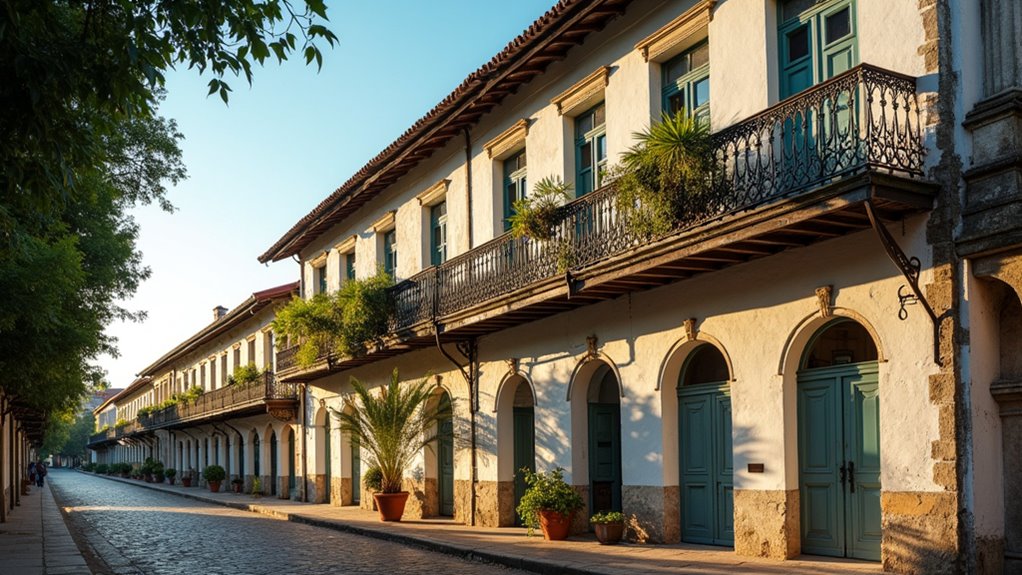
When you step into Paramaribo’s historic inner city, you’ll immediately notice the remarkable preservation of its 17th-century grid layout, which radiates northwest from the imposing Fort Zeelandia along natural shell ridges that provided essential drainage for the original Dutch settlers in 1683.
The UNESCO World Heritage district showcases stunning wooden architecture with symmetrical facades that blend Dutch colonial design with vibrant Creole influences.
Start your exploration at Fort Zeelandia, then walk to Independence Square to admire the Presidential Palace’s stone-and-timber construction.
Don’t miss Saint Peter and Paul Cathedral, one of the region’s largest wooden cathedrals.
You’ll discover Hindu temples, mosques, and synagogues within blocks of each other, reflecting Suriname’s remarkable religious diversity. These structures create a living example of how modern multiculturalism seamlessly integrates with preserved colonial heritage.
The tree-lined streets remain invigoratingly low-rise, preserving authentic colonial sightlines throughout your walking tour.
Hike to Panoramic Views at Brownsberg Nature Park
Rising 400-500 meters above sea level on a dramatic sandstone plateau, Brownsberg Nature Park delivers some of Suriname’s most spectacular panoramic vistas across 12,000 hectares of pristine Amazon rainforest and the shimmering Brokopondo Reservoir below.
Start with the 20-minute hike to Mazaroni Top for sweeping views over Stone Island, then tackle the Giri Pasi viewpoint trail. Combine your scenic quest with waterfall visits—Leo and Irene Falls create perfect loop hikes.
You’ll encounter howler monkeys and colorful poison dart frogs along muddy, root-laden trails that deliberately maintain their wild character.
Plan four hours for the full experience, arriving early morning when cloud cover lifts. The final 13-kilometer dirt road requires patience, but these emerald canopy vistas reward every bumpy kilometer from Paramaribo. The park was established in 1969 as one of Suriname’s important protected natural areas.
Trek to Voltzberg’s Granite Dome in Central Suriname Nature Reserve
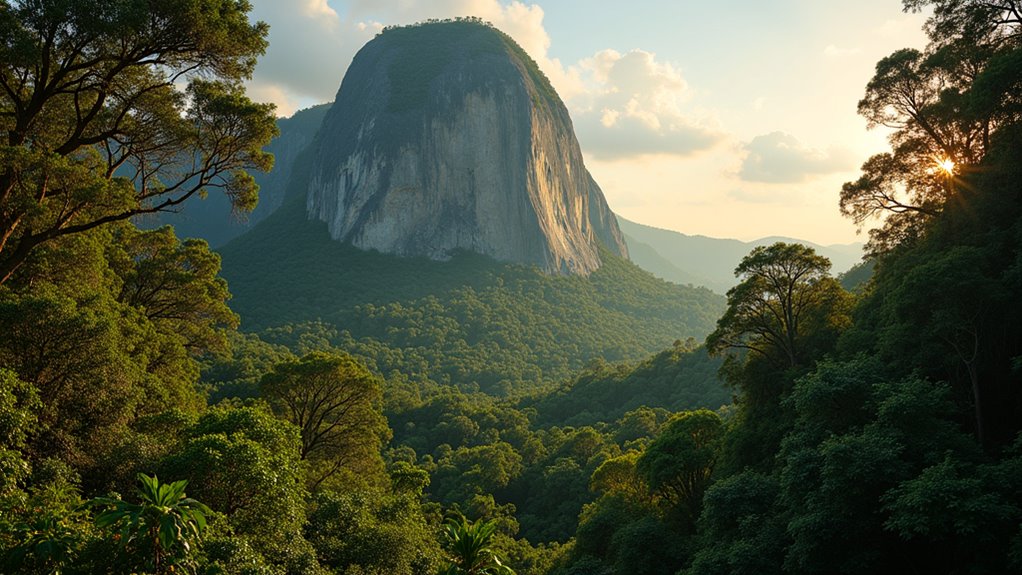
For Suriname’s ultimate wilderness adventure, Voltzberg’s iconic granite dome beckons from deep within the Central Suriname Nature Reserve, a World Heritage rainforest where pristine jungle stretches endlessly in every direction.
This challenging 15-kilometer round-trip trek requires 6-8 hours, starting with a boat journey up the Coppename River to Raleighvallen camp.
You’ll hike three hours through dense primary rainforest, crossing muddy streams and undulating terrain before tackling the steep granite slab ascent—a rope-assisted climb gaining 240 meters. The granite outcrop has been shaped over millennia, creating this spectacular geological formation that stands as the trail’s dramatic climax.
The summit rewards you with breathtaking 360-degree views over endless emerald canopy, meandering rivers, and distant granite outcrops.
Pack sturdy shoes, ample water, and prepare for multi-day camping in hammocks while spotting jaguars, monkeys, and exotic birds throughout this unforgettable wilderness experience.
Watch Scarlet Ibis and Sea Turtles at Bigi Pan and Braamspunt
Two of Suriname’s most spectacular wildlife encounters await in the coastal wetlands northwest of Paramaribo, where crimson-colored Scarlet Ibis flocks paint the mangroves at sunset and ancient sea turtles lumber ashore to nest on pristine beaches.
At Bigi Pan’s 68,320-hectare wetland sanctuary, you’ll witness striking ibis flocks roosting in mangrove stands alongside flamingos and 70+ resident bird species. Evening boat excursions through the Nickerie River estuary offer prime viewing as thousands of birds create a red “blush” over the trees at dusk. The area operates as a Special Control Area where commercial fishing, agriculture, and aquaculture activities coexist with wildlife conservation under sustainable management practices.
Stay overnight at over-water eco-lodges like Akira or Stephanie’s for ideal birding opportunities.
Nearby Braamspunt’s Atlantic coastline provides nesting habitat for Green, Leatherback, Olive Ridley, and Hawksbill turtles. Combine both destinations for Suriname’s ultimate coastal wildlife experience.
Navigate Rivers to Remote Maroon and Indigenous Villages
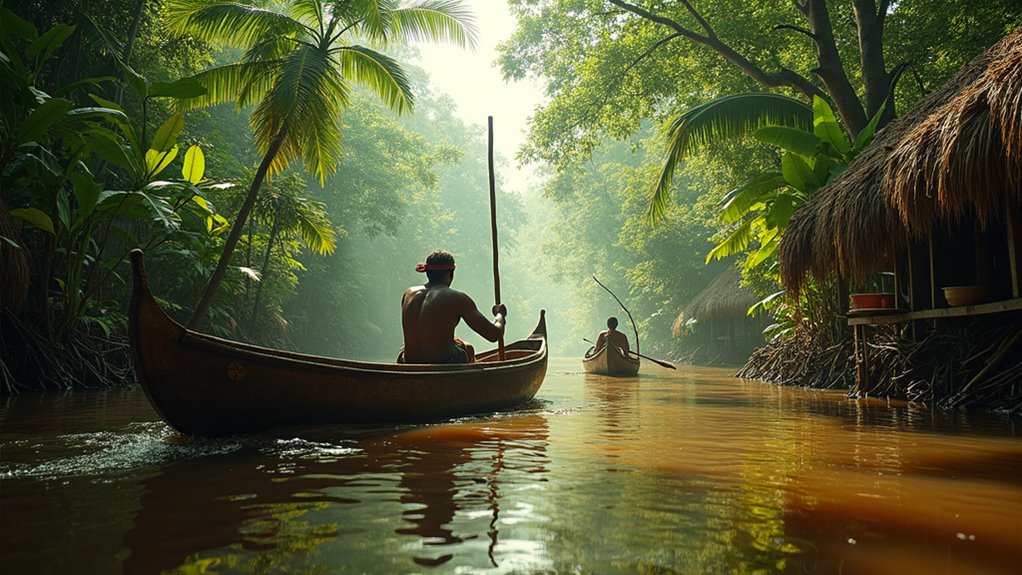
Beyond the coastal wetlands, Suriname’s most profound cultural encounters unfold along jungle rivers where Maroon descendants of escaped enslaved Africans have built autonomous societies for over three centuries.
You’ll reach the Upper Suriname River via Atjoni port, three hours from Paramaribo, then navigate rapids in wooden dugout canoes piloted by experienced boatmen.
Saramaccan villages like Nieuw Aurora showcase traditional stilted houses, matrilineal clan structures, and syncretic spiritual practices blending African traditions with Christianity.
Village captains govern communities of roughly 24,000 Saramaccans across 64 settlements. Remember to ask permission before taking portrait photos of villagers, as Maroon communities maintain traditional cultural protocols.
Multi-day tours include lodge accommodation on river islands, guided village visits, and forest walks.
Independent travelers can catch shared canoes from Atjoni, though language barriers and seasonal water levels make local guides invaluable for deeper culture.
Spot Dolphins and Wildlife on Suriname River Boat Tours
Departing around 4 PM, you’ll spot dolphin families between 5-6 PM, frequently seeing playful calves alongside adults.
Tours cost €25-€67 depending on inclusions, with sunset timing providing spectacular river colors and cooler temperatures.
Traditional covered boats offer shade while maintaining open sides for photography.
Your route passes historical plantations like Rust en Werk and Fort Nieuw Amsterdam, where riverbanks teem with herons and waterfowl among lush mangroves. The tour can be enhanced with caiman spotting for a complete wildlife package.
Explore Rewilded Plantations at Peperpot Nature Park
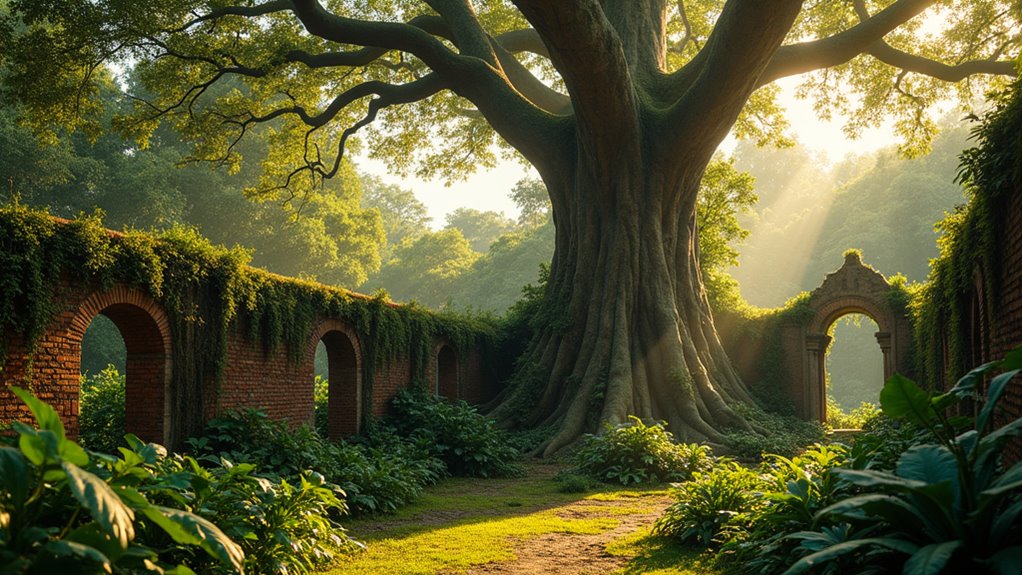
Where coffee and cocoa plantations once dominated the landscape, Peperpot Nature Park now showcases nature’s remarkable ability to reclaim cultivated land. Just 30 minutes from Paramaribo, this 820-hectare preserve encompasses five former plantations dating to the 17th century, where secondary forest gradually transforms back to primary conditions.
You’ll discover over 300 bird species while exploring nature trails that wind past colonial ruins and irrigation canals. The 12-meter bird tower provides canopy-level views for spotting Green-backed Trogons and Blood-colored Woodpeckers.
Wildlife corridors support jaguars, pumas, and tapirs moving between forest fragments, while rare orchids and bromeliads overgrow abandoned coffee trees. The park’s unique ecosystem combines mangrove forests with tropical rainforests, creating diverse habitats near the Commewijne River.
Plan two-hour guided hikes or self-directed walks daily from 8:00 AM to 5:00 PM. Entrance costs 25-50 SRD, with additional fees for specialized tours.
Kayak Through Coastal Mangroves and Tea-Colored Creeks
Four distinct coastal zones offer exceptional kayaking through Suriname’s mangrove labyrinths and tannin-stained waterways. You’ll paddle through Coronie’s dense mangrove belt, the lower Suriname River estuary, and the Commewijne–Matapica coastal zone, where red, black, and white mangroves create intricate root systems sheltering juvenile fish and crustaceans.
In Coesewijne’s savanna regions, you’ll navigate tea-colored creeks darkened by decomposing leaf litter. These salt-adapted habitats serve as vital nurseries for marine life, providing both shelter and food sources that support the broader coastal ecosystem.
Full-day Coronie tours start around €84, including seawall walks and Atlantic views. Two-day Coesewijne expeditions feature hammock camping and wildlife exploration.
Early morning and late afternoon dry-season paddling offers ideal conditions for spotting egrets, herons, iguanas, and monkeys.
Small-group tours depart from Paramaribo or Coronie town, suitable for beginners through intermediate paddlers seeking unspoiled coastal ecosystems.
The Sum Up
You’ll discover Suriname’s extraordinary diversity spans colonial architecture, pristine rainforests, and vibrant wildlife sanctuaries. Pack lightweight hiking boots for jungle treks, waterproof bags for river excursions, and insect repellent year-round. Visit during dry season (August-November) for ideal hiking conditions, though wildlife viewing remains excellent year-round. Book indigenous village visits through certified local guides who’ll provide cultural context and guarantee respectful interactions. Suriname’s untouched wilderness and rich cultural tapestry reward adventurous travelers seeking authentic South American experiences.