
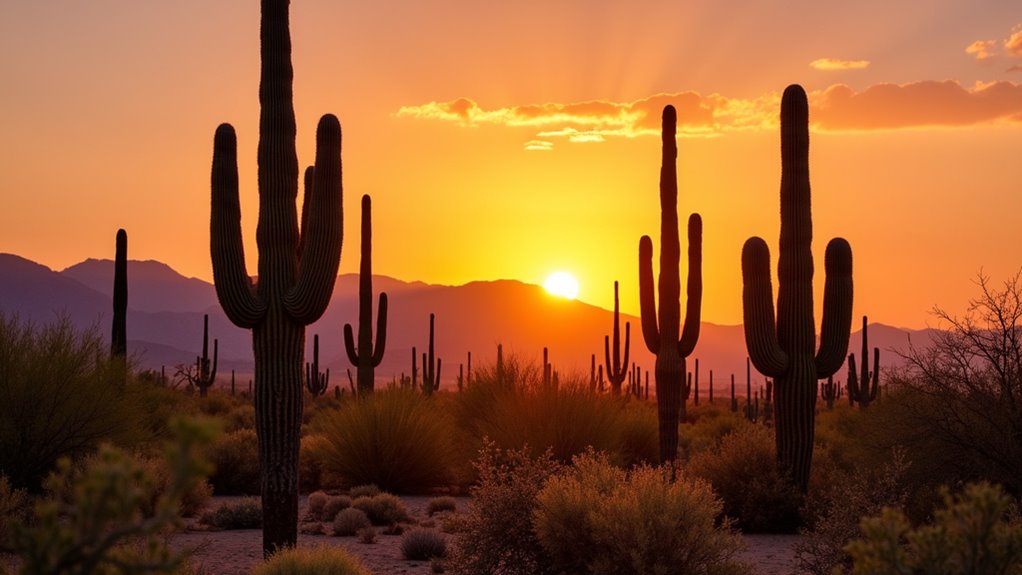
You’ll discover Tucson’s desert magic through the Arizona-Sonora Desert Museum ($25), Saguaro National Park‘s towering cacti ($15), and the stunning Mission San Xavier del Bac (free). Drive Mt. Lemmon’s scenic byway for pine forests, explore Pima Air & Space Museum’s 400 aircraft ($16.75), and wander peaceful botanical gardens ($15). Downtown’s museum district, University of Arizona’s campus attractions, and Colossal Cave tours round out your adventures—each offering unique perspectives on this desert gem’s natural wonders and rich cultural heritage.
- Explore the Arizona-Sonora Desert Museum’s Living Desert Experience
- Drive Through Saguaro National Park’s Giant Cactus Forests
- Discover Aviation History at Pima Air & Space Museum
- Visit the “White Dove of the Desert” Mission San Xavier Del Bac
- Take the Mt. Lemmon Scenic Byway From Desert to Pine Forest
- Hike Sabino Canyon’s Desert Waterfalls and Seven Falls Trail
- Wander Through Tucson Botanical Gardens and Tohono Chul Park
- Browse Art and History in Downtown’s Museum District
- Tour the Underground World of Colossal Cave Mountain Park
- Experience University of Arizona’s Campus Museums and Planetarium
- The Sum Up
Explore the Arizona-Sonora Desert Museum’s Living Desert Experience
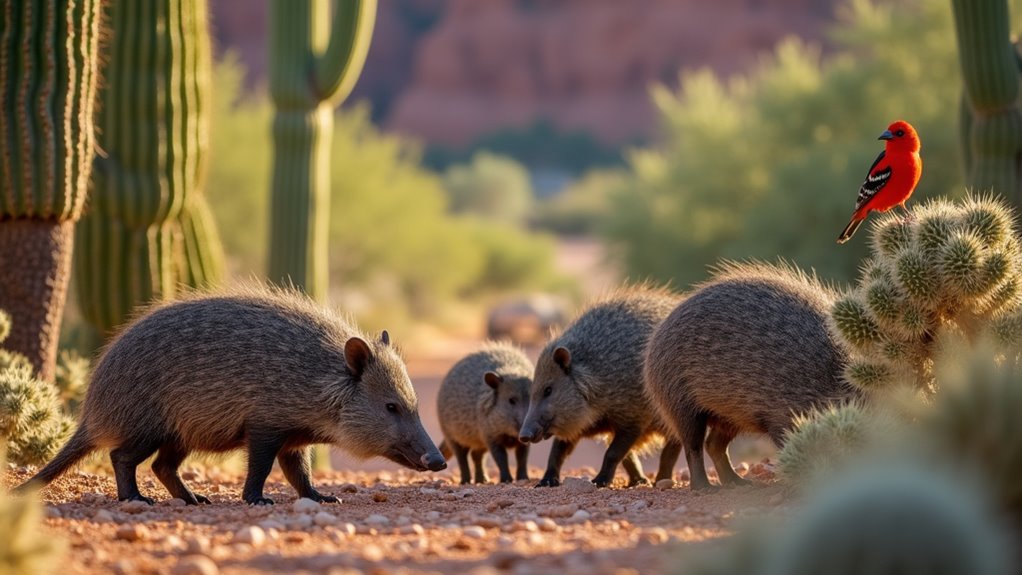
When you’re planning your Tucson adventure, dedicate a full day to the Arizona-Sonora Desert Museum—this 98-acre outdoor wonderland delivers incredible value at around $25 per adult and represents one of the Southwest’s most unique attractions. You’ll experience a living fusion of zoo, botanical garden, and natural history museum set directly in pristine Sonoran Desert terrain.
Start early to beat the heat and catch the Raptor Free Flight program, where hawks and owls soar overhead in dramatic demonstrations. Walk the Desert Loop Trail to spot javelinas and coyotes, then cool off at the air-conditioned Reptile Hall. Experience the fascinating Ancient Arizona exhibit where you can explore prehistoric Arizona and learn about the dinosaur Sonorasaurus.
Don’t miss the Stingray Touch exhibit and Mountain Woodland’s Mexican gray wolves. The museum’s 55,000+ plant collection showcases incredible desert adaptations throughout your visit.
Drive Through Saguaro National Park’s Giant Cactus Forests
Where else can you cruise through America’s most iconic desert landscape for just $15 per vehicle and witness towering saguaro cacti that’ve stood for centuries? Saguaro National Park’s two districts offer distinct driving experiences through dense cactus forests.
The East district’s Cactus Forest Loop provides an 8-mile paved route perfect for any vehicle, while the West’s Bajada Loop offers 6 miles of graded dirt roads accessible to most cars in dry conditions.
You’ll spot massive saguaros reaching 50+ feet tall with dozens of arms—some exceeding 150 years old. Watch for Gila woodpeckers nesting in the cacti and young saguaros growing under “nurse trees.” Scientists have conducted 75-year studies tracking these remarkable cacti, revealing fascinating insights into their survival patterns and growth cycles.
Visit during late spring to catch the spectacular blooming season, when white flowers crown these desert giants.
Discover Aviation History at Pima Air & Space Museum

Since you’re already exploring Tucson’s outdoor attractions, dedicate half a day to the Pima Air & Space Museum—one of the world’s largest non-government aviation museums where you’ll walk among nearly 400 aircraft for just $16.75 admission.
You’ll explore 80 acres of outdoor displays featuring everything from WWII bombers to modern fighters, plus six climate-controlled hangars showcasing restored aircraft and space exhibits.
Don’t miss the Space Gallery’s Apollo command module mockup and authentic lunar rock sample.
The outdoor “boneyard-style” displays let you get remarkably close to massive aircraft that’d cost hundreds elsewhere to tour. The museum’s origins trace back to 1966 when it was founded to preserve disappearing military aircraft from Davis-Monthan Air Force Base.
Plan 3-4 hours minimum—the collection spans from 1903 Wright Flyer replicas to cutting-edge experimental designs.
It’s educational entertainment that’s genuinely worth your time and money.
Visit the “White Dove of the Desert” Mission San Xavier Del Bac
Why settle for photos of Spanish colonial architecture when you can experience Arizona’s most stunning example firsthand? Mission San Xavier del Bac, nicknamed the “White Dove of the Desert,” sits just south of Tucson on the Tohono O’odham reservation. This 1797 masterpiece costs nothing to visit, making it perfect for budget travelers.
You’ll find intricate frescoes, gilded altarpieces, and Native American geometric motifs covering nearly every interior surface. The dramatic lighting creates an almost mystical atmosphere.
Don’t miss the elaborately carved sandstone entrance and the 80-foot bell towers—one intentionally left incomplete.
Arrive early morning or late afternoon for the best lighting and fewer crowds. The surrounding Sonoran Desert setting, with distant mountains as backdrop, makes this Arizona’s most photographed church for good reason. The mission stands prominently on an elevated site, making it visible for miles in every direction across the desert landscape.
Take the Mt. Lemmon Scenic Byway From Desert to Pine Forest
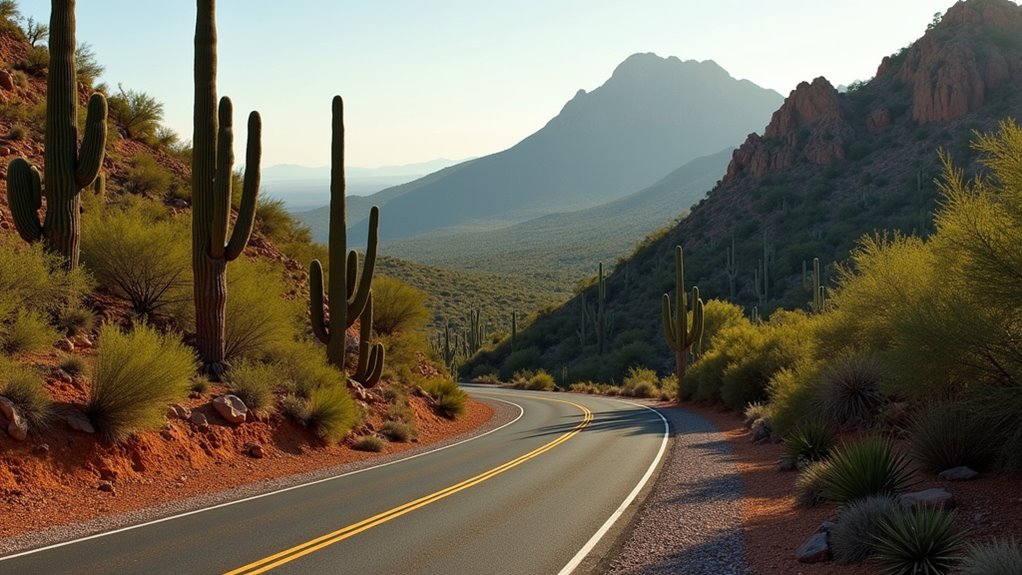
After exploring Tucson’s desert treasures, you can experience an extraordinary climate journey without leaving southern Arizona. The Mt. Lemmon Scenic Byway climbs over 6,000 feet in just 27 miles, taking you from Sonoran Desert cacti to pine forests and aspen groves.
This National Scenic Byway follows Catalina Highway through multiple life zones, offering dramatic temperature relief during Tucson’s sweltering summers.
You’ll pay about $8 per vehicle for day-use access to Coronado National Forest‘s trailheads and picnic areas. Don’t miss Windy Point Vista for expansive desert views.
The route provides excellent photography opportunities as vegetation transitions from saguaro to evergreen. Near the summit, Mount Lemmon ski area operates year-round chairlifts for scenic rides, making this one of the Southwest’s most spectacular drives. Plan to bring your own snacks and water since no food options are available until you reach Summerhaven at the summit.
Hike Sabino Canyon’s Desert Waterfalls and Seven Falls Trail
When you’re ready to experience Tucson’s most rewarding desert hike, the Seven Falls Trail in Sabino Canyon delivers cascading waterfalls just 30 minutes from downtown.
You’ll pay only $5 per car for a day pass, though the $20 annual Coronado National Forest pass pays for itself quickly.
The 8.4-mile round trip involves moderate difficulty with 900 feet of elevation gain and multiple creek crossings.
Cut your hiking distance nearly in half by taking the Bear Canyon shuttle to the trailhead. The shuttle operates on a 30-minute round trip schedule from the Visitor Center.
You’ll traverse classic Sonoran Desert terrain filled with towering saguaros before reaching tiered pools perfect for cooling off.
Visit after winter rains or during monsoon season for the strongest waterfall flow, but bring plenty of water since shade is minimal.
Wander Through Tucson Botanical Gardens and Tohono Chul Park
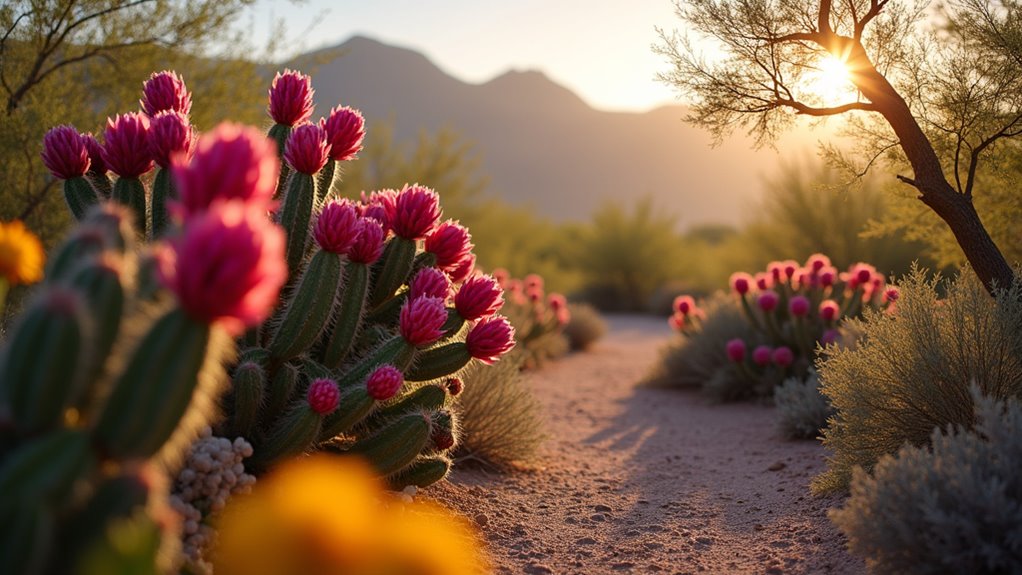
Swap desert trails for cultivated gardens at Tucson Botanical Gardens, where 5.5 acres of themed spaces showcase desert plants from around the world for just $15 admission. You’ll discover 500+ cacti and succulent species, explore the colorful Barrio Garden celebrating Mexican American traditions, and walk the Plants of the Tohono O’odham Path highlighting indigenous plant relationships.
Visit October through May to experience Butterfly Magic in the Cox Pavilion—Southern Arizona’s only tropical butterfly greenhouse. Kids love the hands-on Discovery Garden and model railway, while adults appreciate the Victorian-style Herb Garden and Backyard Bird habitat. Bird enthusiasts can spot hummingbirds, cardinals, finches, and thrashers year-round in the specially designed habitat area.
Pro tip: The extensive shade trees create cooler microclimates than surrounding neighborhoods, making summer visits more comfortable. Check their seasonal events calendar for special exhibitions and classes.
Browse Art and History in Downtown’s Museum District
While desert landscapes define Tucson’s natural beauty, the downtown Museum District reveals the city’s rich cultural layers through world-class art collections and preserved historic architecture.
You’ll find the Tucson Museum of Art anchoring an entire historic block, where restored 19th-century adobes house Latin American, pre-Columbian, and Western art collections. Don’t miss La Casa Cordova, one of Tucson’s oldest surviving buildings, or the Edward Nye Fish House‘s Western art pavilion.
The newer Alfie Norville Gem & Mineral Museum occupies the historic courthouse, showcasing Arizona’s mining heritage through spectacular crystals and gemstones. Though admission runs premium-priced, look for regional attraction passports offering two-for-one deals.
The reconstructed 1775 Presidio rounds out your historical journey, complete with 2,000-year-old archaeological remains. Nearby, the Arizona State Museum explores the region’s cultural heritage through extensive exhibits covering indigenous history and archaeological discoveries.
Tour the Underground World of Colossal Cave Mountain Park
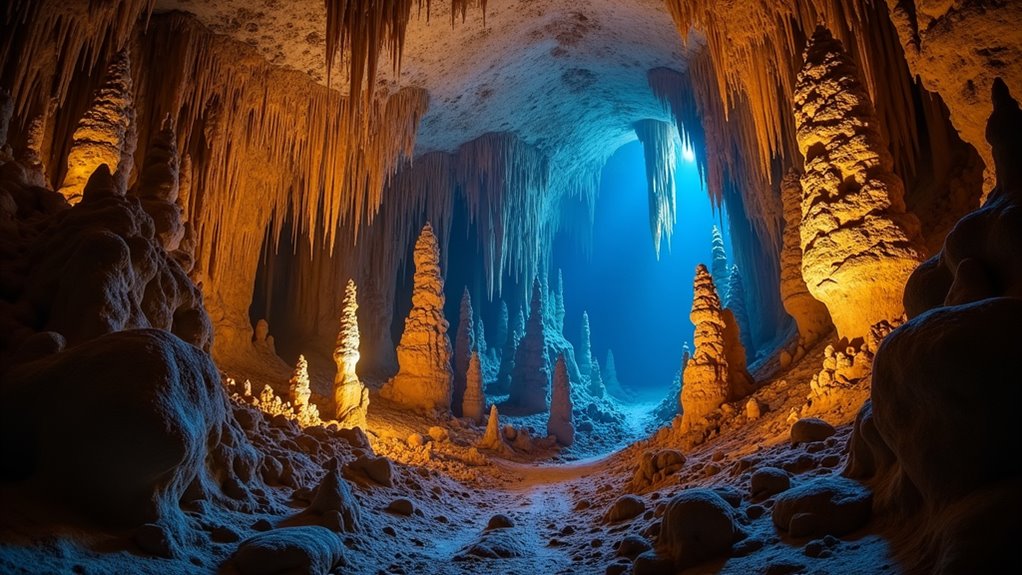
Just 22 miles southeast of Tucson, Colossal Cave Mountain Park offers one of North America’s largest dry cave systems where you’ll descend six stories through 3.5 miles of mapped passageways.
The family-friendly 40-minute tour covers half a mile with 363 steps down well-lit walkways built by the Civilian Conservation Corps. You’ll discover stalactites, flowstone formations, and Wild West train robber legends while enjoying consistent 70°F temperatures year-round.
Budget tip: Standard tours run daily and provide excellent value for families, though children under 5 aren’t permitted. Adventure seekers can book advanced treks exploring undeveloped cave sections.
The 2,400-acre park combines desert hiking with underground exploration, making it perfect for beating summer heat while experiencing Arizona’s geological wonders and 1,000-year human history. Beyond cave exploration, visitors can enjoy horseback riding on scenic desert trails with options ranging from 30-minute rides to full sunset experiences.
Experience University of Arizona’s Campus Museums and Planetarium
Located in the heart of Tucson’s university district, the University of Arizona campus houses an impressive collection of world-class museums and a planetarium that’ll give you exceptional cultural experiences without breaking the bank.
Start at the University of Arizona Museum of Art, where you’ll find eight centuries of masterpieces including works by Jackson Pollock, Mark Rothko, and Georgia O’Keeffe for just $8 admission. Students, faculty, staff, and military get free entry.
Don’t miss the Arizona State Museum for Southwestern cultural exhibits and the Center for Creative Photography, both offering free admission to eligible visitors.
The Flandrau Science Center & Planetarium provides astronomical education, while the Arizona Gem and Mineral Museum showcases worldwide collections.
These campus museums benefit from academic freedoms that allow for open exploration of diverse artistic topics and experimental exhibitions that you might not find in traditional commercial galleries.
Pro tip: visit during coordinated Museum Day events for enhanced programming and community engagement.
The Sum Up
You’ll find Tucson’s best experiences won’t break your budget—many outdoor attractions like Saguaro National Park cost just $15 per vehicle for seven days. Visit during shoulder seasons (March-April, October-November) for pleasant weather and lower hotel rates. Download the Tucson app for discounts at local museums and restaurants. Pack plenty of water and start desert hikes early morning. Most locals recommend staying near downtown to walk between attractions and save on parking fees.