
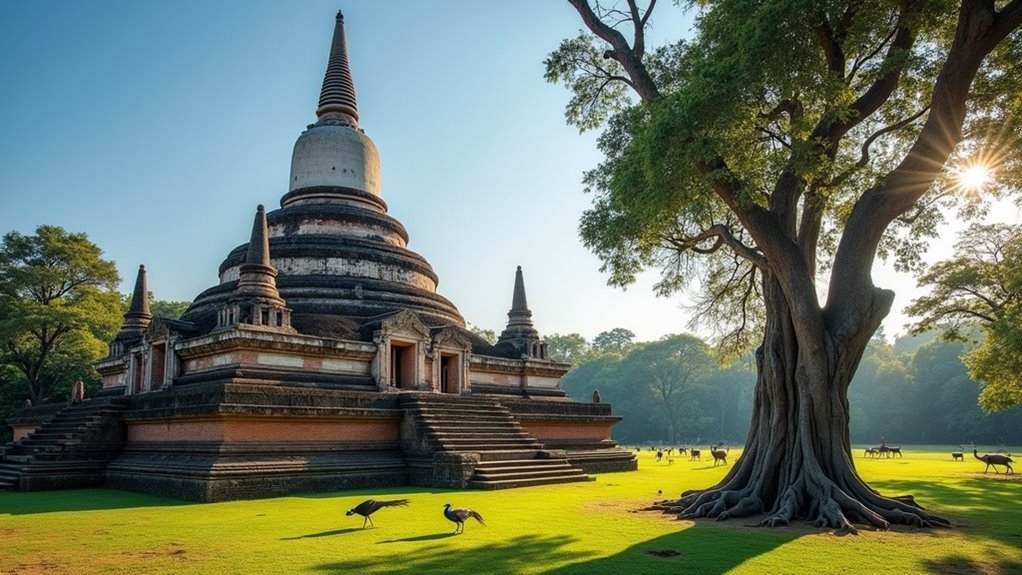
Travelers seeking an affordable blend of spirituality and adventure find Anuradhapura offers exceptional value for money. This ancient Sri Lankan capital houses some of Buddhism’s most sacred sites alongside easy access to world-class wildlife parks. Visitors can explore 2,000-year-old stupas in the morning, then spot elephants and leopards in the afternoon—all without breaking the bank. The city’s unique combination of archaeological treasures and natural wonders creates opportunities that most destinations simply can’t match.
- Visit the Sacred Sri Maha Bodhi Tree
- Explore the Towering Jetavanaramaya Stupa
- Discover Ancient Stone Carvings at Isurumuniya Rock Temple
- Marvel at the Samadhi Buddha Statue in Abhayagiri Monastery
- Walk Through the Extensive Archaeological Complex
- Experience Active Worship Sites at Historic Stupas
- Embark on Wildlife Safaris in Nearby National Parks
- Photography Tips for Capturing Ancient Architecture
Visit the Sacred Sri Maha Bodhi Tree
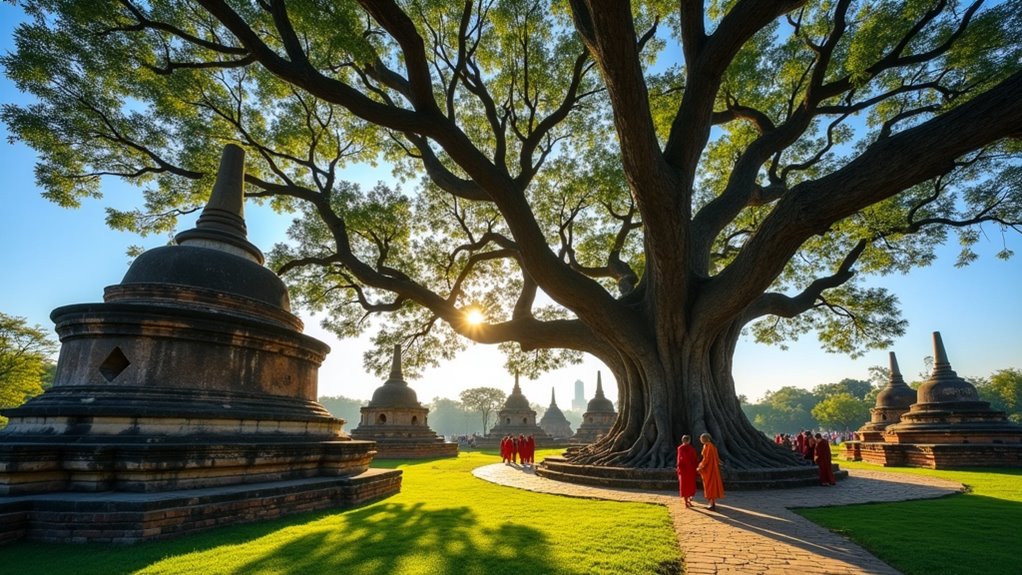
At the heart of Anuradhapura stands one of Buddhism’s most sacred sites—the Sri Maha Bodhi Tree, a living piece of history that’s survived over 2,300 years. This sacred fig tree grew from a cutting of the original Bodhi tree under which Buddha achieved enlightenment, brought to Sri Lanka by Buddhist nun Sangamitta in 236 BCE.
You’ll find the tree elevated on a terrace in Mahamevnāwa Park, surrounded by protective golden fencing and ancient stone structures. Devotees gather daily for prayers and offerings, creating an atmosphere of deep spiritual reverence.
The site’s free to visit, making it accessible for budget travelers seeking authentic cultural experiences. Don’t miss the surrounding Buddha statues and intricate water canals built by successive kings throughout centuries. Just as visitors to Krabi marvel at the region’s dramatic limestone cliffs, the ancient stone terraces here showcase remarkable geological and architectural beauty. Remarkably, this tree holds the distinction of being the oldest living tree with documented history in the world.
Explore the Towering Jetavanaramaya Stupa
Just a short walk from the sacred Bodhi tree, you’ll encounter one of the world’s most impressive ancient structures—the magnificent Jetavanaramaya Stupa. Originally standing at 400 feet tall, this massive brick monument was once the world’s tallest stupa, built by King Mahasena in the 3rd century CE.
Though restoration efforts reduced its height to 233 feet, it remains absolutely breathtaking. The panoramic views from the base offer breathtaking vistas of the surrounding ancient city and landscape.
What makes this site special isn’t just its size—it’s believed to house a relic of Buddha’s sacred belt. The engineering feat is remarkable too, with 93 million bricks and an 8.5-meter-deep foundation. The exterior was protected with a sophisticated lime plaster coating that included unique ingredients like egg whites, sugar syrup, and plant resin for waterproofing.
You can explore the entire monastery complex that once housed 10,000 monks. Don’t miss the on-site museum displaying artifacts spanning five centuries of Buddhist history.
Discover Ancient Stone Carvings at Isurumuniya Rock Temple
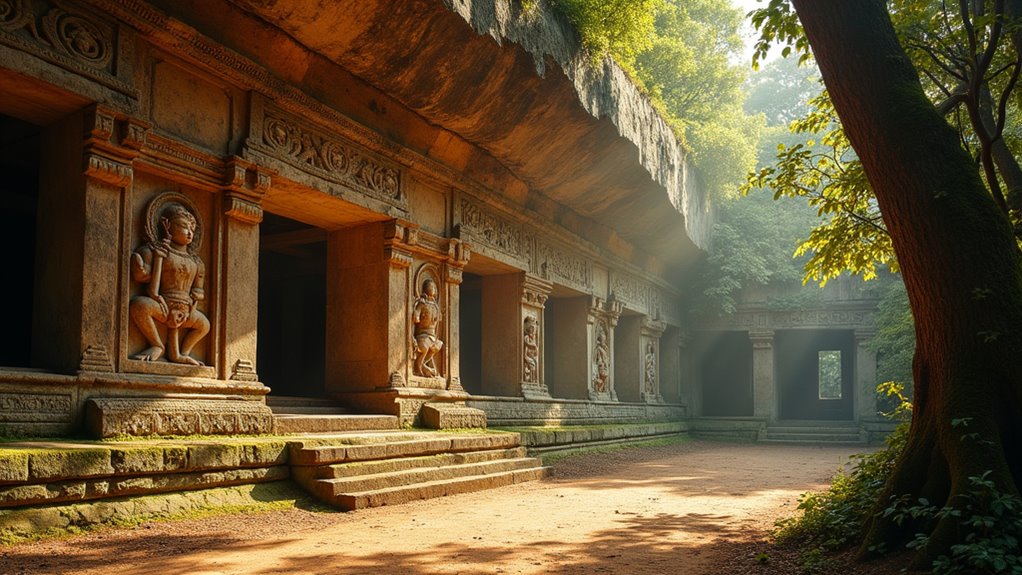
Where else can you find ancient love stories carved in stone? Isurumuniya Rock Temple delivers exactly that with its famous “Lovers” carving from the 6th century. You’ll discover the romantic tale of Prince Saliya and Asokamala, though some believe it depicts Hindu deities instead.
Built by King Devanampiya Tissa around 300 BCE, this temple complex won’t cost much to explore but offers incredible value. The site originally served as residence for 500 children who were ordained during that period. Beyond the lovers, you’ll spot King Dutugemunu with his attendants and impressive elephant carvings that resemble Indian Mamallapuram style.
The temple sits beautifully near Tisa Tank with scenic ponds and rock formations. It’s an easy walk from other Anuradhapura sites, making it perfect for budget travelers wanting to see exceptional ancient art without breaking the bank. Like the vibrant chaos found in bustling Southeast Asian cities, this ancient site offers its own form of beautiful organized disorder with sculptures scattered throughout the rock formations.
Marvel at the Samadhi Buddha Statue in Abhayagiri Monastery
A short walk from the rock carvings brings you to one of Sri Lanka’s most iconic Buddhist sculptures. The Samadhi Buddha Statue sits serenely in meditation pose within Abhayagiri Monastery’s ancient ruins, measuring nearly six feet tall on its stone pedestal.
Dating from the 3rd or 4th century CE, this masterpiece showcases Gupta-influenced craftsmanship with the Buddha’s hands positioned in dhyāna mudrā, symbolizing deep concentration.
Originally painted and exposed to the elements, the statue now rests under protective shelter after extensive conservation efforts. It’s part of the broader Abhayagiri complex, once a major center housing multiple Buddhist traditions. The monastery served as the original custodian of the Tooth relic, one of Buddhism’s most sacred artifacts.
The statue’s profound sense of calm makes it a powerful meditation focal point, explaining why it remains one of Sri Lanka’s most photographed Buddhist artworks.
Walk Through the Extensive Archaeological Complex
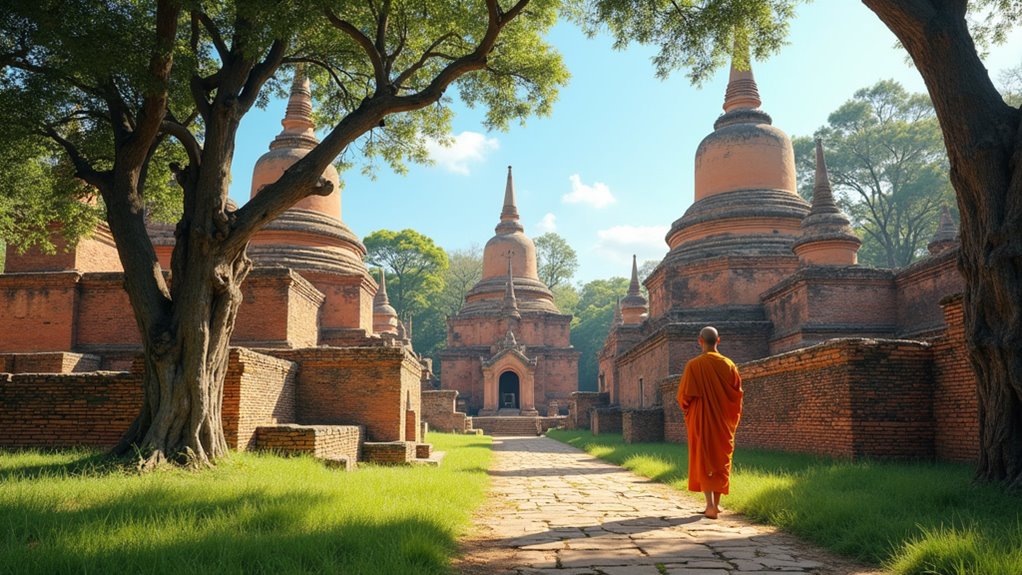
Beyond the individual monuments lies Anuradhapura’s sprawling archaeological complex, where visitors can spend days exploring thousands of interconnected ruins across multiple districts.
The site’s three main building types—dagobas, monastic structures, and pokuna (ponds)—are connected by ancient royal roads that once facilitated administrative and ritual movement.
Walking these paths reveals the city’s sophisticated urban planning, with clearly defined zones for royalty, monasteries, and residential areas.
Recent discoveries include 94 previously unmapped local temples and 79 linear features serving as roads or canals.
Many temples show only scattered bricks, while others hide beneath modern developments.
The complex integration of secular and religious spaces, supported by advanced irrigation systems, showcases how Buddhist cosmological principles shaped this ancient capital’s remarkable layout. Like the magnificent karst mountains of Guilin, these ancient structures rise from the landscape in dramatic formations that captivate visitors from around the world. The extensive ruins span approximately 20 sq km, making bicycle or tuk-tuk transportation essential for covering the site efficiently.
Experience Active Worship Sites at Historic Stupas
What transforms Anuradhapura from a collection of ancient ruins into a living spiritual center? The answer lies in its active worship sites, where centuries-old stupas continue serving devoted pilgrims daily.
Visitors can witness authentic Buddhist practices at five major stupas. Ruwanwelisaya, King Dutugamunu’s masterpiece, draws crowds for its ornate beauty and active ceremonies. The towering Jetavanaramaya, once the world’s tallest brick structure, remains a pilgrimage magnet despite weathered walls. Abhayagiri Dagoba welcomes multiple Buddhist sects, while Thuparamaya houses Buddha’s actual collarbone relic.
Travelers can participate respectfully in circumambulation rituals, watching devotees walk clockwise around sacred domes. They’ll observe flower offerings, lamp lighting, and chanting sessions. The Ruwanvelisaya structure is protected by a wall featuring a frieze of 344 elephants that surrounds the entire sacred monument. During Vesak and Poson festivals, these sites become vibrant spiritual hubs where ancient architecture meets living faith.
Just as South Korea’s palaces showcase cultural heritage alongside modern K-Pop influences, Anuradhapura seamlessly blends historical significance with contemporary Buddhist practice.
Embark on Wildlife Safaris in Nearby National Parks
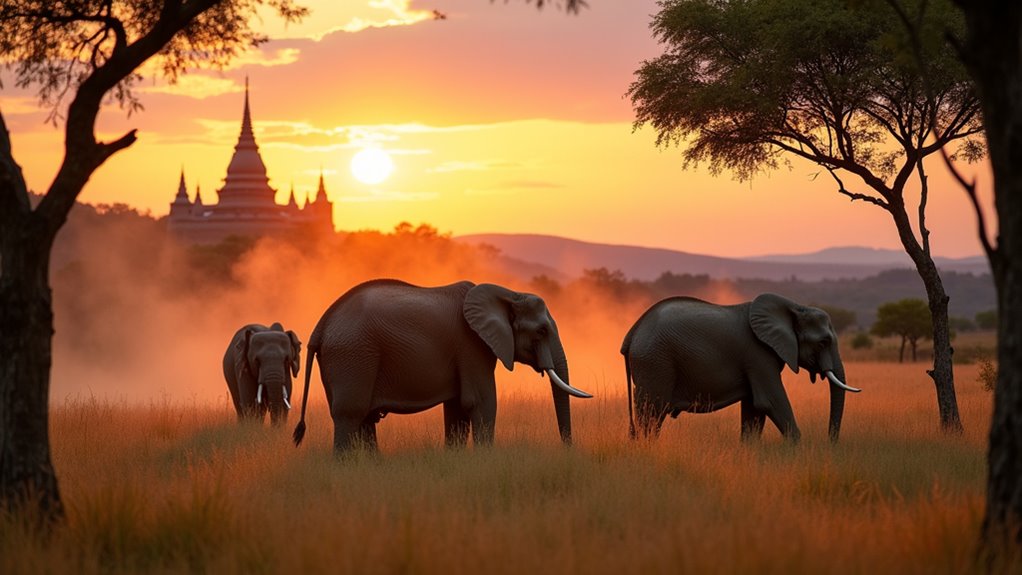
While ancient stupas showcase Anuradhapura’s spiritual heritage, the region’s natural treasures await just beyond the city limits. Wilpattu National Park, located 45 minutes away, offers Sri Lanka’s highest leopard densities alongside elephants, sloth bears, and diverse birdlife across 130,000 hectares.
Safari options include half-day morning, afternoon, or full-day tours starting around 5:00 am, with entry fees from $44 USD per person. Most safari experiences last 3-4 hours by jeep, though extended options are available for more comprehensive wildlife exploration.
Travelers can also explore Minneriya National Park, famous for massive elephant gatherings during dry seasons. Both parks provide open jeep safaris with knowledgeable guides who share ecological insights and animal behavior knowledge. Like other successful planned cities worldwide, these wildlife areas demonstrate thoughtful conservation design and visitor management.
Accommodation ranges from budget hotels in Anuradhapura to luxury tented camps near park entrances, with private transport typically included in safari packages for convenient wildlife adventures.
Photography Tips for Capturing Ancient Architecture
Although smartphone cameras can capture decent shots of Anuradhapura’s ancient structures, dedicated photography equipment and thoughtful techniques will transform ordinary snapshots into compelling images that showcase the site’s architectural grandeur.
A wide-angle lens (10-24mm) captures entire stupas without distortion, while a tripod ensures sharp images in shaded areas. Photographers should shoot during golden hours—early morning or late afternoon—when soft light highlights textures and creates atmospheric shadows. The Moonstone carvings at temple entrances offer intricate details that become particularly photogenic during these optimal lighting conditions. Harsh midday sun washes out colors and creates unflattering contrasts.
Respectful practices are essential: never photograph with one’s back to Buddha statues, dress modestly, and avoid disturbing ceremonies. Planning your photography session around the site’s must-see highlights will ensure you capture the most significant architectural elements while maintaining cultural sensitivity.
Use the rule of thirds for dynamic compositions, shoot in RAW format for editing flexibility, and include surrounding jungle elements to contextualize these magnificent ruins within their natural environment.