
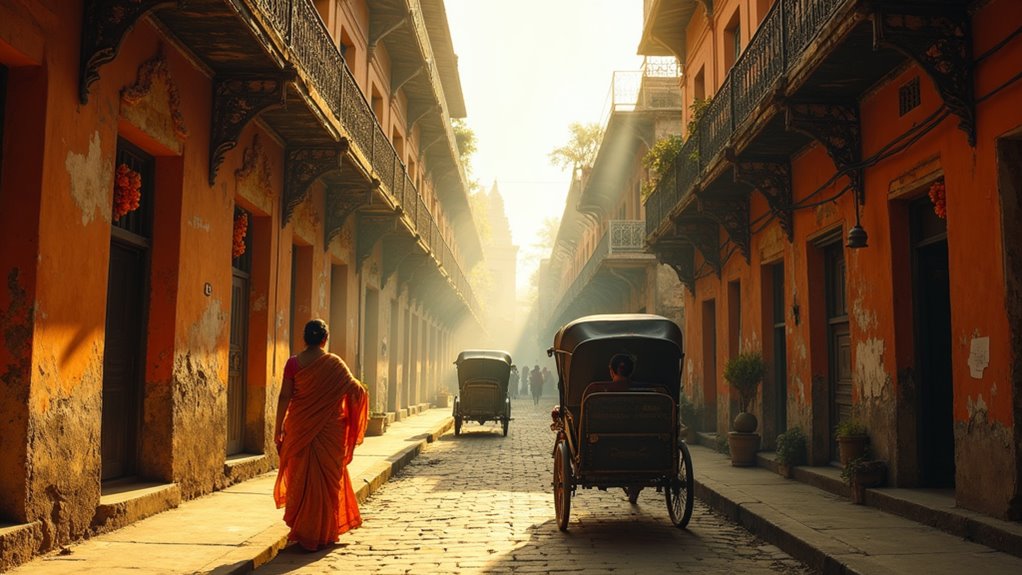
Kolkata’s streets tell two intertwining stories—one of British colonial ambition, another of enduring Bengali spirit. The city’s architectural marvels showcase Indo-Saracenic grandeur alongside traditional terracotta temples, while its cultural quarters buzz with centuries-old artistic traditions. From the marble corridors of Victoria Memorial to the clay-stained hands of Kumartuli’s idol makers, these nine experiences reveal how colonial legacy and Bengali heritage haven’t just coexisted—they’ve created something entirely unique.
- Marvel at Victoria Memorial’s Indo-Saracenic Architecture and Museum Collections
- Explore the Gothic Grandeur of St. Paul’s Cathedral
- Walk Through Historic Dalhousie Square and Colonial Administrative Buildings
- Discover Fort William and the National Military Museum
- Experience Traditional Clay Idol Making in Kumartuli Potters’ Quarter
- Stroll Along Park Street’s Colonial Charm and Modern Vibrancy
- Visit Jorasanko Thakurbari and Rabindranath Tagore’s Literary Legacy
- Find Spiritual Syncretism at Belur Math’s Multi-Religious Architecture
- Take Heritage Tours Through Maidan’s Colonial Landmarks and Green Spaces
Marvel at Victoria Memorial’s Indo-Saracenic Architecture and Museum Collections
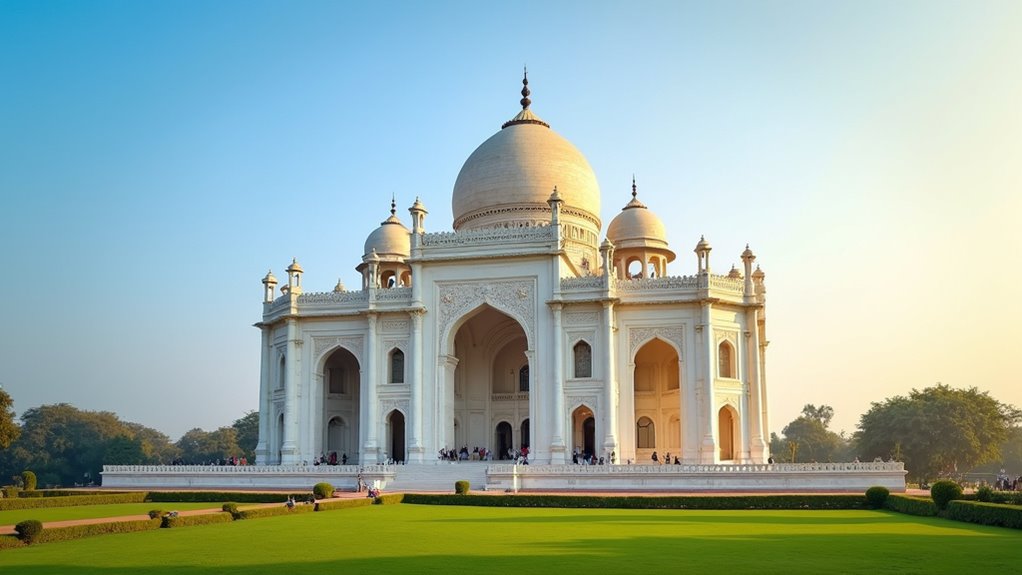
Standing majestically in the heart of Kolkata, the Victoria Memorial represents one of India’s most stunning examples of Indo-Saracenic architecture, where British colonial ambitions met Mughal artistic traditions in white Makrana marble. Sir William Emerson’s design masterfully blends massive domes, arches, and colonnades with traditional Indian elements like jalis and corbels.
The memorial’s 144-foot dome dominates the skyline, crowned by the rotating “Angel of Victory” bronze statue. Inside, visitors explore 25 galleries showcasing British colonial history, Indian art, paintings, manuscripts, and royal memorabilia.
The circular central hall, surrounded by arcades beneath an inverted lotus-shaped dome, creates an impressive backdrop for the museum’s diverse collections. Beyond the typical tourist attractions, the memorial offers unique experiences for those seeking to delve deeper into Kolkata’s cultural heritage through special exhibitions and guided tours. Surrounding the monument, visitors can stroll through 64 acres of meticulously landscaped gardens featuring fountains, pools, floral beds, and the Kanchantala water body where boating adds a recreational element to the historical experience. With 3.5 million annual visitors, it’s become Kolkata’s premier cultural destination.
Explore the Gothic Grandeur of St. Paul’s Cathedral
While the Victoria Memorial showcases Indo-Saracenic splendor, St. Paul’s Cathedral represents Kolkata’s finest Gothic Revival architecture. Built between 1839-1847, this Indo-Gothic masterpiece was the first Anglican cathedral of the Victorian age and the East India Company’s official cathedral.
Military engineers Major William Nairn Forbes and C.K. Robinson designed the structure, modeling its tower after Canterbury Cathedral’s “Bell Harry” tower.
The cathedral’s lightweight brick construction with Chunar stone dressings creates an ethereal appearance, while its spacious basilican interior accommodates up to 1,000 visitors.
Don’t miss the stunning west window by Sir Edward Burne-Jones, created by Morris & Co. in 1880 as a memorial to Lord Mayo.
The cathedral’s pointed arches, Gothic tracery, and stained glass panels demonstrate remarkable Victorian craftsmanship adapted to India’s climate. The cathedral’s impressive flagstaff rises to 175 feet above ground level, adding to its commanding presence in the Maidan landscape. Visitors often admire the cathedral’s nighttime illumination, which enhances its Gothic silhouette against Kolkata’s skyline.
Walk Through Historic Dalhousie Square and Colonial Administrative Buildings
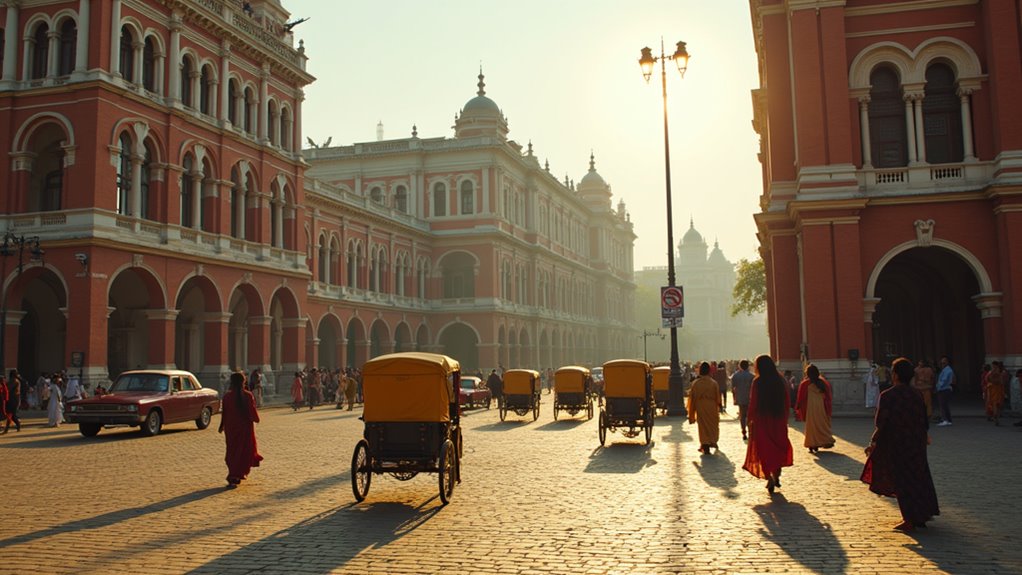
Where can visitors witness the most concentrated display of British colonial power in Kolkata? Dalhousie Square stands as the epicenter of colonial administration, housing 55 Raj-era buildings within its heritage zone. Established as the British East India Company’s trading hub on the Hooghly River, this square served as India’s commercial and political center for over two centuries.
The imposing Writers’ Building dominates the north side with its French Renaissance facade and Greek deity statues symbolizing Justice, Commerce, Science, and Agriculture.
The General Post Office showcases classical architecture with Corinthian columns and a striking dome.
Meanwhile, the Currency Building displays Italian styling from 1833. Like Tokyo’s seamless blend of modern architecture and traditional temples, Kolkata presents visitors with layers of history across different eras. Visitors can explore the Reserve Bank, Treasury Office, and Eastern Railway headquarters while walking around Lal Dighi, the central water tank that once supplied European residents. This area earned the nickname Office Para due to its concentration of colonial-era institutions and government offices.
Discover Fort William and the National Military Museum
Beyond the administrative grandeur of Dalhousie Square, Fort William represents the military might that backed British colonial rule in India. Built in 1696 and reconstructed after Siraj-ud-Daulah’s 1756 attack, this octagonal star fort showcases impressive 18th-century military architecture.
The structure covers 70.9 acres with six reinforced gates and a deep moat that could flood from the Hooghly River. The fort’s design draws inspiration from Vauban-style bastions with thick, angular walls engineered for maximum defensive capability.
Today, Fort William serves as headquarters for the Indian Army’s Eastern Command, maintaining its strategic importance. Like other historical cities across Asia, Kolkata’s colonial landmarks represent some of India’s most underrated destinations for cultural exploration. The National Military Museum inside displays India’s military heritage through historical weaponry, uniforms, and artifacts spanning colonial and post-Independence eras.
Visitors can explore centuries of military history while appreciating the fort’s enduring architectural significance in Kolkata’s colonial landscape.
Experience Traditional Clay Idol Making in Kumartuli Potters’ Quarter
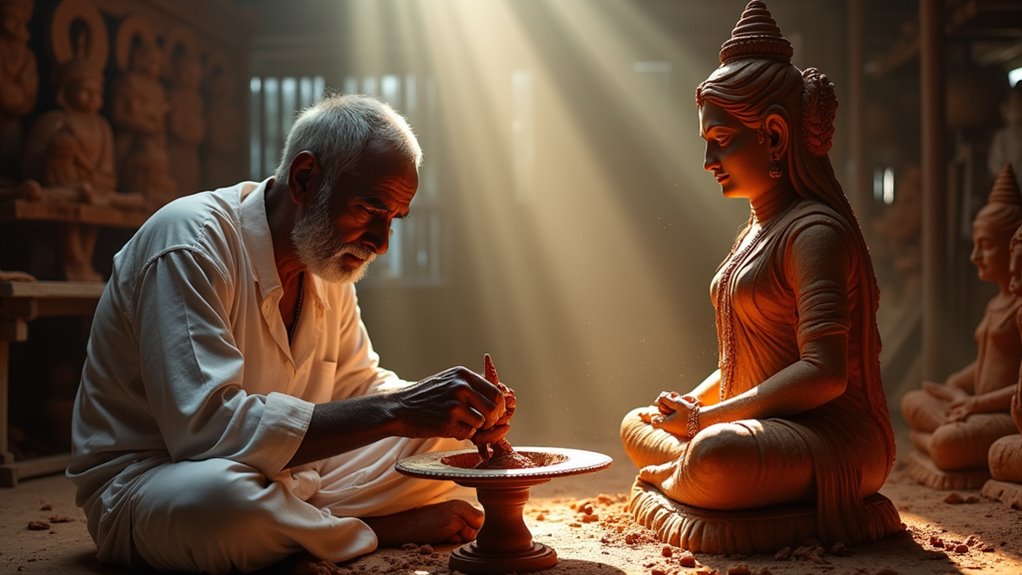
As visitors navigate Kolkata’s bustling North district, they’ll discover Kumartuli, a 300-year-old potters’ quarter where master artisans transform humble Ganges clay into breathtaking religious sculptures. Over 500 workshops line narrow alleys, where families preserve generations-old techniques passed down since Raja Nabakrishna Deb invited skilled potters from Krishnanagar in the early 18th century.
The creation process fascinates onlookers as craftsmen shape clay frames, add bamboo support structures, and apply intricate details to Durga idols destined for festivals. Artists spend months perfecting each piece, later adding vibrant paints and ornate decorations. Modern artisans are embracing eco-friendly materials to address environmental concerns while maintaining their traditional craftsmanship. Like Xi’an’s famous Terracotta Warriors, these clay masterpieces represent centuries of artistic heritage and cultural significance.
These masterpieces travel worldwide, reaching Bengali communities across America and Europe.
Visitors can observe artisans at work year-round, though the pre-Durga Puja season offers the most dynamic experience when creativity peaks.
Stroll Along Park Street’s Colonial Charm and Modern Vibrancy
When travelers venture down Park Street—officially renamed Mother Teresa Sarani in 2004—they’ll encounter one of Kolkata’s most mesmerizing boulevards where colonial grandeur seamlessly blends with contemporary energy.
The street showcases magnificent 18th and 19th-century architecture, with the Asiatic Society, St. Xavier’s College, and Park Mansions displaying classic Corinthian columns and ornate facades.
Originally called Badamtala for its almond trees, Park Street earned its nickname as the “Street that Never Sleeps” through its vibrant dining and nightlife scene. Notable venues like Trincas and Monkey Bar cater to diverse preferences and host live performances by local musicians.
Visitors can explore the historic South Park Street Cemetery, browse art galleries, and enjoy hawker-free shopping. Like Hanoi’s famous Old Quarter, this historic district captivates visitors with its enchanting blend of heritage architecture and bustling street life.
The area transforms during Christmas celebrations with dazzling lights and street performances, making it perfect for both daytime sightseeing and evening entertainment.
Visit Jorasanko Thakurbari and Rabindranath Tagore’s Literary Legacy
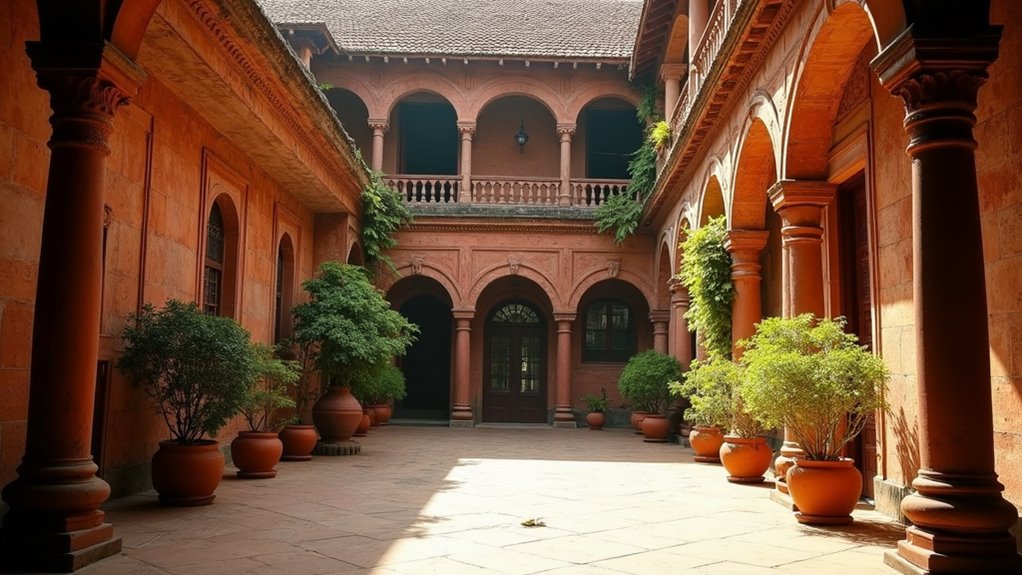
Visitors stepping into Jorasanko Thakurbari enter the birthplace and lifelong home of Nobel laureate Rabindranath Tagore, where Bengal’s intellectual renaissance took root in the late 18th century. Built in 1784 and expanded by Tagore’s grandfather Prince Dwarkanath, this architectural gem showcases traditional Bengali Dalan style with Indo-European influences.
The complex’s rounded verandah overlooks an internal performance stage where the Tagore family hosted cultural programs that challenged orthodox traditions. Women participated freely in literary debates, defying purdah customs of the era. Much like how visitors today can explore the dramatic limestone cliffs of distant coastal regions, the Thakurbari’s architectural elements create equally striking vertical perspectives within its courtyards.
Today’s visitors explore Rabindra Bharati University and its museum, which houses over 2,000 books, paintings, photographs, and personal belongings. The museum exhibits reveal Tagore’s global influence through his interactions and cultural exchanges with countries like Japan, China, and Hungary. The preserved courtyards and original architectural elements maintain the residence’s intimate atmosphere, offering insight into the family that shaped modern Bengali culture and literature.
Find Spiritual Syncretism at Belur Math’s Multi-Religious Architecture
Beyond the literary heritage of central Kolkata, the serene west bank of the Hooghly River hosts one of Bengal’s most remarkable architectural achievements. Belur Math, founded in 1897 by Swami Vivekananda, showcases stunning spiritual syncretism through its multi-religious architecture.
The central temple brilliantly fuses Hindu, Islamic, Christian, and Buddhist elements into one harmonious structure. Visitors can spot Mughal-inspired domes alongside Gothic arches and Buddhist chaitya windows. Hindu symbols like Ganesha blend with Islamic decorative motifs, while the entrance echoes Rajput palace styles. The striking visual appeal comes from the use of red sandstone contrasted against white marble throughout the complex.
Designed by Swami Vijnanananda and completed in 1938, this architectural masterpiece embodies Vivekananda’s vision of universal religious harmony. Like the vibrant chaos that defines modern Ho Chi Minh City, Belur Math represents a beautiful fusion of diverse cultural influences that create something uniquely compelling. The 40-acre campus includes gardens and additional temples, making it both a pilgrimage destination and testimonial to Bengal’s inclusive spiritual philosophy.
Take Heritage Tours Through Maidan’s Colonial Landmarks and Green Spaces
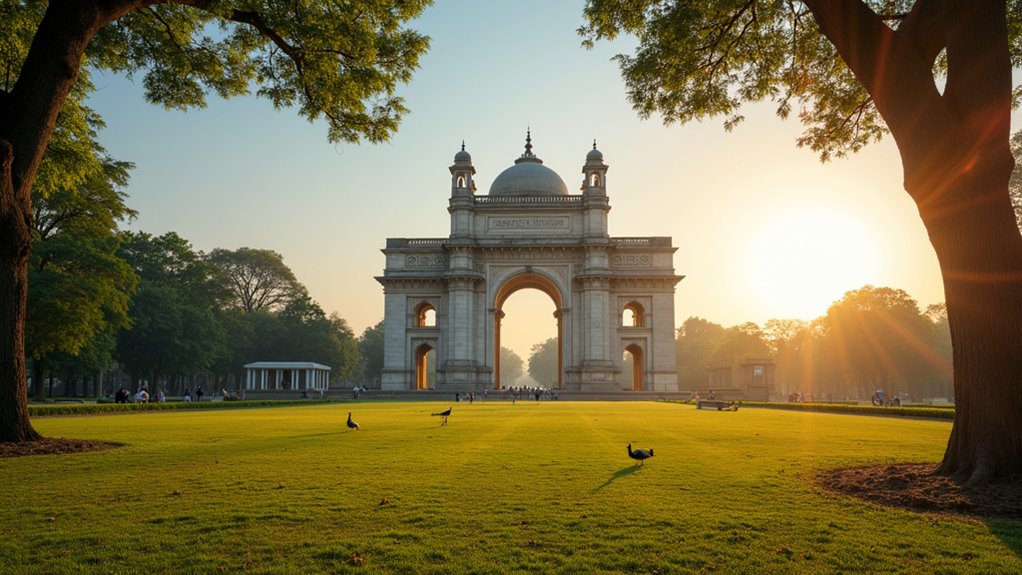
As Kolkata’s green heart stretches across 1,000 acres in the city center, the Maidan offers heritage enthusiasts an unparalleled journey through colonial history and urban evolution. Visitors can explore Fort William, built between 1758-1773 after the Battle of Plassey, which cost the British East India Company two million sterling.
The towering Shahid Minar rises 48 meters, while the magnificent Victoria Memorial showcases Mughal, Venetian, and Islamic architectural influences designed by William Emerson in 1921. This historic space once forced village residents to relocate to Taltala, Kumartuli, and Shovabazar to make way for British military development.
Heritage walkers discover how this space transformed from marshy forest into a military parade ground, then evolved into Kolkata’s premier public gathering area. Like other cultural destinations in the Tohoku region, these heritage sites offer visitors immersive experiences that blend historical significance with natural beauty.
St. Paul’s Cathedral, Government House, and the Indian Museum complete the colonial circuit, creating an outdoor museum where Bengali culture meets British legacy.